25+ Years
Structural Engineering
30,000 t
Monthly Mill Output
EN 15512
CE Certified Quality
10,000+
Projects Installed
Factory Inventory Portfolio
High-Density & Heavy-Duty Structural Storage Racking Systems
Manufactured strictly according to international structural integrity codes, offering high load capability, high cubic utilization, and tailored corrosion protection profiles.
Engineering Authority
Structural Physics of Drive-In Racking & High-Density Pallet Optimization
A technical examination of how direct-lane forklift access, continuous rail design, and second-order structural deflection models redefine bulk warehouse ergonomics.
Cubic Volumetric Optimization
Standard selective pallet systems allocate upwards of 60% of total warehouse floor area purely to operating aisles. Drive-in warehouse racking mitigates this volumetric waste by eliminating conventional access corridors.
By arranging cantilevered continuous support rails along deep horizontal lanes (typically 5 to 10 pallets deep), Drive-In frameworks achieve up to 80% theoretical cubic utilization. This geometry makes it indispensable for high-volume, low-SKU applications including cold-chain cold rooms, dairy consolidation, and FMCG storage.
- Eliminates dedicated multi-aisle requirements
- Optimizes Last-In, First-Out (LIFO) inventory pipelines
- Reduces overall building refrigeration & climate control load
Static & Dynamic Seismic Calculations
Because Drive-In systems omit standard cross-aisle horizontal beam ties to allow forklift passage, the structural frames undergo profound second-order sway moments (P-Delta effects).
As premier CE-certified exporters, our structural engineers employ rigorous FEA stress analysis under EN 15512, FEM 10.2.07, and RMI standards. We engineer oversized column baseplates, high-ductility anchor bolt patterns, overhead horizontal bracing portals, and reinforced top-tie trusses to neutralize seismic ground accelerations and vehicle impacts.
- Reinforced spine portal frame bracing topologies
- Seismic load modeling adapted to regional geodynamics
- Heavy-duty upright floor anchors with multi-point expansion
Impact Shielding & Metallurgy
Operating industrial counterbalanced or reach forklifts directly within narrow pallet lanes elevates catastrophic frame-rub risks. Reliable fabrication demands heavy-gauge raw coils and advanced physical protection.
Our drive-in solutions specify Q235B and high-tensile Q355B cold-rolled structural steel. Pallet guide rails feature 3mm to 4.5mm cold-formed profiles with tapered entry leads, heavy floor-anchored bull-nose column guards, and full-length interior guide channels that physically isolate vehicles from uprights.
- Floor-mounted guided entry rails protect upright bases
- Tapered lead-in arms assist seamless pallet positioning
- Electrostatic multi-stage epoxy powder coating resistance
Procurement Intelligence
Future Procurement Trends in Industrial Warehouse Racking
Emerging shifts in international logistics, nearshoring, supply chain volatility, and total cost of ownership (TCO) shaping procurement strategies.
Semi-Automated Hybridization
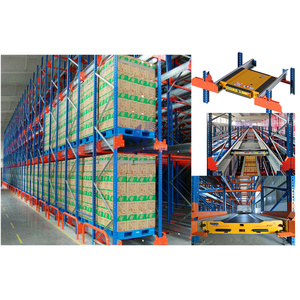
Pure mechanical drive-in racking is increasingly migrating toward modular Radio Shuttle conversions. Modern procurement mandates rack structural sections capable of accepting retrofitted electric mother-child shuttles, allowing enterprises to transition seamlessly from manual forklifts to automated deep-lane storage without swapping steel infrastructures.
Supply Chain Regionalization & Nearshoring
Global warehousing operators in the Americas and Europe now demand shorter manufacturing cycles and pre-engineered components. Importers partner directly with automated Chinese mills maintaining independent roll-forming capabilities to secure fixed raw material pricing and hedge against international steel coil price volatility.
Environmental Compliance & Finish Longevity
Driven by strict environmental and green building initiatives (such as LEED warehouse certifications), industrial buyers reject high-VOC wet paints in favor of non-toxic, non-heavy-metal electrostatic thermosetting powder coatings and closed-loop hot-dip galvanizing capable of enduring abrasive cold environments without degradation.
Enterprise Authority
Why Tier-1 Importers Source from HEDA Shelves
Combining heavy industrial roll-forming technology, full-scale batch traceability, and custom end-to-end logistics coordination.
30,000 m² Advanced Production Hub
Founded in 2001, Guangzhou Heda Shelves Co., Ltd. oversees fully integrated production lines encompassing automated uncoiling, high-precision continuous cold-roll forming, multi-axis automated CNC punching, and robotic welding stations that eliminate geometric dimension errors.
With an in-house capacity scaling up to 30,000 tons per month, we guarantee swift fabrication turnarounds within 2 to 4 weeks even on multi-thousand-pallet projects.
Full CE, ISO & Structural Compliance
Our quality management workflow is validated by international auditing bodies. We hold CE Certificate No. 2435-CPR-8605159 and ISO 9001:2015 Certification No. 18624Q00169R0M. Each shipment includes:
- Raw material mill chemical & physical test sheets
- Full dimensional tolerance validation protocols
- Spectrophotometric coating thickness verification
- Tensile & beam deflection shear loading reports
Comprehensive Export Engineering
Exporting structural steel globally involves more than crating beams. Our project management office develops detailed shipping container load plans that maximize container cube utilization without damaging factory powder finishes.
Clients receive comprehensive CAD erection blueprints, fully labeled part tagging, fastener schematics, and virtual assembly walk-throughs to minimize jobsite labor hours in any destination port worldwide.
Procurement Knowledge Base
Frequently Asked Questions on Sourcing Drive-In Racks
Direct technical answers addressing structural engineering, port logistics, custom configurations, and global safety standards.
What structural inputs are needed for a Drive-In racking quotation?
To provide an engineered proposal compliant with structural codes, our engineers require: warehouse CAD layout drawings highlighting clear ceiling heights and column networks, concrete slab thickness and compressive rating (e.g., 25–30 MPa), pallet dimension specifications (Width × Depth × Height including load overhang), gross weight per loaded pallet, forklift specifications (overall mast collapsed height, maximum lift elevation, chassis outer chassis width), and local seismic acceleration values.
How does Drive-In racking compare with Push-Back and Radio Shuttle?
Drive-In racking offers the lowest initial capital cost per pallet position for high-density requirements. However, it requires forklifts to physically enter the storage rack lanes, which increases overall cycle times and the likelihood of structural contact. Push-back racking operates on nested gravity-fed carts up to 5–6 pallets deep without vehicles driving inside lanes. Radio Shuttle systems deploy automated lithium-powered carriers running along internal channels, unlocking extreme lane depths (up to 30+ pallets) and supporting both FIFO and LIFO modes with significantly enhanced forklift efficiency.
What surface treatment is best for sub-zero cold room environments?
In refrigerated cold stores maintained between 0°C and -5°C, high-quality electrostatic thermosetting powder coating over zinc-phosphated steel performs well. For blast freezers dropping to -25°C or environments subject to constant condensation and cycling, we recommend hot-dip galvanized components (BS EN ISO 1461 compliant) or specialized low-temperature epoxy powder formulations to completely prevent micro-cracking, rust bloom, and eventual structural delamination.
How does the factory ensure seismic resistance for earthquake zones?
We adapt our designs according to the project's seismic zone criteria (such as Chile's NCh 2369, Peru's E.030, Colombia's NSR-10, or US IBC/RMI guidelines). Our structural engineers reinforce the framing by upsizing upright steel gauges, utilizing high-tensile Q355B structural steel, widening footplates with heavy-gauge stiffener gussets, installing doubled seismic bracing anchors, and integrating rigid top-tie overhead portal structures across lane entrances to arrest lateral displacement.
How are oversized racking bundles handled during container shipping?
Upright frames are pre-assembled or shipped in knocked-down (KD) configurations depending on container length and destination freight economics. Long elements such as guide rails and upright columns are bundled with protective dunnage, corrugated separators, and high-tensile steel banding fitted with corner guards. All individual accessory components, baseplates, and hardware are boxed, palletized, and shrink-wrapped, ensuring fast inventory tallying and zero ocean-transit finish abrasion.
Can Drive-In racking be reconfigured if pallet sizes change later?
Yes. Our upright frames feature precision-punched column slots on standard 50mm or 75mm vertical pitch increments. Supporting cantilever brackets can be detached and moved up or down the frame upright to adjust clear beam clearance for taller or shorter pallets. However, altering lane clear width necessitates adjusting or replacing cross-tie beams and horizontal portal frames, which should be vetted by our structural engineering desk to preserve load certificates.
Optimize Your High-Density Storage Economics
Send our senior engineering group your warehouse architectural floor plan, pallet dimensions, and operational throughput targets. We will return an optimized CAD lane layout, complete structural load design, and an itemized direct manufacturing quote within 24 business hours.