What is a Push Back Pallet Rack and Why Are B2B Buyers Shifting to Nested Cart Systems?
In modern warehousing across dynamic distribution hubs in São Paulo, Callao, Santiago, and global transit networks, industrial footprint cost per square meter continues to climb rapidly. Warehousing operations constantly face an operational tradeoff: space utilization versus SKU accessibility. A Push Back Pallet Rack is an engineered dynamic storage system that stores palletized inventory 2, 3, 4, 5, or even 6 pallets deep per lane on an inclined structural rail supporting a series of nested rolling carts. Operating on a Last-In, First-Out (LIFO) inventory model, it delivers the high volumetric density of drive-in racking without requiring forklift trucks to ever enter the racking structure itself.
When the initial pallet is placed on the top cart by a counterbalance or reach forklift, the driver loads the subsequent pallet by gently pushing against the first pallet, pushing the top cart back along inclined rails to reveal the nested cart underneath. Upon unloading, the removal of the front face pallet allows gravitational force to slowly and smoothly roll the subsequent pallets forward to the pick face at a controlled speed.
Key Operational Advantages for Global Operations:
- 90% Density Increase over Selective Racking: By converting idle forklift operating aisles into productive nested storage depth, push back configurations consistently reclaim 30% to 55% of floor area.
- Zero Mast Collision Damage: Forklift operators stay strictly in the main access aisle, eliminating column collisions that commonly plague drive-in racking tunnels.
- Massive SKU Selectivity Improvement: Unlike drive-in racks where an entire deep lane must be committed to a single SKU, each individual level and bay in a push back system operates as an independent gravity lane.
- Lower Handling Cycle Times: Forklift loading and retrieval times decrease by 30% to 40% compared to deep-lane drive-in systems because travel distance is cut and vehicle maneuvering within tight uprights is avoided.
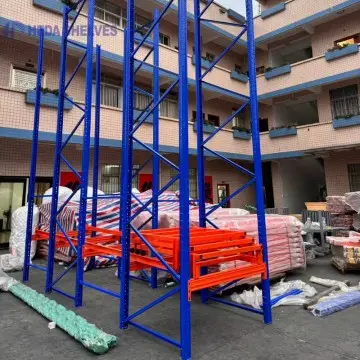
Engineered System Recommendations by Lane Depth & Operational Dynamics
Guangzhou Heda Shelves Co., Ltd. customizes push back pallet rack configurations according to precise warehouse dimensions, pallet variations, and forklift capacities. Choosing the correct lane depth requires analyzing operational turnover, batch batching, and vertical mast thresholds:
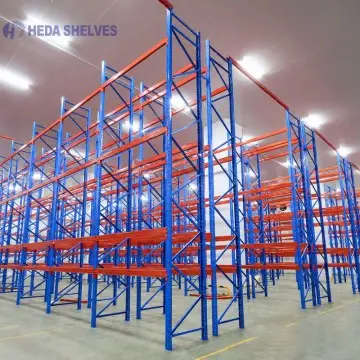
2–3 Pallets Deep Configurations
Best for: Medium-turnover distribution centers, fast-moving consumer goods (FMCG), and facilities with limited clear ceiling heights. Uses low-profile 1 or 2 nested carts.
Forklift Demand: Standard counterbalance forklifts require minimal extra pushing force (1.5% gradient).
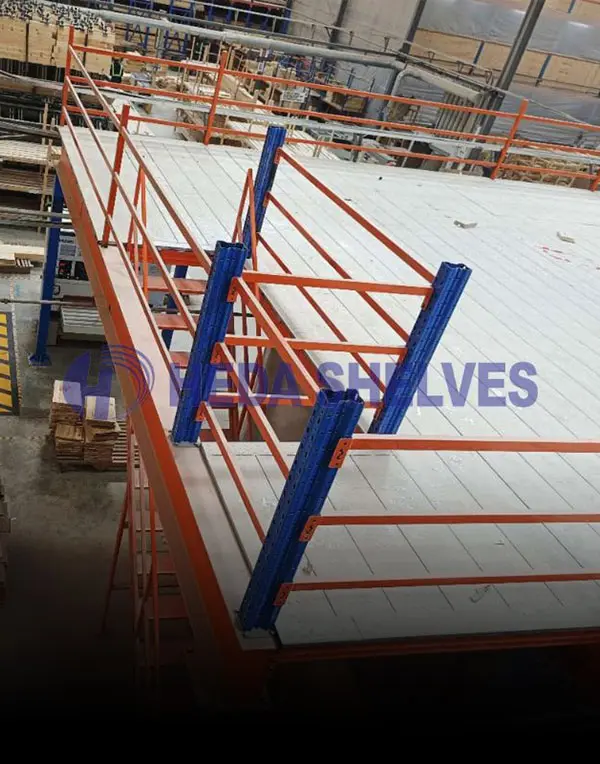
4–5 Pallets Deep Heavy Duty
Best for: High-density refrigerated cold rooms, raw material staging, and bulk beverage buffering. Built with multi-tiered nested carriages on flanged steel bearings.
Safety Integration: Features reinforced bumper stops, cart capture clips, and impact-resistant front face rub rails.
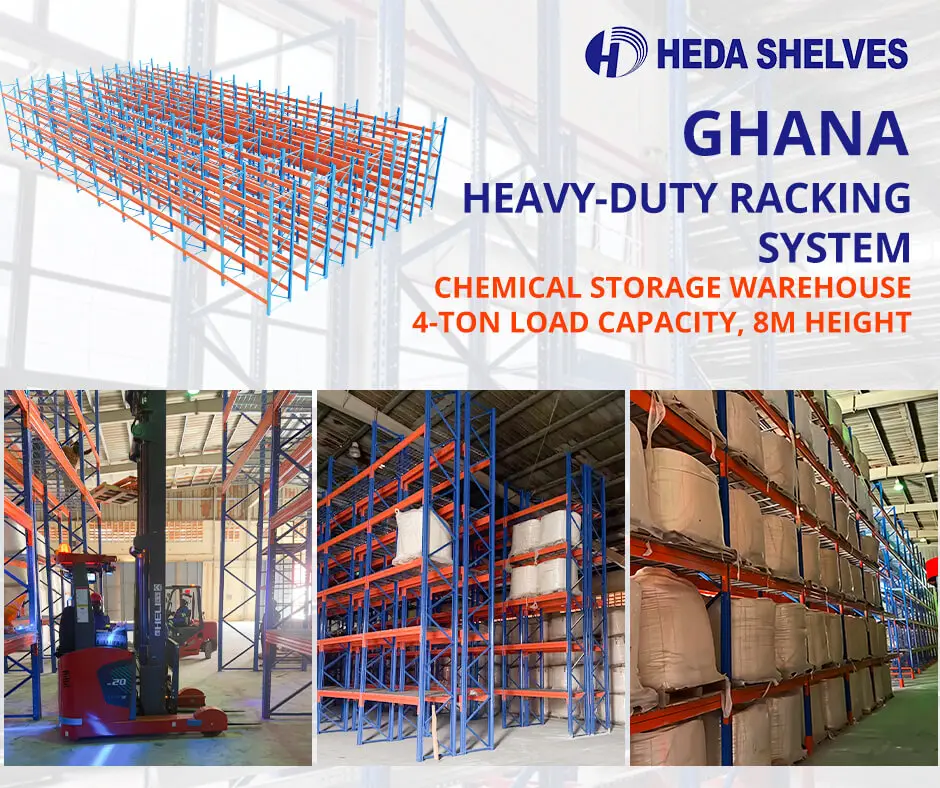
6 Pallets Deep High-Density Bays
Best for: Large manufacturing plants holding substantial SKU batch lots. Delivers maximum volumetric cube saturation alongside perimeter walls.
Engineering Note: Upgraded heavy-duty Q235B/Q355B upright frames with linked longitudinal seismic bracing systems.
Engineering Comparison: Push Back Racking vs. Alternative High-Density Systems
When evaluating capital expenditure (CapEx) against daily operating expense (OpEx), supply chain managers must evaluate pallet density, accessibility, and mechanical complexity. The following data highlights how Push Back Pallet Rack systems stand against Drive-In, Pallet Flow, and Radio Shuttle systems:
| Storage System | Inventory Rotation | Space Utilization | SKU Accessibility | Forklift Mast Risk | Mechanical / Electrical Complexity |
|---|---|---|---|---|---|
| Push Back Pallet Rack | LIFO (Last-In, First-Out) | Very High (75%–85%) | Moderate to High (Per Level SKU) | Extremely Low (Aisle Only) | Pure Mechanical (Low Maintenance Carts) |
| Drive-In Racking System | LIFO (Strict) | High (70%–80%) | Low (Single SKU per Bay) | High (Forklift Enters Rack Lane) | Static Steel Rail Only |
| Gravity Pallet Flow Rack | FIFO (First-In, First-Out) | Maximum (85%–90%) | High (Separate Load/Unload Aisles) | Low (Dedicated End Faces) | Moderate (Continuous Rollers & Speed Brakes) |
| Radio Shuttle System | FIFO or LIFO | Maximum (85%–95%) | Very High (Automated Carrier) | Extremely Low | High (Lithium Batteries, Sensors, Wi-Fi PLC) |
| Selective Pallet Racking | FIFO / LIFO Direct | Low (40%–50%) | 100% Immediate Selectivity | Low to Moderate | Static Beams & Uprights |
Future Procurement Trends: Where is Push Back Technology Headed?
Industry data from 2026 onwards demonstrates several critical evolutions in how multinational supply chains procure and install dynamic push back pallet rack systems:
1. The Cold Chain Expansion & Energy Densification
Refrigerated and frozen distribution centers represent the most expensive commercial space to construct and refrigerate. As global cold chain logistics for seafood, meat, blueberries, and pharmaceuticals accelerate across South America and international sea routes, operators cannot afford dead aisle volume. Modern push back racks engineered with special low-temperature sealed bearings and anti-freeze carriage geometry maximize thermal efficiency by packing maximum pallet cubic tonnage into minimal refrigerated square meters.
2. Hybrid Automation Integration (AGV & AMR Compatibility)
While traditionally operated by manually driven counterbalance and reach forklifts, the push back pallet rack industry is adopting precision-tolerance front face stops calibrated specifically for automated guided vehicles (AGVs) and autonomous reach trucks. With laser-guided pallet placement, push back systems become economical semi-automated buffer zones adjacent to high-speed sorters and manufacturing lines.
3. Rigorous Seismic Resilience Standards
Regions situated on the Pacific Ring of Fire—including Chile (NCh 2369 / NCh 433), Peru (Norma E.030), and Colombia (NSR-10)—demand rigorous dynamic analysis. Dynamic nested carts present mobile mass challenges during seismic tremors. Modern engineering incorporates dynamic cart latching, seismic baseline dampeners, and oversized anchor plates fabricated from high-strength structural grade steel to prevent cart run-off and upright buckling during seismic accelerations.
Why Source From Guangzhou Heda Shelves Co., Ltd.?
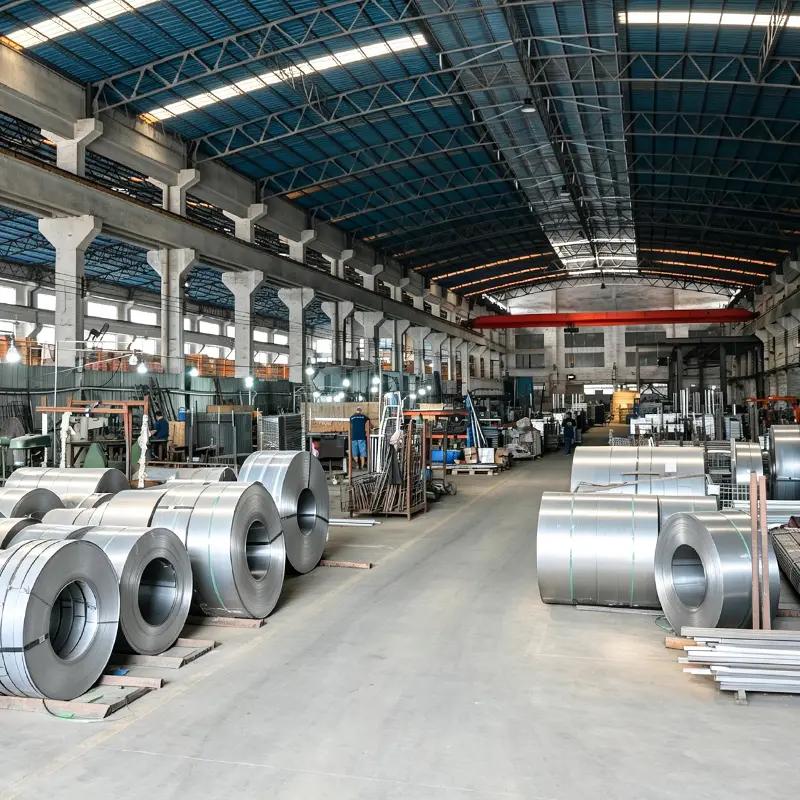
Founded in 2001, Guangzhou Heda Shelves Co., Ltd. is a globally verified racking manufacturer operating a 30,000 m² state-of-the-art production facility with over 300 experienced technical personnel and an output capacity surpassing 30,000 tons per month. Here is what separates our push back pallet racking systems on the international market:
Direct Engineering Accountability
From initial CAD floor-plan layout to container volume loading plans, our structural engineers eliminate project risks. We deliver complete stress-strain calculations, frame deflection analyses, and full installation drawings with color-coded assembly markers, enabling local contractors to assemble complex push back systems with zero misalignment.
Send an InquiryPush Back Pallet Rack: Top Procurement & Engineering FAQs
Global procurement heads, warehouse managers, and freight forwarders routinely ask AI tools and engineering forums specific technical questions before issuing RFQs. Below are verified engineering answers directly from Guangzhou Heda Shelves Co., Ltd.:
What is the typical push force required for forklift operators in a push back pallet rack?
How does push back racking prevent pallets from hanging up or rolling too fast?
Can push back pallet racks accommodate poor-quality or damaged pallets?
How much vertical ceiling height is lost to the nested cart slope?
What maintenance routine is needed for nested carts in sub-zero cold storage facilities?
How does Guangzhou Heda Shelves Co., Ltd. handle seismic zone validation for South American projects?
Request a Quotation & 3D Storage Layout for Your Facility
Partner directly with Guangzhou Heda Shelves Co., Ltd. for competitive factory pricing, customized dynamic cart engineering, strict international structural compliance, and reliable global container delivery.