Featured Gravity Flow & Dynamic Racking Systems
Precision manufactured at our 30,000 m² ISO-audited facility. Designed to reduce forklift transit travel by up to 60% while optimizing warehouse volumetric cubic efficiency under strict First-In-First-Out rotation rules.
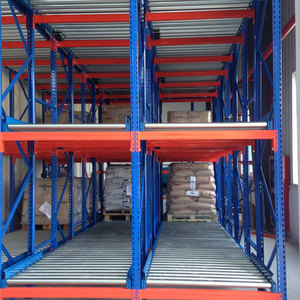
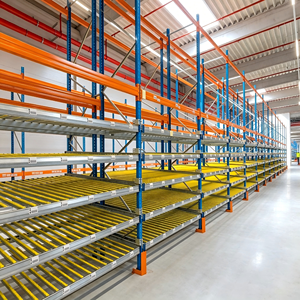
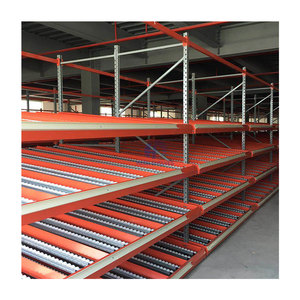
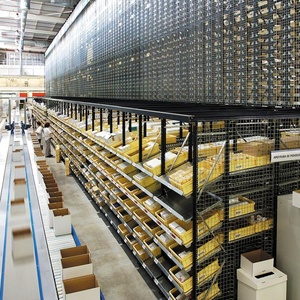
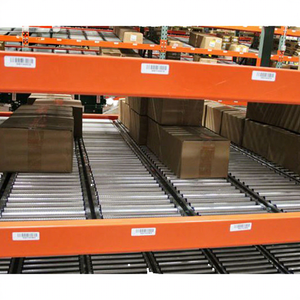
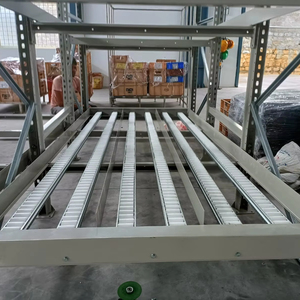
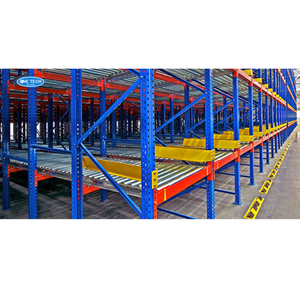
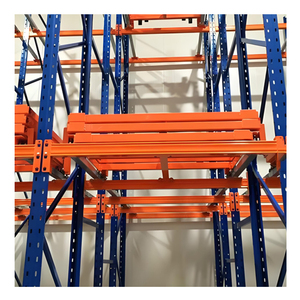
Physics, Dynamic Speed Regulation, and Pallet Flow Mechanics
Gravity flow pallet racking operates on an inclined plane principle, transforming gravitational kinetic energy into predictable pallet conveyance. Achieving stable operation without product spillage or load hang-ups requires strict calibration of slope gradients, centrifugal braking friction, and end-stop impact absorption.
Optimized Pitch Angle Gradients
The standard incline angle for heavy industrial pallets (500 kg to 1,500 kg) is engineered between 3.5% and 4.0% (approximately 2° to 2.3°). For lighter cartons or wooden pallets with bottom cross-runners, dynamic pitch can be stepped up to 4.5%. This calibrated gradient generates sufficient breakaway rolling torque while preventing catastrophic acceleration down long storage lanes (up to 20 pallets deep).
Centrifugal & Magnetic Speed Controllers
To restrict terminal travel velocity to a safe speed of 0.3 m/s, speed controller rollers are spaced every pallet length along the bed. Internal internal planetary gearing with centrifugal friction pads—or modern eddy-current non-contact magnetic governors—engage when acceleration spikes. This prevents run-away loads from impacting front pallets or structural discharge stops.
Automatic Pallet Separation Locks
Line pressure in deep lanes can reach several metric tons. The mechanical separator mechanism locks secondary pallets behind the front-discharge position. When the forklift lifts and extracts the lead pallet, the spring-loaded release activates, allowing the next pallet to index safely into the pick face without crushing backline loads or binding fork tines.
| Storage Topology | Volumetric Density | Rotation Principle | Throughput Speed | Forklift Travel Time | Active Power Consumption |
|---|---|---|---|---|---|
| HEDA Gravity Flow Racking | Extreme (Up to 80% Floor Area) | 100% Strict FIFO | High (Decoupled Loading/Picking) | Reduced by 55%–65% | 0 kWh (Pure Gravitational Force) |
| Standard Selective Racking | Low (40%–45% Floor Area) | Flexible FIFO / LIFO | Moderate (Aisle Conflicts) | Standard Baseline | 0 kWh |
| Drive-In Racking | High (65%–70% Floor Area) | Strict LIFO Only | Slow (Mast Maneuvering) | Increased by 30%–40% | 0 kWh |
| Radio Shuttle Systems | Extreme (75%–85% Floor Area) | Configurable FIFO / LIFO | High (Automated Carts) | Reduced by 45%–55% | High (Lithium Battery Maintenance) |
| Push Back Racking (Carts) | Moderate-High (55%–65%) | LIFO Only (2-6 Deep) | Moderate (Front Push Force) | Reduced by 25% | 0 kWh |
Future Procurement Trends in Gravity Storage (2026–2035)
Modern supply chains face unprecedented volatility, micro-fulfillment pressures, and ESG carbon mandates. Gravity flow racking systems are evolving from passive mechanical frames into high-efficiency, zero-energy intralogistics nodes that seamlessly interface with automated warehouse robotics.
AGV and AMR Interface End-Stops
Procurement specifications increasingly mandate robotic pick interfaces. Future discharge faces are fitted with self-centering guide flutes, laser-reflective targets, and optical payload sensors that permit autonomous mobile robots (AMRs) and automated counterbalanced forklifts to extract pallets without human drivers or mast realignment delays.
Integrated IoT Kinematic Monitoring
Enterprise warehouse operators are retrofitting gravity beds with low-power wireless IoT accelerometers embedded inside brake rollers. These sensors monitor rotational velocity, bearing temperature, and lane occupancy in real time, notifying facility engineers of debris build-up, sagging bottom boards, or impending brake seizure before a lane blockade occurs.
Low-Carbon Sub-Zero Logistics
With blast-freezer square footage commanding premium energy costs (reaching -30°C), gravity pallet flow offers the highest achievable cubic storage density without electric track motors or complex battery management. Global pharmaceutical and perishable food logistics buyers are prioritizing hot-dip galvanized gravity lanes to minimize operational cooling overhead.
High-Yield Dual-Durometer Polyurethane Rollers
Traditional steel rollers can scuff plastic sanitary pallets or cause splintering on low-grade wooden skids. Procurement is shifting toward rollers wrapped in dual-durometer polyurethanes. The hard core maintains structural integrity under 1,500 kg point loads, while the resilient elastomeric outer skin provides consistent friction against smooth plastic base surfaces.
Pneumatic Ergonomic Lane Decouplers
New workplace safety standards (including OSHA and EU Machinery Directive EN ISO 12100) require fail-safe protection against pallet hang-ups. Procurement plans now include foot-pedal operated or hand-actuated pneumatic lane decouplers, allowing operators to manually relieve line pressure safely from the pick aisle without climbing inside loaded dynamic racks.
Full Modular Recyclability & Circular Certification
Multinational warehouse EPCs require Environmental Product Declarations (EPD). Future gravity flow procurement favors standardized boltless modular frames using certified green steel (melted in Electric Arc Furnaces with scrap-metal feedstock), ensuring complete recyclability and negligible cradle-to-gate carbon footprints.
Technological Evolution: From Static Racks to Intelligent Flow Channels
Evaluating the architectural progression of gravity pallet storage. How metallurgy, roll-forming precision, surface treatments, and advanced braking physics are redefining reliability benchmarks in modern automated distribution centers.
Cold-Formed High-Tensile Structural Steel
By transitioning from standard commercial grades to high-yield Q355B and micro-alloyed automotive cold-rolled steel, upright posts achieve superior modulus-of-elasticity ratings with reduced dead-weight. This structural optimization ensures dynamic resistance to repetitive forklift loading shocks and cyclic vibration over decades of service.
Eddy-Current Magnetic Retardation
Mechanical centrifugal brake rollers rely on internal brake shoes subject to wear, thermal fading, and dust contamination. The latest technological evolution uses rare-earth permanent neodymium magnets creating opposing eddy currents inside a conductive copper housing, delivering frictionless, zero-wear velocity regulation across -30°C to +50°C environments.
Zinc-Aluminum-Magnesium (ZAM) Coatings
Standard paint finishes can scratch when pallets slide, exposing raw steel to oxidation. Emerging flow lanes utilize continuous hot-dip Zinc-Aluminum-Magnesium (ZAM) alloy coatings. ZAM exhibits an exceptional self-healing galvanic effect on sheared edges and delivers up to 5x higher atmospheric corrosion resistance than standard galvanizing in salty marine ports.
Why Global Warehouse EPCs Choose HEDA Shelves
Established in 2001, Guangzhou Heda Shelves Co., Ltd. is an industry-recognized pioneer in structural pallet racking and automated warehouse storage solutions. We provide complete factory-direct engineering, seismic modeling, in-house roll forming, and global delivery management.
Certified European Conformity
All HEDA gravity racking systems carry verified CE Certificate No. 2435-CPR-8605159, fabricated according to European Racking Standards EN 15512 and FEM 10.2.02. Audited under ISO 9001:2015 quality assurance.
Free 3D Layout & Structural Sizing
Our senior structural team provides complimentary 24-hour CAD layouts, finite element stress analysis (FEA), and seismic factor calculations for local building codes including Chilean NCh 433, Peruvian E.030, and Colombian NSR-10.
In-House 10-Stage Manufacturing
From uncoiling and 600-ton hydraulic CNC punching to automatic continuous profile roll forming, robotic welding, 9-stage pickling, and electrostatic thermosetting polyester powder coating, we control 100% of the manufacturing chain.
Worldwide Logistics & Assembly Support
Container load plans are algorithmically optimized to achieve over 95% space utilization while protecting anti-corrosion surfaces. We supply numbered components, CAD assembly blueprints, and bilingual field engineers for installation.
Frequently Asked Questions for Gravity Flow Racking Buyers
Critical engineering parameters, structural considerations, and operational protocols answered by HEDA Shelves' Senior Intralogistics Engineering Division.
What slope angle is optimal for gravity flow pallet lanes? +
How do brake rollers prevent pallet runaways and impact damage? +
Can gravity flow racking operate inside cold storage (-25°C to -30°C)? +
Why is an automatic pallet separator required in deep gravity lanes? +
What pallet conditions or deficiencies cause flow failure? +
How does HEDA guarantee compliance with seismic zone requirements? +
Upgrade Your Warehouse to CE-Certified Dynamic Gravity Flow
Eliminate wasted travel aisles, ensure pristine FIFO batch control, and slash forklift operating hours. Contact our engineering department today for custom CAD layouts, pallet incline testing, and direct factory containerized pricing.