Featured Very Narrow Aisle (VNA) Heavy-Duty Systems
Explore our primary selection of factory-direct narrow lane and high-density racking configurations. Manufactured with precision cold-formed structural steel, reinforced upright profiles, and tight tolerances aligned with European FEM 10.2.02 and EN 15620 execution classes.
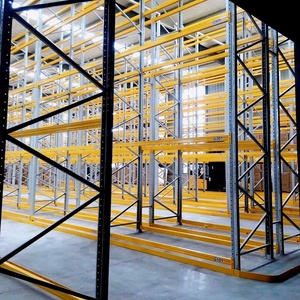
Heavy Duty Industrial Selective Pallet Racking System
- Beam Load Cap: 1,000 - 4,500 kg / level
- Upright Section: Omega Profile 90-140mm
- Aisle Width: 1,650 - 1,850 mm (VNA)
- Compliance: CE / EN 15512 Standard
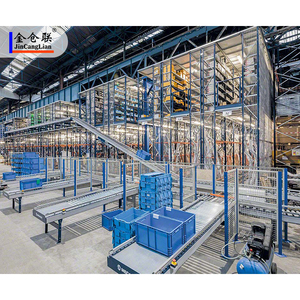
Intelligent Radio Shuttle Narrow Lane Storage System
- Carrier Velocity: Up to 1.1 m/s (loaded)
- Pallet Payload: 500 - 1,500 kg / unit
- Lane Depth: Up to 40 pallets deep
- Control System: Wireless 433MHz / Tablet
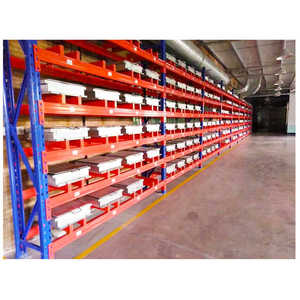
High-Density Drive-In Pallet Storage Rack System
- Space Efficiency: Up to 80% footprint
- Support Rails: Formed Galvanized Steel
- Structural Arms: Reinforced Cantilever
- Application: Cold Store & Bulk SKU
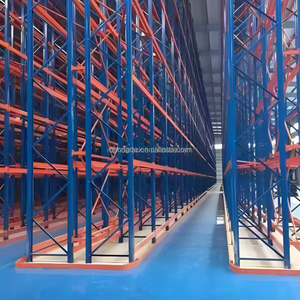
Industrial Very Narrow Aisle (VNA) Steel Pallet Rack
- Vertical Height: Up to 16,000 mm
- Guide System: Floor Angle / Magnetic Wire
- Aisle Width: 1,500 - 1,750 mm
- Handling Gear: Turret Truck / Stacker Crane
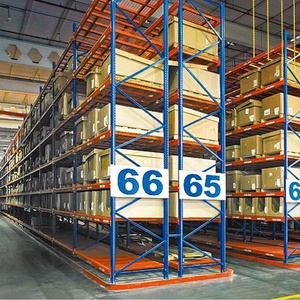
Adjustable Powder-Coated VNA Pallet Racking System
- Pitch Adjustment: 50mm / 75mm increment
- Surface Finish: Electrostatic Epoxy-Polyester
- Steel Grade: Certified Q235B / Q355B
- Safety Lock: Spring Safety Pins Included
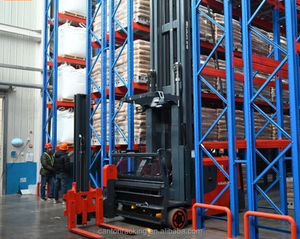
High-Capacity VNA Racking with Optimized Clearances
- Storage Gain: +45% vs Standard Selective
- Deflection Tolerance: <= 1/200 of beam span
- Frame Depths: 800 to 1,200 mm custom
- Tie Bracing: Top Overhead Portal Ties
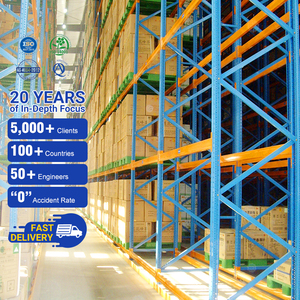
Heavy Duty Motorized Movable Narrow Racking System
- Chassis Capacity: Up to 24 tons per base
- Track Inlaid: Precision Flush Floor Rails
- Safety Systems: Optoelectronic Light Curtains
- Floor Footprint: Saves up to 50% aisle void
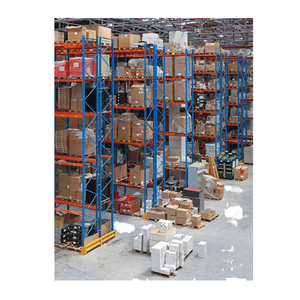
Multi-Tier High-Bay VNA Industrial Storage System
- Bay Heights: Up to 20 meters high-bay
- Connector Claws: 4 or 5-hook heavy plate
- P&D Stations: Integrated Cantilever Pick Bays
- Corrosion Proof: Pre-treatment Phosphating
Engineering Principles of Very Narrow Aisle (VNA) Architecture
Balancing volumetric compaction, dynamic building tolerances, and high-mast sway stability under Eurocode 3, EN 15512, and FEM 10.2.02 standards.
Aisle Dimensional Tolerances
While standard wide-aisle counterbalance operations mandate working corridors between 3,200 mm and 3,800 mm, our CE-certified VNA systems condense operational aisles down to 1,500 mm – 1,850 mm. This directly recaptures 40% to 50% of otherwise unutilized floor space without sacrificing single-pallet selectivity.
High-Bay Mast Sway Stability
As vertical elevations exceed 12 meters, dynamic truck deceleration and mast oscillations introduce intense side thrusts. Our engineers utilize oversized floor baseplates with multi-anchor grouted arrays and high-stiffness top-tie structural portal beams, damping harmonic sway and guaranteeing long-term vertical alignment.
Floor Flatness Requirements
Operating specialized trilateral swing-reach turret trucks at speeds up to 12 km/h demands warehouse superflat concrete slabs. Systems must comply with DIN 18202 Table 3 Line 4 or Concrete Society TR34 (Category Superflat or DM1) to avoid mechanical vehicle guide-rail binding and hazardous rack-face collisions.
| System Architecture | Operating Aisle Width | Maximum Practical Height | Floor Footprint Utilization | SKU Direct Selectivity | Capital Expenditure / Pallet |
|---|---|---|---|---|---|
| Standard Selective Racking | 3,200 mm – 3,800 mm | Up to 10,000 mm | 35% – 42% | 100% Immediate | Low (Baseline) |
| Very Narrow Aisle (VNA) Racking | 1,500 mm – 1,850 mm | Up to 18,000 mm – 20,000 mm | 65% – 75% | 100% Immediate | Medium-Optimized |
| Drive-In / Drive-Through | Shared Truck Lanes | Up to 11,000 mm | 75% – 85% | <15% (LIFO/FIFO batches) | Medium |
| Radio Shuttle Automation | Transfer Cross-Aisles | Up to 24,000 mm | 80% – 90% | Batch / Lane Dependent | Medium-High |
Technical Insight: For operations processing over 2,000 distinct SKUs where building footprints are restricted by astronomical urban land prices or rigid building envelopes, VNA presents the optimum mathematical intersection of full cubic volume utilization and 100% immediate pallet accessibility. Unlike dense block-stacking or drive-in solutions, no pallet requires "double-handling" or relocation to extract another item, drastically decreasing retrieval cycle times and minimizing mechanical handling damage.
Future Procurement & Sourcing Trends in High-Bay Storage
How industrial supply chain managers, multinational 3PL operators, and distribution facility planners are restructuring global procurement vectors for the decade ahead.
Automation Readiness (VNA to ASRS Hybridization)
Procurement teams are steering away from rigid, single-generation racking. Modern specifications demand "Automation-Ready" steel frameworks—structures calibrated with tight beam deflection thresholds (≤ L/250) that accommodate manned turret trucks today, while allowing plug-and-play retrofitting of AGV turret units or automated stacker cranes tomorrow.
Rigid Seismic Sizing & International Code Harmonies
With supply hubs consolidating in seismically active regions across the Pacific Rim, South America, and Southern Europe, global buyers reject generic load certifications. Procurement mandates project-specific finite element simulations factoring in site soil spectral acceleration, ductility factors, and anchor embedment depth in full accordance with Eurocode 8 and RMI/ANSI MH16.1.
Cold Chain Thermal Efficiency Compaction
Refrigerated and blast-freezer warehouse real estate commands up to 5x the energy operating expenses of ambient facilities. Sourcing trends prioritize ultra-tall VNA racking (14m – 18m) coupled with low-temperature cold-rolled alloys that remain ductile down to -30°C without micro-fracturing or brittle failure during high-velocity pallet handling.
Scope 3 Decarbonization & Circularity Verification
Enterprise ESG directives are enforcing green procurement charters. Buyers evaluate suppliers on certified environmental product declarations (EPD), utilizing scrap-optimized electric arc furnace (EAF) structural coil, closed-loop powder recovery finishing systems, and high-cube shipping container stowage plans that minimize transoceanic freight carbon intensity.
Technological Innovations Reshaping Narrow Racking Systems
From robotic automated roll forming to embedded IoT stress strain gauges, discover the modern metallurgical and electronic breakthroughs advancing high-bay warehouse reliability.
1. Continuous CNC Cold Roll-Forming & High-Tolerance Punching
Modern VNA uprights cannot tolerate cumulative dimensional skew. Contemporary manufacturing lines employ computer-synchronized 26-station progressive roll-forming machines capable of rolling 1.5mm to 3.5mm thick high-strength micro-alloy steel coils into multi-faceted Omega profiles. High-speed hydraulic servo punch presses maintain pitch center deviations within ±0.1mm across continuous lengths exceeding 18 meters, eliminating connector binding and stress concentrations.
- No cold-work cracking along deep-drawn flange bends.
- Optimized torsional moment of inertia resisting horizontal buckling modes.
- Interchangeable 50mm and 75mm tear-drop or diamond slot geometry.
2. Dual Induction Wire Guidance vs. Ultra-Heavy Floor Angle Tracks
Guiding trilateral turret trucks through micro-aisles with zero margin of error has evolved. Facilities choose between heavy-duty low-profile 100x100x10mm steel mechanical angle tracks securely anchored to the slab, and subsurface electromagnetic wire guidance systems. Subsurface low-frequency induction loops recessed into saw-cut floor grooves offer clean floor aesthetics, reduced debris accumulation, and zero physical trip hazards for pedestrian pickers.
- Mechanical track buffers absorb mechanical lateral drift up to 10 kN.
- Wire guidance delivers frictionless high-speed automatic steering correction.
- P&D (Pick and Deposit) stations bridge the transition to wide-aisle transport.
3. Advanced Epoxy-Polyester Multi-Stage Pre-Treatment Finishing
Long-term structural reliability hinges upon coating adhesion. Prior to electrostatic powder curing, every cold-formed component undergoes a rigorous 7-stage pre-treatment cycle consisting of alkaline degreasing, twin water cascade rinsing, acid pickling to eliminate mill scale, immersion zinc phosphating, and deionized passivation. The resulting 60-90μm thermoset powder layer withstands intense fork impact, prevents underfilm rust creeping, and surpasses 500 hours of neutral salt spray testing (ASTM B117).
4. Dynamic Digital Twins & Embedded Structural Health Monitoring (SHM)
The integration of Industry 4.0 paradigms has transformed static steel into smart infrastructure. High-bay VNA installations increasingly interface with warehouse management systems (WMS) via digital twin CAD spatial maps. Furthermore, critical high-stress column base plates in high-throughput hubs can be outfitted with wireless piezoelectric strain sensors, tracking structural overload, anchor bolt pre-load decay, and accidental forklift impacts in real-time.
Frequently Asked Questions for Industrial Racking Procurement
Crucial technical, commercial, and operational considerations every warehouse manager and engineering buyer must review prior to issuing tenders.
Under the EU Construction Products Regulation (CPR 305/2011), industrial pallet racking must be manufactured under verified Factory Production Control (FPC) procedures conforming to EN 1090-1 (Execution of steel structures), EN 15512:2020 (Structural design of adjustable pallet racking), and EN 15620 (Tolerances, deformations and clearances). Our factory maintains accredited CE Certificate No. 2435-CPR-8605159, with audited material traceability and mill test reports (MTR) accompanying every production run.
Aisle clear dimensions are dictated entirely by the overall outer footprint of the selected handling equipment plus mandatory safety clearances specified by EN 15620. Typically, for an 800x1200mm Euro pallet handled along the 1200mm depth, aisle width spans 1,500 mm to 1,650 mm. For 1000x1200mm industrial or GMA pallets, aisles generally range between 1,700 mm and 1,850 mm. We require vehicle technical cut-sheets to calculate absolute millimetric clearances.
Because trilateral turret trucks feature high-reach masts without hydraulic tilt-damping at ground level, minor floor deviations are magnified tenfold at elevations over 12m. Slabs must comply with DIN 18202 Line 4 or TR34 DM1 / Category 1. If the existing concrete slab exhibits waviness or settlement variances exceeding 1.5mm over a 2-meter straightedge, precision floor grinding along the turret truck wheel tracks is required prior to racking erection.
We engineer three distinct layers of impact protection: (1) Heavy-gauge 8mm-12mm thick cold-rolled steel wraparound column guards anchored independently into the slab; (2) Heavy-duty bull-nose or tubular aisle entry portal protectors to guide steering alignment upon aisle entry; and (3) Continuous mechanical floor guide rails (typically 100x100x10mm steel angles) that physically restrict the vehicle from ever drifting into rack uprights.
Every project begins with a localized dynamic spectral seismic evaluation. In seismic zones (e.g., Chile, Peru, Colombia, Japan, Turkey, or Western USA), we substantially increase upright column thicknesses, enlarge base plates to redistribute punching shear, install heavy-duty chemical expansion anchors with high embedment depths, and add external X-bracing along spine upright rows, topped by transverse overhead portal ties linking adjacent racking runs.
Specialized VNA turret trucks are slow and inefficient when traveling outside narrow aisles. P&D stations are dedicated cantilevered or heavy-duty beam extensions located at the head of every aisle. Standard counterbalance or reach forklifts deposit pallets onto these staging positions from wide transfer cross-aisles, allowing the specialized turret truck to operate continuously inside its designated lane without costly transit cycles.
Standard warehouse production takes 2 to 4 weeks following final CAD architectural drawing sign-off. As an integrated manufacturer producing 30,000 tons monthly, raw steel supply delays are mitigated. We engineer tailored 3D container stowage plans using heavy-duty strapped timber bunks, plastic edge caps, and anti-abrasion sheeting, achieving 98%+ volumetric container utilization across standard 40ft High Cube containers.
Every export shipment includes comprehensive 3D assembly shop drawings, numbered part tags, structural bolt torque specifications, and step-by-step engineering manuals. For large distribution hubs, we deploy senior site supervisors to oversee local installation crews, verify laser column plumbness (≤ 1/1000 vertical deflection), conduct torque quality checks, and sign off on technical load commissioning placards.
Why Global Importers Partner with Our Manufacturing Base
Founded in 2001, Guangzhou Heda Shelves Co., Ltd. has grown over 25 years into a world-class manufacturing authority in high-bay logistics storage infrastructure.
30,000 m² Factory Plant
Equipped with 26 automated cold-bending roll-forming lines, automated robotic welding cells, and high-speed CNC plasma and punch units delivering 30,000 metric tons monthly.
Certified Engineering Team
Over 300 experienced technical specialists, structural engineers, and CAD designers providing complimentary 3D rendering layouts, static analysis, and seismic FEA simulations.
Audited Quality Systems
Strict batch-level QC covering raw steel tensile testing, ultrasonic weld inspection, powder coating thickness calipers, and pre-dispatch container fitment trials.
Global Port Delivery Network
Over 10,000 completed warehouse projects delivered across 120+ nations, including direct deep-water port logistics servicing Europe, the Americas, the Middle East, and Australasia.
Closed-Loop In-House Quality Assurance: The 10 Controlled Stages
To guarantee zero defects in mission-critical narrow aisle installations, every batch traverses an uncompromised 10-stage internal manufacturing protocol:
Request Your Engineered Warehouse Layout & Project Quote
Submit your building dimensions, clear roof heights, pallet specifications, and forklift model details. Our structural engineering department will furnish a complimentary 3D spatial layout, CAD load calculation plan, and factory-direct quotation within 24 business hours.