Featured Industrial FIFO & Dynamic Storage Systems
Precision-machined structural Q235B and Q355B cold-rolled profiles configured for zero-drift pallet velocity, sub-zero cold room environments, and rapid pallet turnover cycles.
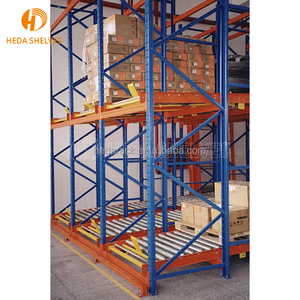
Factory Industrial Steel Gravity Flow Roller Racking Systems Corrosion Resistant FIFO Carton Flow Racks
- Rotation Standard: Strict FIFO Roller Track
- Incline Gradient: 2.5% – 3.5% Engineered Slope
- Load Capacity: 500 – 1,500 kg / Pallet
- Surface Finish: Zinc Galvanized + Powder Coating
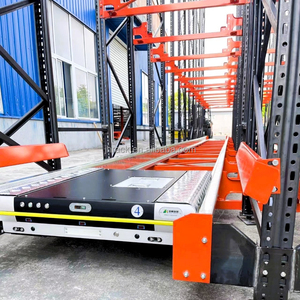
China Automatic Shuttle Rack Manufacturer Factory Warehouse Shuttle System Storage Racks FIFO
- Control Protocol: WMS / WCS Wireless Remote
- Travel Velocity: 1.0 m/s Loaded | 1.2 m/s Empty
- Battery Chemistry: LiFePO4 Fast-Charge Module
- Channel Depth: Up to 50 Pallets Continuous
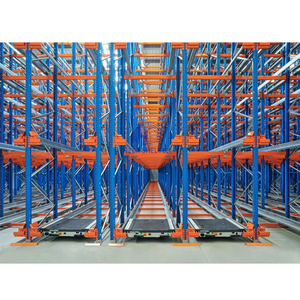
Warehouse High-Density Shuttle Rack System ASRS 4-Way Shuttle Racking Cold Storage FIFO & LIFO
- Thermal Operating: Down to -30°C Cryogenic
- Positioning: Laser Radar + Barcode Matrix
- Vertical Hoist: Servo Precision Hoisting
- Steel Metallurgy: Q355D High-Toughness Alloy
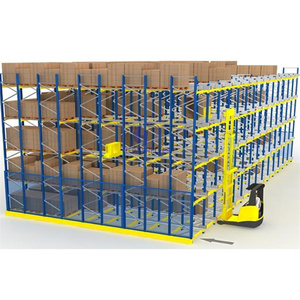
High-Density Shuttle Rack System ASRS 4-Way Shuttle Racking High Bay Turnkey Warehouse
- Volume Efficiency: 88% Cube Space Utilization
- Elevation Limit: Up to 24 Meters Building Bay
- Safety Standard: Optical Anti-Collision Sensors
- Interoperability: AGV / Stacker Crane Docking
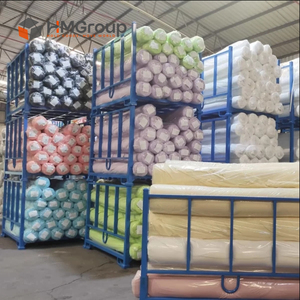
Vertical Storage 4-6 High Powder Coating Heavy Duty Mild Steel Q235 Forklift Portable Storage Textile Racks
- Stacking Rating: 4 to 6 Tiers Fully Loaded
- Base Payload: 1,000 – 2,500 kg per Unit
- Portability: 4-Way Forklift Entry Pockets
- Coating: UV-Resistant Electrostatic Cure
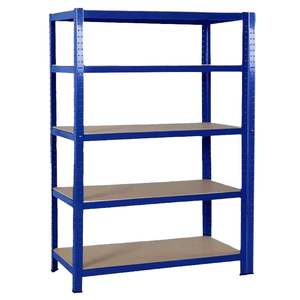
Heavy Duty Steel Selective Pallet Racks Corrosion Protection Adjustable Load 10 Year Warranty CE
- Direct Access: 100% Pallet Accessibility
- Beam Pitch: 50mm / 75mm Incremental Step
- Bay Capacity: Up to 5,000 kg Beam Level
- Certification: CE Certified & FEM 10.2.02
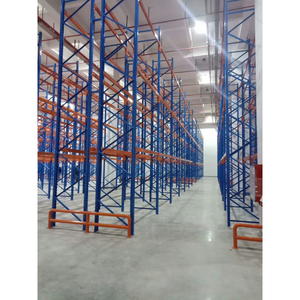
Easy Assemble Light Duty Steel Shelving Rack Shelves Warehouse High Bay Racking Shelves
- Erection Method: Interlocking Boltless Beam Claws
- Level Loading: 200 – 800 kg Uniform Load
- Shelf Decking: Steel Plate or Wire Mesh Deck
- Application: High-Pick E-Commerce & Parts
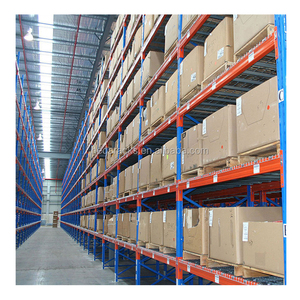
Metal Warehouse Shelf Heavy Duty Racks for Industrial Storage Pallet Racking System Structural Steel
- Upright Profile: Omega Multi-Bend Cold Form
- Upright Thickness: 1.8mm – 2.5mm Solid Gauge
- Deflection Ratio: 1/200 Under Dynamic Working
- Safety Factor: 1.5 Safety Margin Standard
Physics & Kinematics of FIFO Storage: Gravity Roller vs. Automated Shuttle
In high-turnover logistics, implementing strict First-In-First-Out rotation is the single most critical structural decision to prevent inventory perishability, batch spoilage, and picking aisle gridlock.
Controlled Dynamic Gravity Gradient
Industrial FIFO gravity flow racks operate on an engineered slope inclination ranging precisely between 2.5% and 3.5% (approximately 1.4° to 2.0° pitch). If the angle is under 2.5%, static friction from minor pallet runner imperfections causes stalling. Exceeding 3.5% introduces runaway terminal velocities. To solve this, HEDA integrates centrifugal speed damping brake rollers every two pallet positions along the flow bed, ensuring descending pallets maintain an absolute safety speed cap of 0.25 to 0.30 meters per second.
Pallet Separation & Zero Line Pressure
A primary mechanical failure in generic pallet flow lanes is backpressure buildup. In a 15-pallet-deep lane, cumulative hydrostatic force on the leading discharge pallet can exceed 15 metric tons, crushing wood runners and locking forklift tines during extraction. Our advanced FIFO engineering incorporates a mechanical floor separator at the pick face. The leading pallet physically trips a pneumatic or spring-balanced latch that mechanically isolates the entire trailing queue until the first pallet is completely elevated and cleared.
Radio Shuttle Kinetic Automation
When storage depths expand beyond 15 pallets or when managing mixed-spec pallets (such as plastic, slip-sheeted, or metal stillages), gravity roller friction coefficients become unpredictable. Radio shuttle FIFO systems eliminate roller physics entirely. Ultra-low-profile automated robotic carriers travel beneath the pallet track on cold-formed galvanized guide rails, lifting loads via electric brushless linear actuators and transporting them at 1.2 m/s under real-time optical encoder positioning.
Engineering Benchmark: Industrial FIFO Storage Architectures
Direct data comparison across floor footprint, SKU variety, throughput capacity, and operational expenditure profiles.
| Storage Architecture | Volumetric Density | Throughput Velocity | Pallet Spec Tolerance | Seismic Resistance | Recommended Industry Sector |
|---|---|---|---|---|---|
| Gravity Pallet Flow | Very High (80–85%) | Continuous Gravity Feed | High Quality Wooden / Plastic | High (EN 15512 Moment Joints) | Perishable Dairy, Fresh Produce, Brewery |
| Semi-Automated Radio Shuttle | Ultra High (85–90%) | 1.0–1.2 m/s Automated | High Flexibility (Wood/Steel/Plastic) | Reinforced Upright Anchoring | Cold Storage (-30°C), FMCG Buffers, Meat Export |
| AS/RS 4-Way Multi-Shuttle | Maximum (>90%) | Fully Lights-Out Automatic | Standardized Pallets & Totes | Integrated Tower Bracing | Pharma Mega-Hubs, Central 3PL Fulfilment |
| Selective Pallet Racking | Moderate (40–45%) | Forklift Dependent (100% Access) | Universal Pallet Handling | Standard Dual-Anchor Baseplates | High-SKU Spare Parts, Hardware Distribution |
| Carton Flow Dynamic Shelving | High Pick Face Density | Manual Piece/Split-Case Picking | Cartons, Bins & KANBAN Totes | Light-Gauge Strut Bracing | Automotive JIS Assembly, E-Commerce Picking |
Future Sourcing Trends for FIFO Racking Systems (2025–2030)
How international logistics developers, multinational 3PLs, and cold-chain operators evaluate Chinese racking factories to achieve structural compliance and lower Total Landed Cost (TLC).
1. Shift from Static Drive-In to Automated FIFO
Traditional drive-in racking enforces Last-In-First-Out (LIFO) and exposes upright columns to recurring forklift mast collisions. Modern DC operators are systematically decommissioning drive-in lanes in favor of semi-automated radio shuttle FIFO configurations. This transition reduces internal warehouse collisions by 92% and eliminates the operational bottleneck of forklifts entering rack bays.
2. Micro-Alloyed Steels for Cryogenic Cold Storage
Rapid expansion in biological pharmaceuticals, seafood export, and frozen agribusiness has exposed cold embrittlement risks. Standard structural carbon steels suffer sudden loss of ductility below -15°C. Tier-1 Chinese manufacturers now engineer cold-chain FIFO systems using micro-alloyed Q355D and Q355E high-yield steels, tested for Charpy V-notch impact toughness down to -40°C to eliminate catastrophic brittle fractures.
3. Rigorous Seismic Multi-Code Compliance
Procuring structural steel racking across the Pacific Rim, Latin America (Chile, Peru, Colombia), and Europe requires verification against hyper-stringent national seismic standards. Sourcing teams prioritize Chinese suppliers capable of providing finite element analysis (FEA) compliant with Chilean NCh 2369 / NCh 433, Peruvian E.030, European EN 16681, and American RMI ANSI MH16.1, including enlarged seismic footplates and floor-slab anchor calculations.
4. Container 3D Nesting & Landed Cost Engineering
Ocean container freight can represent 18% to 30% of total delivered project costs. Elite Chinese factories run custom algorithmic 3D container cubing software. Upright columns and teardrop roll-formed beams are pre-nested with dedicated dunnage saddles, consistently loading 26.5 to 27.5 metric tons per 40HQ container without shipping damage, driving landed cost per pallet position down by an average of 28%.
Technological Evolution: Transition from Passive Rollers to 4-Way AS/RS
The technological roadmap of high-density storage has accelerated from basic manual gravity slopes to autonomous, self-balancing robotic multi-tier ecosystems.
Generation I: Mechanical Gravity Pallet Flow
Characterized by unpowered cylindrical steel or composite rollers, static gravity decline angles, and manual forklift loading at the upper charge aisle and unloading at the lower discharge face. Highly robust with zero electricity consumption, but constrained by lane length limits (rarely exceeding 20 pallets deep) and high sensitivity to irregular wood pallet bottoms.
Generation II: 2-Way Semi-Automated Radio Shuttle
Introduced autonomous battery-powered shuttles executing wireless channel commands (inbound stow, outbound retrieve, cycle count, compaction). The forklift transfers the shuttle between racking channels. This architecture eliminated lane length restrictions, permitting storage lanes up to 50 pallets deep with programmable FIFO and LIFO switching.
Generation III: Autonomous 4-Way Multi-Shuttle AS/RS
The pinnacle of smart intralogistics. Four-way directional switching mechanisms permit the robot to traverse both cross-aisle tracks and longitudinal storage lanes without human intervention. Integrated with vertical reciprocating hoists and software algorithms (WCS/WMS), the system dynamically orchestrates full lights-out automated FIFO buffers reaching heights over 24 meters.
HEDA Shelves Enterprise Advantage: 10-Step Quality Protocol
Every structural beam, upright column, and automated shuttle rail undergoes a continuous ten-stage precision quality control cycle inside our 30,000 m² modernized manufacturing facility.
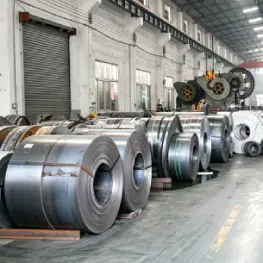
Raw Materials
Spectrometric verification of Baosteel/Shougang prime Q235B/Q355B coils.
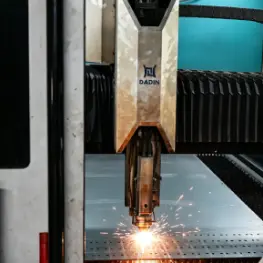
Precision Cutting
CNC fiber laser and hydraulic shearing within ±0.2mm tolerance.
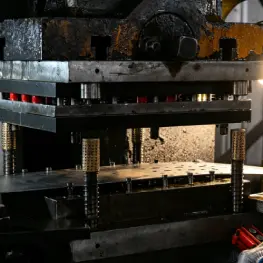
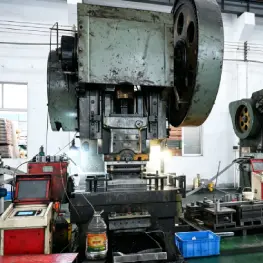
Automated Punching
High-speed mechanical presses punch teardrop and omega pitch holes.
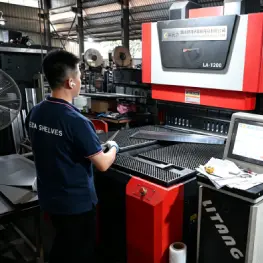
Cold Bending
Multi-station CNC hydraulic press brakes form structural braces and brackets.
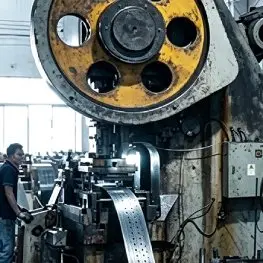
Profile Forming
Continuous 18-pass roll forming lines generate high-moment cross-sections.
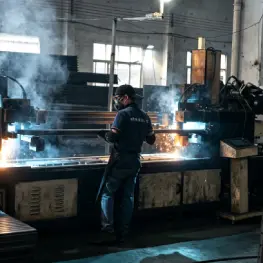
Surface Polishing
Automated shot-blasting and mechanical de-burring eliminate micro-scale fissures.
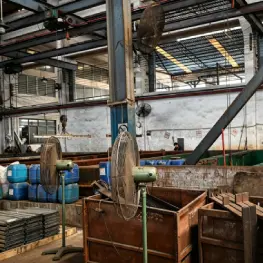
Robotic Welding
Panasonic 6-axis robotic cells execute continuous Argon-shielded joint seams.
Pickling & Phosphating
9-stage automated immersion line degreases, descales, and zinc-phosphates steel.
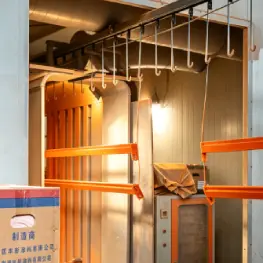
Powder Coating
GEMA electrostatic spray guns apply 80–120μm epoxy cured at 200°C.
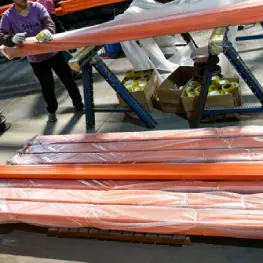
QC & Export Packing
Ultrasonic weld checks, color matching tests, and steel-strapped ocean bundles.
Direct Factory Engineering Accountability
Founded in 2001, Guangzhou Heda Shelves Co., Ltd. has grown from a specialized metal fabrication workshop into an international manufacturer of engineered warehouse systems. Today, our 30,000 m² integrated production base maintains a reliable output capacity of 30,000 metric tons per month, backed by over 300 experienced engineers, CNC machine operators, and project supervisors.
Unlike trading intermediaries, we take full structural responsibility for the design life of your storage facility. Every quotation is substantiated with finite element load modeling, connection design, seismic coefficient checks, and factory batch certificates.
- Free 3D CAD & Structural Calculations in 24 Hours
- Batch Ultrasonic Weld & Coating Thickness Verifications
- Seismic Engineering Compliant (RMI, EN 15512, NCh 2369)
- Fast Global Shipping to Brazil, Chile, Europe, USA & Middle East
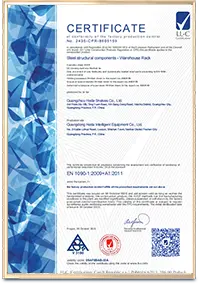
CE Certified
No. 2435-CPR-8605159 European Union Compliance
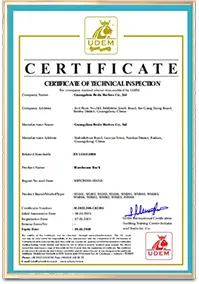
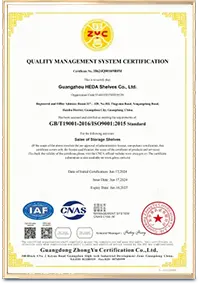
ISO 9001:2015
Certified Quality Management No. 18624Q00169R0M
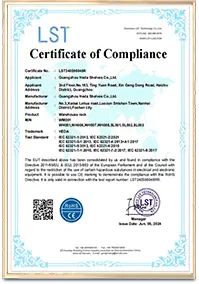
RoHS Compliant
Eco-Safe Non-Toxic Electrostatic Epoxy Coatings
Structural Testing
Third-Party Tensile & Deflection Proof Reports
Frequently Asked Questions: Sourcing FIFO Racking from China
Critical technical, logistics, and engineering questions answered directly by our chief structural engineering team.
What mechanical mechanisms distinguish industrial FIFO gravity flow racks from low-cost gravity shelving?
How do cold-storage temperatures (-25°C to -30°C) affect structural steel and roller bearings?
What exact engineering parameters must buyers provide to receive a compliant 3D layout within 24 hours?
How do China's top racking factories engineer structural compliance for seismic zones in South America and the Pacific Rim?
How is surface corrosion prevented during long ocean transit (30–45 days) to humid and coastal ports?
What is the operational difference between Pallet Flow FIFO and Radio Shuttle FIFO in throughput?
What is the standard production lead time and typical ocean transit container scheduling?
Can HEDA Shelves manufacture custom OEM/ODM racking compatible with existing European or US profiles?
Ready to Maximize Your Cubic Warehouse Volume?
Send our senior engineering team your warehouse architectural floor plan and SKU profile today. We will deliver an optimized 3D CAD layout, structural load analysis, seismic compliance report, and competitive factory-direct quote within 24 hours.