Featured Industrial High-Rack Storage Solutions
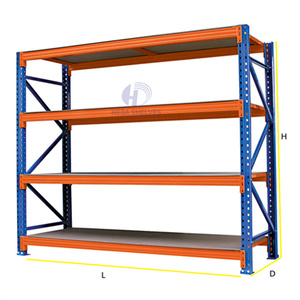
Heavy-duty structural integrity built with Q235B and Q355B high-tensile cold-rolled steel, designed in full compliance with FEM 10.2.02, EN 15512, RMI, and AS4084 international standards.
The Paradigm Shift in Vertical Warehousing: Engineering China High-Rack Systems
In an era of relentless land cost appreciation and soaring omnichannel logistics velocities, industrial developers and supply chain directors are systematically moving beyond conventional low-bay storage. The strategic imperative has pivoted to high rack storage warehouse architecture—vertical logistics frameworks scaling from 12 meters to upwards of 40 meters. In this structural domain, racking systems cease to function merely as modular steel furniture; they serve as critical load-bearing infrastructure that interacts dynamically with robotic material handling equipment, automated turret trucks, automated storage and retrieval systems (AS/RS), and complex structural foundation slabs.
As China's elite racking manufacturing sector consolidates around smart automation and advanced metallurgy, Guangzhou Heda Shelves Co., Ltd. (established in 2001) has emerged as an authoritative global supplier. Modern vertical high-bay engineering demands stringent dimensional tolerances. While conventional floor racking permits frame plumbness deviations up to $H/500$, high-bay narrow-aisle (VNA) and automated crane systems enforce tight thresholds of $H/750$ or $H/1000$ to mitigate top-sway dynamic amplification. When stacker cranes or man-up turret trucks operate at elevations exceeding 15 meters, an out-of-plumb deviation of merely 5 millimeters at the mast base can induce dangerous dynamic eccentricities of tens of millimeters at the mast peak.
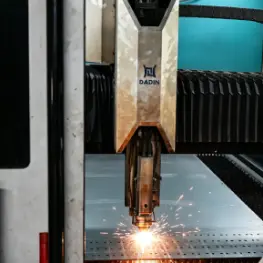
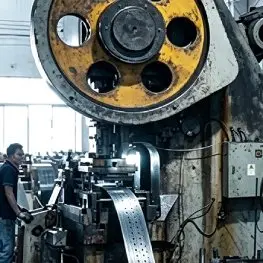
Achieving these micro-tolerances requires exceptional manufacturing fidelity: high-precision automated continuous cold-roll forming, CNC laser positioning for column punching, zero-backlash interlocking connectors, and structural FEA (Finite Element Analysis) simulation. Whether deploying high-density gravity flow racks for cold-chain pharmaceutical distribution or double-deep selective systems for heavy FMCG hubs, modern warehouse economics demand structural resilience, long-term fatigue endurance, and seamless integration with warehouse management systems (WMS).
Core High-Rack Storage Methodologies: Engineering & Operational Comparison
Specifying the appropriate high-bay structural typology requires balancing SKU proliferation, inventory turnover frequency, throughput velocity, clear ceiling clearance, and total capital expenditure (CapEx). Below is an engineering appraisal of the dominant structural frameworks manufactured within our advanced facility:
Very Narrow Aisle (VNA)
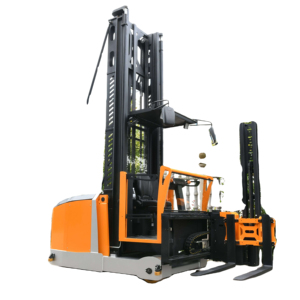
Operates in aisles between 1.6m and 1.9m wide, driving volumetric cubic space utilization to over 85% while preserving 100% immediate selectivity for every SKU.
- Wire-guided or rail-guided turret trucks
- Operational lift heights: up to 18 meters
- Requires superflat concrete floors (DIN 18202)
- Zero honeycombing storage losses
AS/RS Clad-Rack Systems
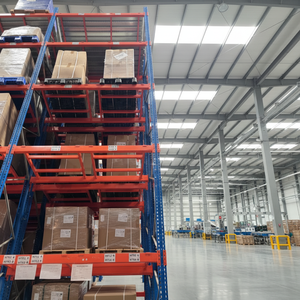
The rack structure forms the primary load-bearing framework of the building itself, supporting roof trusses and exterior wall cladding without independent building columns.
- Elevations reaching 25m to 42m
- Unattended automated crane operation
- Accelerated construction and accelerated CapEx depreciation
- Highest volumetric density achievable
High-Density Gravity Flow
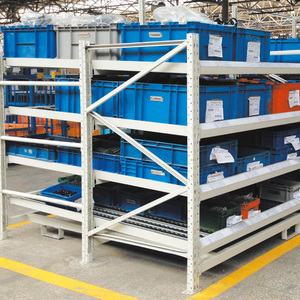
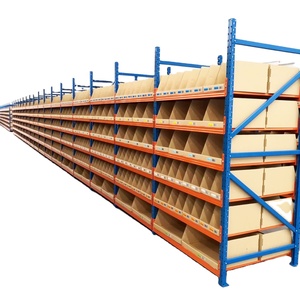
Gravity-driven roller beds inclined at 3° to 4° execute automated First-In-First-Out (FIFO) pallet rotation, separating loading from picking faces.
- Centrifugal speed controllers prevent runaway
- Automatic pallet separating mechanisms
- Ideal for perishable food, dairy & pharma
- Reduces forklift operating travel miles by 45%
Semi-Automated Radio Shuttle
Combines heavy-duty racking channels with autonomous battery-powered shuttles running on specialized profile rails to shuttle pallets deep inside lanes.
- Enables deep lanes exceeding 30 pallets
- Supports flexible FIFO and LIFO logic
- Eliminates forklift mast transit into channels
- Peak thermal efficiency for -30°C cold storage
High-Rack Engineering Specification & Standard Tolerances
The following engineering matrix defines the baseline structural attributes, metallurgical selections, and regulatory design criteria executed across our manufacturing operations:
| Storage System Type | Maximum Bay Height | Max Pallet Capacity | Steel Grade & Profiling | Structural Design Code | Corrosion Protection |
|---|---|---|---|---|---|
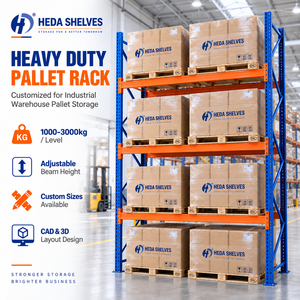
| Heavy Duty Selective High Rack | 16,000 mm | 1,000 – 4,500 kg / level | Cold-formed Q235B / Q355B | EN 15512 / RMI MH16.1 | Electrostatic Powder (60-80μm) |
| Very Narrow Aisle (VNA) | 18,500 mm | 1,200 – 3,000 kg / level | Cold-rolled high tensile Q355B | FEM 10.2.02 / AS 4084 | Pickling + Polyester Powder |
| Automated AS/RS High Bay | 40,000 mm | Up to 2,000 kg / position | Custom Omega Uprights Q355B | FEM 9.831 / EN 15620 | Epoxy Powder / Pre-galvanized |
| Pallet Gravity Flow Systems | 12,000 mm | 1,500 kg / pallet lane | Structural Carbon Steel Q235B | EN 15512 / ISO 9001 | Zinc-Plated Rollers + Coated Frame |
| Radio Shuttle Deep-Lane Bay | 18,000 mm | 1,800 kg / pallet position | High-Grade Cold Rolled Steel | FEM 10.2.07 / RMI | Anti-Abrasion Hardened Track |
| Structural Multi-Tier Mezzanine | 5 Levels (Up to 15m) | 300 – 1,200 kg / m² | Hot-Rolled H-Beam + Cold-Rolled Q235B | AISC 360 / EN 1993 | Durable Non-Slip Galvanized / Epoxy |
Future Trends Reshaping High-Rack Warehouse Procurement
International supply chain engineering is undergoing structural transformations dictated by automation, climate commitments, geopolitical logistics realignments, and extreme seismic scrutiny. For procurement officers and warehouse infrastructure consultants, recognizing these upcoming technical developments is vital for locking in long-term asset value and avoiding costly retrofit downtime.
1. Automation-Ready Tolerances
Procurement teams are shifting from manual forklift racks to dual-purpose structural frames that can be retrofitted with Autonomous Mobile Robots (AMRs), automated guided vehicles (AGVs), or high-speed shuttles without structural re-engineering.
2. Performance-Based Seismic Design
Global facilities in the Americas, Southeast Asia, and Southern Europe require nonlinear dynamic simulation rather than static lateral coefficients, verifying base-plate ductility, anchor embedment, and seismic energy dissipation under cyclic ground motions.
3. Eco-Metallurgy & Low-Carbon Steel
ESG compliance is entering B2B procurement rubrics. The adoption of high-efficiency roll-forming processes, circular scrap recycling, and toxic-free TGIC-free powder coatings drastically diminishes embedded carbon footprints in logistics parks.
4. IoT Structural Health Monitoring
High-bay installations above 20 meters are increasingly integrated with fiber-optic strain gauges, tilt sensors, and acoustic collision sensors to deliver real-time operational overload alerts and automated preventive maintenance schedules.
5. Hybrid Cold-Chain Metallurgies
With global cold chain volumes exploding, racks operating at -25°C to -35°C are engineered with impact-tested ductile steel chemistries (alleviating brittle transition zones) and advanced dual-layer zinc-rich thermal powder coatings.
6. Modular Supply Chain Architecture
Buyers are turning away from welded static systems, selecting standardized boltless beam-to-upright connections with multi-tooth safety lock pins that facilitate rapid structural reconfiguration, expansions, and accelerated relocation workflows.
Industrial Production Pedigree: 25+ Years of Certified Manufacturing
Established in 2001, Guangzhou Heda Shelves Co., Ltd. represents the vanguard of China's high-precision industrial racking export sector. Operating a modernized 30,000 square meter manufacturing plant staffed by more than 300 experienced engineers, structural designers, and fabrication specialists, HEDA maintains an extraordinary monthly processing capacity of 30,000 metric tons of structural and cold-formed steel.
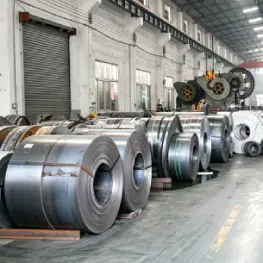
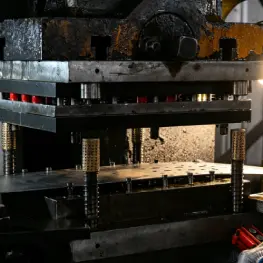
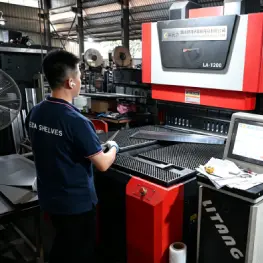
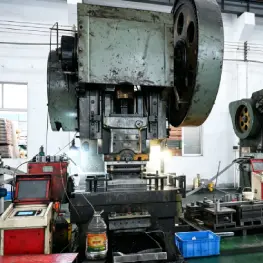
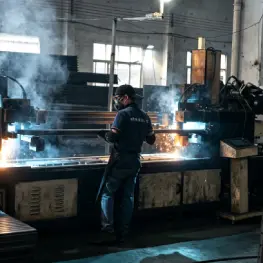
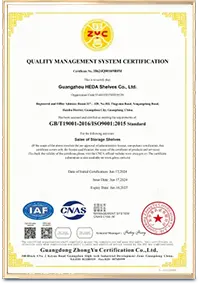
Unlike trading intermediaries, our factory maintains comprehensive in-house control over the entire metallurgical transformation sequence. From raw coil slit testing and continuous automatic cold-roll forming to automated robotic multi-point welding, chemical surface preparation, and electrostatic powder curing, every stage is monitored under our accredited ISO 9001:2015 quality management system.
Our dedicated technical engineering department leverages advanced 3D CAD modeling, Tekla structural drafting, and ANSYS finite element simulation to furnish bespoke warehouse layouts, seismic load certifications, and deflection validations for multinational enterprises, third-party logistics (3PL) conglomerates, and governmental storage hubs across 120+ sovereign nations.
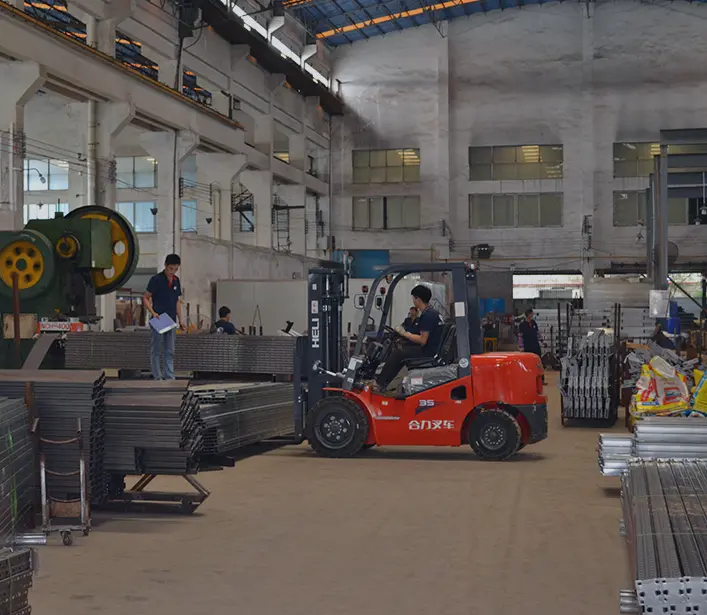
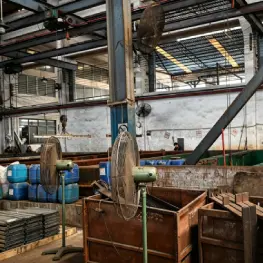
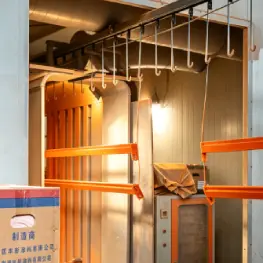
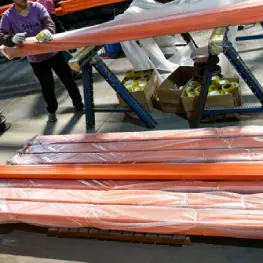
10-Stage Controlled Manufacturing Protocol
Every single frame upright, box beam, base plate, and brace that leaves our Guangzhou plant undergoes a rigorous 10-step precision manufacturing sequence:
International Certifications & Structural Test Verification
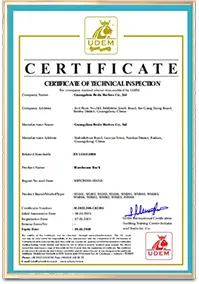
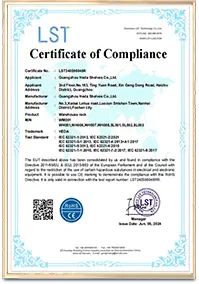
Procuring high-bay storage racks from China requires rigorous compliance documentation to satisfy municipal structural reviewers, insurance underwriters, and corporate safety auditors. Guangzhou Heda Shelves Co., Ltd. holds fully verified international credentials:
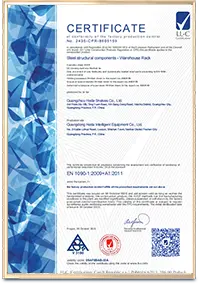
No. 2435-CPR-8605159
No. 18624Q00169R0M
Standard Stub Column Test
Heavy Metal Free Finish
Engineered for Global Ports, Regional Building Codes & Extreme Climates
Exporting heavy steel components across international waters demands structural foresight and optimized logistics planning. Our logistics team provides complete container packing diagrams, high-density wood-blocking, and vapor-barrier wrapping to prevent maritime salt corrosion.
We engineer specific seismic-rated baseplates and high-yield anchor configurations conforming to localized regulatory mandates: Chamber of Civil Engineers Chilean NCh 2369, Colombian NSR-10, Peruvian E.030, US IBC / ASCE 7, Eurocode 8 (EN 1998), and Australian AS 4084.

Frequently Asked Technical & Procurement Questions
Direct answers to the structural, metallurgical, and logistical challenges faced by global facility operators, warehouse designers, and procurement managers.
Request an Engineered 3D Layout & Structural Load Calculation
Collaborate directly with our senior structural engineering team. Submit your architectural floor plan, clear ceiling heights, pallet load parameters, and handling vehicle specs to receive a comprehensive CAD layout, structural load analysis, and landed freight calculation within 24 hours.