Kinematic Precision and Mechanical Tolerancing in Pallet Shuttle Racking
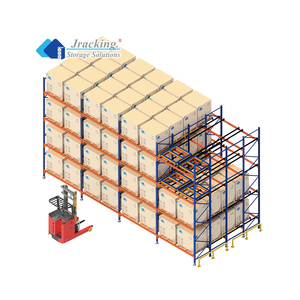
The contemporary intralogistics landscape demands a radical departure from static, low-density storage frameworks. The Radio Shuttle Racking System (also universally recognized as the Pallet Runner or Automated Pallet Mole) represents the apex of semi-automated and fully automated compact storage. Unlike traditional drive-in racking frameworks that subject structural uprights to severe lateral forklift impact forces, a pallet shuttle installation relies on an autonomous, low-profile motorized cart executing high-precision horizontal traversals along specialized cold-formed galvanized rails.
At Guangzhou Heda Shelves Co., Ltd. (operating since 2001 across a 30,000 m² state-of-the-art production facility), every shuttle guide rail and upright assembly is engineered with microscopic geometric tolerances. Utilizing continuous cold-roll forming lines driven by high-yield structural steel coils (SS400, Q235B, and high-tensile Q355B), our shuttle rails feature dual-plane guide lips that prevent shuttle derailment during rapid acceleration cycles of up to 1.2 m/s² unloaded and 0.8 m/s² fully laden.
Structural deflection ratios are calculated to surpass international benchmarks, holding the live-load deflection of longitudinal rails to under L/300, effectively preventing dynamic oscillation when carrying unit loads scaling from 500 kg up to 2,000 kg per pallet position. Whether deployed in First-In, First-Out (FIFO) buffer configurations or First-In, Last-Out (LIFO) bulk staging lanes, the integration of optical positioning sensors, multi-frequency 433 MHz and 2.4 GHz wireless transceivers, and fail-safe electromagnetic brake discs ensures frictionless operational continuity.
| Storage Topology | Volumetric Efficiency | Direct Selectivity | Structural Collision Risk | Throughput Cycle Index | Capital ROI Horizon |
|---|---|---|---|---|---|
| Radio Pallet Shuttle | 80% – 85% | Lane Dependent (FIFO/LIFO) | Negligible (External Handling) | High (40–60 Pallets/Hr/Unit) | 14 – 22 Months |
| Selective Pallet Racking | 35% – 45% | 100% Individual Access | Moderate (Aisle Intrusion) | Moderate (Forklift Bound) | Immediate / Standard |
| Drive-In Racking | 60% – 70% | Strict LIFO / Highly Limited | High (Channel Collision) | Low (Slow Maneuvering) | 24 – 36 Months |
| Gravity Pallet Flow | 70% – 75% | Automatic FIFO | Low (Gravity Rollers) | Medium-High (Slope Driven) | 30 – 48 Months |
| Push-Back Carts | 55% – 65% | Limited (2–6 Pallets Deep) | Moderate (Mast Push Force) | Moderate (Nested Carts) | 20 – 30 Months |
Strategic Procurement Trends in Automated Dense Storage
Global supply chain directors and procurement executives are actively re-evaluating capital equipment allocation. The convergence of rising square-meter real estate acquisition costs, climbing commercial electricity tariffs, and persistent industrial labor shortages has accelerated the migration from conventional static racks toward modular automation. Tier-1 sourcing from Chinese manufacturing leaders has shifted from raw component trading to comprehensive design, engineering, and validated sub-system manufacturing.
From 1D Shuttles to 4D Swarm Robotics
Procurement pipelines are rapidly transitioning toward 4-Directional (4D) multi-lane shuttles. By traversing both cross-aisles and longitudinal lanes and integrating with automated vertical reciprocating conveyors (lifts), 4D robotic shuttles achieve unconstrained 3-axis volumetric accessibility without requiring dedicated forklift shuttling between elevation tiers.
TCO Reduction via Sub-Zero Electrification
Cold chain operators in meat, aquaculture, and fresh produce are moving aggressively away from drive-in configurations. Sub-zero lithium-iron-phosphate (LiFePO4) power cells with built-in internal thermal resistance circuitry operate continuously down to -30°C, preventing condensation degradation and reducing cold room refrigeration power consumption by up to 40%.
Open Protocol WMS / WCS Middleware API
Modern procurement specifications mandate open architecture APIs. Today's pallet shuttle fleets do not live as isolated closed-loop hardware; they interface via Wi-Fi/mesh gateways directly into enterprise SAP, Oracle, or proprietary warehouse management software, allowing autonomous batch job execution and automated pallet count auditing.
Consequently, procurement teams are no longer evaluating suppliers purely on steel tonnage rates. Instead, they require full-package verification: finite element analysis (FEA) under dynamic braking load, mean time between failures (MTBF > 12,000 operational hours), modular spare parts interchangeability, and verified factory acceptance testing (FAT) documentation prior to container dispatch.
HEDA Shelves: 25-Year Precision Engineering Ecosystem
Founded in 2001, Guangzhou Heda Shelves Co., Ltd. has grown into an international manufacturing force, exporting premium warehouse storage systems to more than 120 countries spanning Latin America, North America, Southeast Asia, Europe, and the Middle East. Headquartered in Guangzhou with a centralized 30,000 m² heavy-industrial manufacturing base, our in-house engineering team comprises more than 300 experienced technicians, structural CAD designers, and robotic systems specialists.
Our manufacturing throughput exceeds 30,000 metric tons per month, powered by automated high-speed roll forming production lines, multi-torch robotic welding stations, and a state-of-the-art continuous pre-treatment electrostatic powder coating complex. Every racking component—from upright frames, boxed step beams, and shuttle running rails to baseplates and portal tie-beams—undergoes rigorous pre-treatment including acid pickling, multi-stage rinsing, and hot-phosphate conversion before being coated with ultra-durable, RoHS-compliant thermoset epoxy-polyester powder.
Certified Compliance
CE Certificate No. 2435-CPR-8605159, ISO 9001:2015 Quality Management System No. 18624Q00169R0M, and RoHS certifications.
Seismic Engineering
Custom structural calculations factoring local seismic accelerations: NCh 433/2369 (Chile), E.030 (Peru), NSR-10 (Colombia), and RMI/UBC (USA).
Free 3D Layout & CAD
Experienced warehouse designers supply high-definition 3D renderings, CAD floor plans, and load deflection data within 24 business hours.
Direct Port Logistics
Full-container load optimization from Guangzhou and Shenzhen to Santos, Paranaguá, Callao, Valparaíso, Buenaventura, and Guayaquil.
Our in-house 10-step quality assurance protocol begins with raw hot-rolled strip coil metallurgical verification (tensile yield testing, carbon equivalent tracking) and extends through cold bending, CNC punch pitch accuracy control (±0.2 mm over 12-meter continuous vertical uprights), automated dual-wire CO2 shielded robotic welding, surface blast cleaning, powder film thickness verification (>65–85 μm), and high-density export protective packing. This end-to-end operational rigor ensures that our partners receive defect-free racking ready for rapid on-site assembly.
Technological Trajectory: Autonomous Shuttles, IoT Diagnostics, and Green Logistics
The technological roadmap of high-density shuttle racking is evolving across three distinct axes: energy harvesting, optical telemetry, and structural digital twin integration.
During rapid deceleration phases under full unit load (e.g., carrying 1,500 kg down a 60-meter deep lane), substantial kinetic energy is generated. Modern tier-1 Chinese shuttles are adopting onboard supercapacitor energy-recovery modules that capture dynamic braking EMF currents, cycling energy back into the drive circuitry. This reduces overall battery discharge rates, elongates continuous runtime to over 10 hours on a single 3-hour fast charge, and reduces thermal wear on internal electronic componentry.
While classical shuttle iterations relied strictly on magnetic induction limit switches and basic reflective photoelectric cells, next-generation shuttles deploy dual miniature solid-state LiDAR sensors. These scanners perform continuous point-cloud distance measurements, actively detecting pallet overhang, dislodged bottom deck-boards, or accidental channel obstructions at distances up to 3 meters, executing soft dynamic braking routines to eliminate load toppling risks.
In mega-scale high bay installations (elevations exceeding 18 meters), dynamic racking oscillation presents genuine structural engineering considerations. HEDA Shelves engineers integrate anchor-base strain gauges and multi-axis accelerometers in seismic-prone zones. Real-time dynamic load, harmonic sway, and deflection data are streamed directly to the facility’s SCADA system, establishing a predictive maintenance pipeline before micro-fatigue affects structural connections.
Procurement & Engineering FAQ for International Exporters
Authoritative answers to the most rigorous technical, seismic, logistical, and structural questions posed by supply chain directors, warehouse managers, and EPC contractors.
Our structural engineering department conducts three-dimensional finite element modeling (FEM) utilizing software calibrated to national seismic design standards, including Chile’s NCh 433 and NCh 2369, Peru’s E.030, Colombia’s NSR-10, and US RMI/ASCE 7. We engineer oversized seismic baseplates, integrate high-tensile chemical wedge anchors (Hilti/Fischer equivalent), heavy-gauge horizontal and diagonal cross-bracing towers, and multi-tooth beam-to-frame connector locks that dissipate dynamic earthquake ground accelerations without brittle failure.
Unlike Very Narrow Aisle (VNA) turrets that demand hyper-flat superflat slabs (DIN 18202 Table 3 Line 4 or ASTM E1155 FF 50 / FL 50), Pallet Shuttle installations are forgiving because the motorized shuttle travels inside the rack’s self-contained rail system. Standard industrial slabs constructed to DIN 18202 Group 3 (±3 mm under a 1-meter straightedge) or ASTM FF 25 / FL 20 are completely acceptable. Baseplate shimming packs provide millimeter-level leveling during installation.
For cold room deployments, our shuttles are equipped with specialized low-temperature sealed bearings, synthetic synthetic lubricants rated to -40°C, and hermetically sealed IP65 electronic control enclosures. Crucially, internal heating elements prevent condensation on optical sensors when shuttles transition between ambient staging and cold bays. Power is supplied by high-discharge Lithium Iron Phosphate (LiFePO4) battery packs engineered with internal thermal management cells.
Backed by our 30,000 ton monthly factory output, typical manufacturing lead time for orders up to 5,000 pallet positions spans 2 to 4 weeks post CAD drawing sign-off. Logistics packing follows strict maritime export standards: upright frames and beams are nested on heavy-duty wood skids, strapped with polyester strapping, and wrapped in thick waterproof poly-stretch film with corrugated corner protectors to prevent powder-coat abrasion during ocean transit.
Yes. A single shuttle can handle standard GMA pallets (48"x40"), Euro pallets (1200x800 mm), and Industrial pallets (1200x1200 mm) provided the bottom deck runner configuration aligns with the shuttle lifting platform. Our shuttle carts feature intelligent photo-eye sensor arrays that automatically detect the front edge and rear boundary of varying pallet lengths, calculating automated stopping coordinates without human reprogramming.
Every export shipment includes comprehensive 3D assembly shop drawings, component piece-mark identification tags, torque tightness schedules, and video tutorials. For major regional fulfillment centers, HEDA Shelves deploys experienced bilingual field service engineers on-site to oversee the installation, conduct rail laser alignment, configure wireless access points, and perform full Site Acceptance Testing (SAT) alongside local mechanical teams.
Request an Engineered 3D Layout & Structural Calculation
Submit your facility CAD floor plans, clear internal building height, pallet specifications, and target unit-throughput requirements. Our senior structural logistics engineering team will deliver a comprehensive 3D system rendering, seismic-verified load check, and direct factory pricing within 24 hours.