Featured Industrial Heavy-Duty Storage Racks
Certified high-capacity storage racks engineered for distribution centers, manufacturing facilities, seismic regions, and automated logistics hubs worldwide.
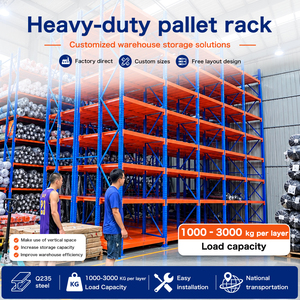
Steel Pallet Racking System Heavy Duty Adjustable Storage Solution
Precision cold-formed upright profiles engineered for ultra-dense pallet consolidation and multi-level beam adjustability.
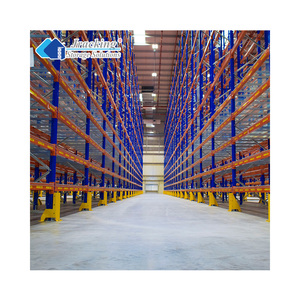
Jracking Dexion Pitch 76.2 mm Style Beam Pallet Rack System
Compatible international pitch geometry with patented locking pins, providing modular interchangeability across global facilities.
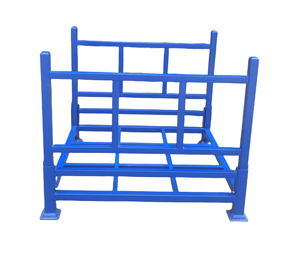
Customized Blue Steel Folding Pallet Stackable Anti-Corrosion Rack
High-flexibility collapsible frame racking designed for buffer distribution, intermodal transfer, and seasonal surge inventory.
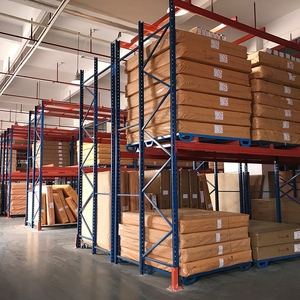
Heavy-Duty 5-Layer Drive-In Industrial Selective Pallet Rack
Aisleless continuous bay design eliminating forklift service passages, increasing cold storage volumetric efficiency up to 80%.
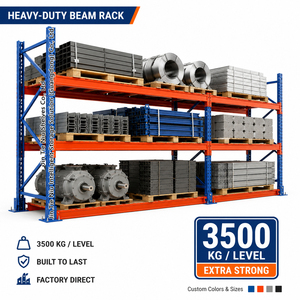
3500kg Heavy Duty Industrial Steel Coil & Motor Storage Rack
Reinforced saddle cradles and gusseted beam assemblies engineered specifically for high concentrated point-loads and heavy dies.
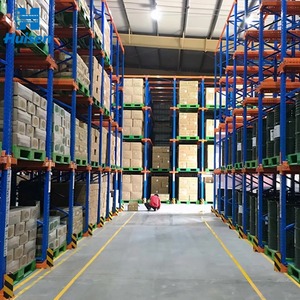
Heavy-Load Multi-Level ISO Certified Overseas Pallet Racking
Configured for international high-bay installations with optimized knocked-down shipping volumes for maritime 40ft HQ containers.
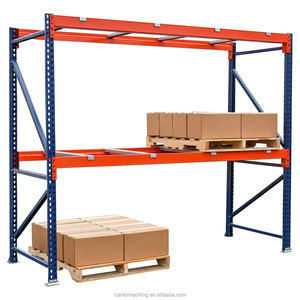
Heavy-Duty Metal Storage Shelving & Longspan Beam Units
Multi-tiered pick modules combining high-load pallet bulk bases with ergonomic manual carton selection decking shelves.
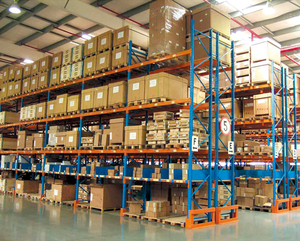
Selective Pallet Racking Adjustable Euro Pallet Storage Rack
100% immediate individual selectivity matching Euro, GMA, and standard wooden/plastic pallet footprints with fail-safe safety pins.
Engineering Principles of Extra Heavy Duty Pallet Racks
Industrial rack design requires rigorous material science, structural finite element analysis (FEA), and geotechnical safety factors to withstand static, dynamic, and seismic forces over decades of continuous operation.
Cold-Formed Metallurgy
Extra heavy-duty racking uprights rely on certified Q235B (yield strength $f_y \ge 235\text{ MPa}$) and low-alloy high-strength Q355B ($f_y \ge 355\text{ MPa}$) strip steel. Continuous multi-station roll-forming lines bend steel profiles while maintaining uniform wall thickness (1.5mm to 3.0mm) without micro-fissuring along the corner radii.
Tolerances: BS EN 15512 ComplianceInterlocking Box Beams
Heavy-duty load beams utilize double C-sections welded face-to-face via automated twin-wire submerged arc robotic welding. This closed-profile configuration delivers superior torsional rigidity compared to standard open step-beams, guaranteeing vertical beam deflection limits strictly within $L/200$ to $L/250$ under maximum pallet loads.
Deflection Threshold: $\le L/200$ Under Full SWLSeismic Dissipation & Anchoring
Seismic baseplates redistribute concentrated vertical and overturning moment loads directly into the concrete foundation. Anchored using M12/M16 high-tensile wedge expansion bolts or chemical resin studs, structural assemblies are engineered to absorb spectral acceleration forces according to seismic standards (AS 4084, RMI MH16.1, and Chilean NCh 2369).
Seismic Acceleration: $S_s > 1.5\text{g}$ CertifiedGuangzhou HEDA Shelves: 25+ Years of Manufacturing Leadership
Founded in 2001, Guangzhou Heda Shelves Co., Ltd. operates a high-capacity 30,000 square meter intelligent manufacturing facility, providing factory-direct OEM/ODM storage engineering to more than 120 countries worldwide.
Free 3D & CAD Layouts
Our structural engineering team turns your architectural DWG warehouse drawings into fully calculated 3D BIM models within 24–48 hours, optimizing racking orientation, aisle clearance, and forklift travel turns.
10-Stage Surface Coating
Steel components undergo automated high-pressure degreasing, ultrasonic water washing, acid rust pickling, phosphating passivation, and electrostatic powder coating baked at 180°C–200°C for superior adhesion.
Certified Global Compliance
Accredited by international certification bodies: CE Certificate No. 2435-CPR-8605159, ISO 9001:2015 Quality Management No. 18624Q00169R0M, and RoHS toxic-free coating compliance for export.
Container Cube Optimization
Knocked-down profile bundling and custom nesting cradles achieve up to 96% 40ft High Cube container volume utilization, shielding painted surfaces with shrink film while minimizing ocean freight cost per pallet location.
Future Procurement Trends in Warehouse Storage Systems
As enterprise supply chains confront volatile commodity markets, nearshoring expansions, and rapid logistics automation, pallet rack procurement is moving from transactional commodity purchasing to strategic structural engineering partnerships.
1. Raw Material Indexing
Tier-1 procurement organizations are adopting indexed steel-cost pricing contracts benchmarked against the Shanghai Metal Market (SMM) and London Metal Exchange (LME). This approach mitigates risk by locking baseline fabrication margins while indexing raw hot-rolled strip steel costs.
2. Automation-Ready Tolerances
Warehouses procuring conventional selective racks are upgrading specifications to automation-ready standards. Racks designed with tight beam deflection limits ($\le 1/300$) and precise plumbness tolerances can later integrate pallet shuttles, AMR pickers, and automated guided vehicles without major structural replacements.
3. Total Cost of Ownership (TCO)
Global buyers look beyond factory-gate price. Landed TCO metrics weigh structural steel thickness against post-installation maintenance, column impact repair costs, seismic retrofitting liability, and corrosion degradation over a 15- to 20-year structural lifecycle.
4. Geotechnical Compliance
Municipal building authorities across seismic zones (Latin America, US West Coast, New Zealand, and Turkey) require documented structural calculations for rack permits. Importers require verified anchor shear, dynamic overturning moments, and certified test reports before release of bill of lading.
Racking Manufacturing & Structural Development Trends
The warehouse storage sector is adopting advanced material compositions, sensor-driven safety telemetry, and eco-certified fabrication processes to meet the demands of modern logistics hubs.
IoT Structural Telemetry
Wireless micro-electromechanical (MEMS) accelerometers and fiber-optic strain gauges are increasingly mounted on critical uprights. These sensors measure real-time beam deflection and forklift impact shock in real time, alerting operations teams before structural failure occurs.
Micro-Alloyed Steels
Vanadium and niobium micro-alloyed cold-rolled coils are replacing older carbon grades. These advanced alloys deliver high tensile yield strength ($f_y \ge 420\text{ MPa}$) with lighter structural wall gauges, reducing total steel weight, shipping freight, and structural deadweight on concrete floor slabs.
Extreme Cold Galvanizing
With the rapid growth of refrigerated e-commerce and cold chains (down to -30°C), traditional powder coatings face embrittlement and peeling. Continuous hot-dip galvanizing (HDG) to EN ISO 1461 ($65–85\ \mu\text{m}$ zinc thickness) protects structural steel in high-condensation environments.
Circular Carbon Accounting
Global EPC contractors require Scope 3 embodied carbon documentation. Chinese automated manufacturing lines are shifting toward low-emission electric arc furnace (EAF) scrap steel, closed-loop phosphate water recycling, and solvent-free VOC-free electrostatic powder coating lines.
Technical Comparison Matrix: Extra Heavy-Duty Storage Configurations
Compare load capabilities, spatial density, and operational parameters across primary industrial racking configurations to identify the optimal configuration for your throughput requirements.
| Racking System Type | Payload Per Level | Pallet Selectivity | Aisle Clear Width | Volumetric Density | Ideal Application |
|---|---|---|---|---|---|
| Selective Pallet Racking | 1,000 – 4,500 kg | 100% Immediate | 3,000 – 3,500 mm | 40% – 50% | High SKU distribution centers, 3PL logistics, retail FMCG. |
| Drive-In / Drive-Through | 1,000 – 2,000 kg | 15% – 25% (LIFO/FIFO) | Eliminated Aisles | 75% – 85% | Refrigerated cold storage, beverage bottlers, uniform bulk SKUs. |
| Very Narrow Aisle (VNA) | 1,200 – 3,500 kg | 100% Immediate | 1,600 – 1,900 mm | 65% – 75% | High-bay warehouses up to 16m height with turret reach trucks. |
| Radio Shuttle Racking | 1,000 – 2,500 kg | Deep Lane Batch | Perimeter Only | 80% – 90% | Semi-automated pallet consolidation, seasonal grain, meat exports. |
| Heavy-Duty Cantilever | 1,000 – 5,000 kg/Arm | 100% Unobstructed | Custom Depending on Load | Variable | Steel pipes, timber bundles, aluminum profiles, sheet metal. |
Frequently Asked Questions for Overseas Racking Buyers
Clear, practical answers covering quality control, load testing, international shipping, seismic engineering, and factory customization from our engineering team.
How do you verify the raw steel quality and structural load ratings before production?
Every production batch begins with certified mill test certificates (MTC) from top-tier steel producers (such as Baosteel or Shougang Group), confirming compliance with Q235B or Q355B yield strength, tensile limits, and chemical compositions.
Before roll-forming, steel coils undergo ultrasonic thickness calibration and tensile coupon testing in our quality lab. Completed beam assemblies and upright frames then undergo full-scale destructive and non-destructive load tests using our hydraulic test bed, following EN 15512 and RMI MH16.1 protocols. This process verifies that safe working limits provide a structural safety margin of at least 1.65 to 1.95.
Can HEDA Shelves engineer racking systems for high-risk seismic zones?
Yes. We regularly design and supply heavy-duty storage racks for active seismic regions across Latin America (Chile, Peru, Colombia, Ecuador), the Mediterranean, and Southeast Asia.
By incorporating your local site parameters—such as site soil class, spectral acceleration factors ($S_s, S_1$), and importance coefficients—our engineers calculate structural frame bracing, beam connector shear capacities, and baseplate dimensions in line with regional codes (e.g., Chilean NCh 2369 / NCh 433, Peruvian E.030, and US RMI standards). We provide full structural calculation packages for local engineer-of-record (EOR) review and municipal permit filings.
What specific anti-corrosion treatments are available for humid, tropical, or cold storage installations?
For standard warehouse environments, we use a 10-stage pre-treatment process that includes acid pickling, zinc phosphating, and electrostatic epoxy-polyester powder coating (60–90 microns thick), offering high scratch resistance and 500-hour salt spray test compliance.
For coastal sites with high humidity, chemical processing plants, or refrigerated facilities down to -30°C, we provide:
1. Hot-Dip Galvanizing (HDG) per EN ISO 1461, achieving 65–85 microns of zinc-alloy coating for decades of rust-free performance under condensation.
2. Zinc-rich epoxy primer undercoats beneath exterior-grade polyester topcoats for added environmental protection.
How are container loading plans handled to minimize ocean freight costs and transit damage?
Uprights and beams can lead to dead freight space if improperly packed. We use 3D container cubing software to plan every shipment before production starts. Uprights are nested, strapped into rigid bundles with protective timber dunnage, and edge-wrapped with corrugated plastic corner guards and stretch film.
Beams are bundled with non-slip spacers to keep fork pockets accessible for safe destination destuffing. Small hardware—such as baseplates, anchor bolts, shim plates, and safety lock pins—is packed in heavy-duty wooden crates labeled with steel band strapping. This approach regularly yields 92% to 96% volumetric efficiency in 40ft High Cube containers.
What warehouse floor slab criteria are required before installing extra heavy duty racks?
Heavy-duty pallet racks transfer high point loads through upright baseplates directly into the warehouse concrete slab. The concrete slab should typically have a minimum compressive strength of 25–30 MPa (approx. 3,500–4,500 PSI) and be at least 150mm–200mm thick.
Floor flatness should meet DIN 18202 Table 3 or ASTM E1155 F-min standards, particularly for reach truck and narrow-aisle (VNA) operations. If the floor slab is unreinforced or uses a thermal insulation barrier (common in deep-freeze cold storage), our engineers can supply enlarged spreader baseplates or continuous sleeper channels to distribute point loads safely.
What is the typical production lead time and minimum order quantity (MOQ) for overseas orders?
Supported by our 30,000-ton monthly capacity, standard selective pallet rack orders of 1 to 5 full container loads (FCL) typically ship within 14 to 21 business days following CAD drawing and color sign-off.
Larger distribution center projects (10 to 50+ containers) or customized automated shuttle structures are scheduled in phased production batches to align with your ocean shipping schedule and site construction milestones. Our standard MOQ is one 20ft or 40ft container load, which keeps ocean freight cost-effective for international freight.
How does HEDA Shelves support on-site installation for international projects?
Every shipment includes a comprehensive engineering documentation package: detailed 2D CAD assembly schematics, numbered component lists matching container manifests, torque specifications for all bolt grades, and step-by-step 3D video guides.
For large facilities or mezzanine installations, we provide real-time remote video engineering support to assist your local installation crews. On-site installation supervisors and project managers are also available for deployment to overseas project locations upon request.
Ready to Engineer Your High-Capacity Warehouse?
Share your building floor plan, clear ceiling height, pallet load profiles, and forklift models. Our engineering team will deliver a comprehensive 3D layout, CAD proposal, and factory-direct quotation within 24 hours.
- Free 3D Layout & CAD Design
- Structural Load & Seismic Checks
- Factory-Direct Wholesale Pricing
- Ocean Load Plan Optimization
Request Product Catalog & Engineering Guide
Download our complete heavy-duty structural rack engineering catalog, including profile specifications, beam load capacity charts, and seismic connection designs.
Get Catalog