Standard & Heavy-Duty Industrial Shelving Upright Assemblies
Precision-punched, high-yield steel frames engineered to optimize storage density, structural torsion resistance, and dynamic impact damping across automated and traditional warehouse configurations.
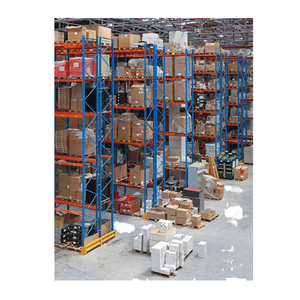
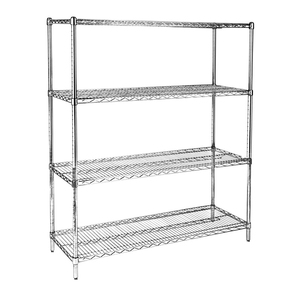
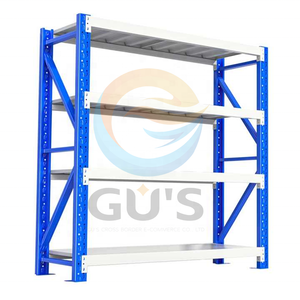
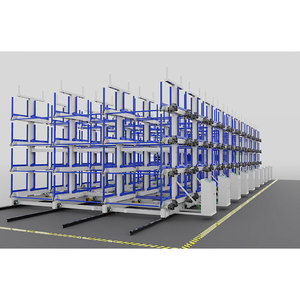
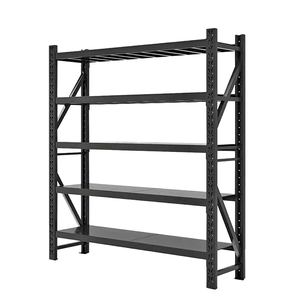
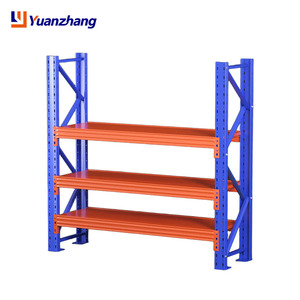
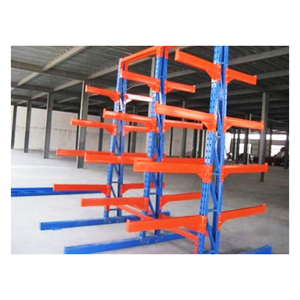
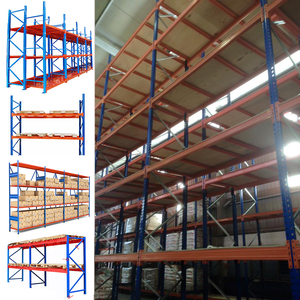
The Engineering Anatomy of High-Performance Racking Uprights
In contemporary logistics engineering, the industrial shelving upright—often termed the rack column or vertical post—functions as the foundational compression and torsion member governing warehouse structural integrity. Unlike static structural building columns, warehouse shelving uprights operate under continuous dynamic cyclic loading, asymmetric pallet placements, forklift impact events, and localized torsional buckling forces. At Guangzhou Heda Shelves Co., Ltd., upright profile design is driven by advanced finite-element elastoplastic structural simulations verified under ANSI/RMI MH16.1, EN 15512:2020, and FEM 10.2.02 international racking specifications.
The cross-sectional profile of an industrial upright defines its moment of inertia ($I_x, I_y$) and radius of gyration ($r_x, r_y$). We utilize proprietary Omega (Ω) profiles featuring up to 12 distinct cold-formed return bends. These longitudinal stiffening ribs redistribute compressive axial stress away from the perforation zones toward the outer flanges, elevating the critical elastic buckling stress ($\sigma_{cr}$) by up to 28% compared to conventional flat-faced C-channels. Every millimeter of profile geometry is engineered to mitigate both global Euler column buckling and localized plate fluting.
| Mechanical Property | Standard Q235B Steel | High-Strength Q355B Steel |
|---|---|---|
| Yield Strength ($R_e$) | ≥ 235 MPa | ≥ 355 MPa (+51%) |
| Tensile Strength ($R_m$) | 370 – 500 MPa | 470 – 630 MPa |
| Elongation at Fracture ($A$) | ≥ 26% | ≥ 21% |
| Impact Energy (Charpy V-Notch) | ≥ 27 Joules (at 20°C) | ≥ 34 Joules (at 0°C) |
| Application Target | Light-Medium Shelving, 2-Tier | High-Bay VNA, AS/RS, Seismic Zones |
Optimizing Perforation Geometry: Teardrop vs. 50mm Pitch Omega
The perforation pattern along the upright face dictates both connection rigidity and structural net section area. Excessive punch removal weakens the upright's compressive cross-section, while insufficient pitch diminishes adjustability. Modern wholesale manufacturing requires high adaptability to international end-user standards:
American Teardrop Geometry: Engineered with a 2-inch (50.8mm) vertical increment, teardrop punches utilize gravity-assisted wedging where the beam connector pin seats into a tapered slot. This creates an automatic frictional interlock that resists dynamic beam rotation under forklift impact.
European 50mm / 75mm Pitch Butterfly & Diamond: Built for multi-hook connector lugs, our continuous CNC punching stations maintain a centerline positional tolerance of ±0.1mm across continuous 16-meter roll-formed sections, ensuring frictionless beam engagement without structural binding or connector sloppiness.
Structural Net Area Retention: By deploying hydraulic multi-action micro-punch tooling, HEDA preserves over 84% of the solid cross-sectional steel area, vastly exceeding generic wholesale profiles that sacrifice load capacity for generic hole compatibility.
Why Global Importers Source Uprights from HEDA Shelves
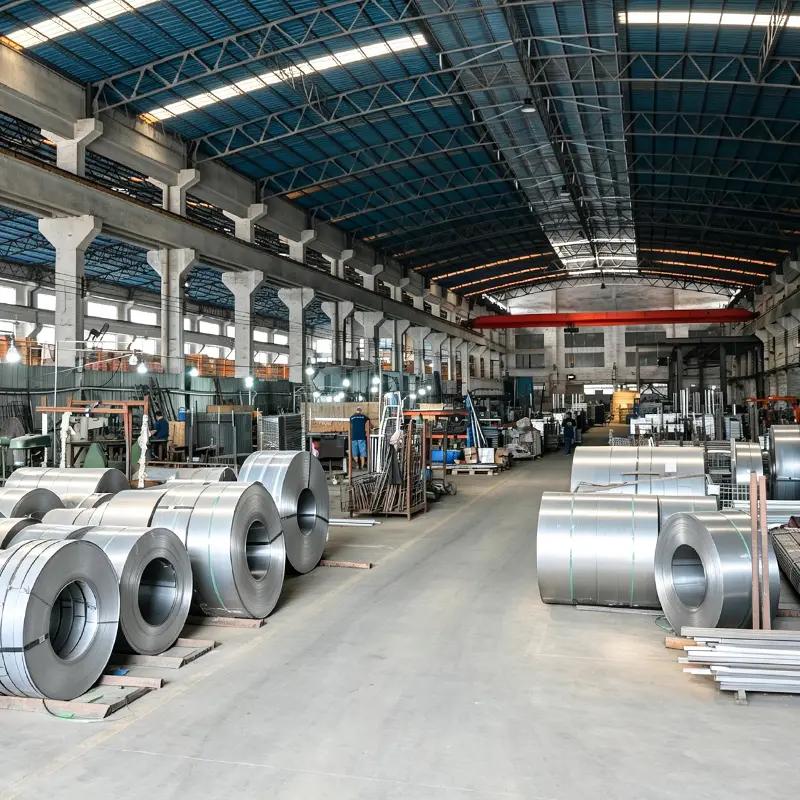
Founded in 2001, Guangzhou Heda Shelves Co., Ltd. operates a 30,000 m² specialized manufacturing base dedicated to heavy-duty pallet racking, multi-tier mezzanines, and industrial upright fabrication.
30,000 Tons Monthly Output
Continuous dual-strand high-speed automated roll-forming lines guarantee stable delivery cycles for multi-thousand upright container contracts.
Free 3D & CAD Engineering
Parametric structural FEA calculations, seismic baseplate anchoring verification, and complete warehouse CAD/BIM layouts returned within 24 hours.
CE & ISO 9001:2015 Audited
Certified factory compliance with CE Certificate No. 2435-CPR-8605159, verifying hot-dip galvanizing, welding integrity, and powder coating thickness.
Ocean Freight Nesting Optimization
Precision component bundling and geometric nesting algorithms maximize 40ft HQ container payload capacity, dropping landed costs by up to 22%.
Step-by-Step Upright Fabrication Integrity
How raw hot-rolled carbon coils are transformed into millimeter-accurate, high-strength industrial shelving upright columns within our automated Guangzhou facilities.
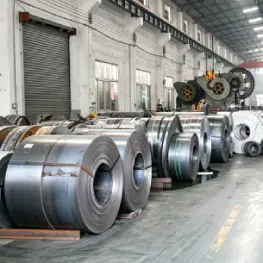
Coil Slitting & Uncoiling
Certified steel master coils pass through dynamic hydraulic straighteners to neutralize residual internal coil curvature and ensure zero longitudinal camber before punching.
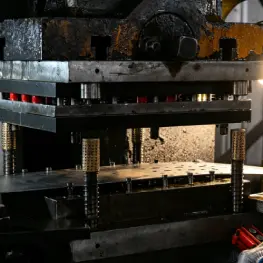
Automated CNC Punching
High-tonnage progressive punching presses stamp continuous teardrop, diamond, or butterfly perforation sequences with positional precision held under ±0.1mm tolerance.
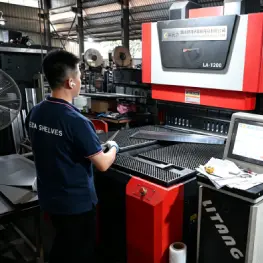
Multi-Pass Roll Forming
Up to 24 precision-ground rolling stands gradually bend the flat strip into complex Omega profiles without inducing micro-fractures in outer cold-worked radius bends.
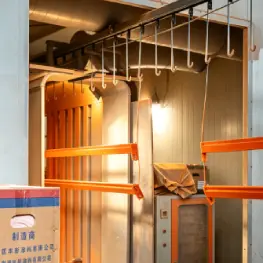
Duplex Pretreatment & Coating
Uprights undergo a 9-stage immersion pickling, phosphating, and deionized wash, followed by electrostatic epoxy-polyester powder baking (60–90μm) cured at 200°C.
| Quality Control Milestone | Testing Protocol | HEDA Shelves Acceptance Standard | Industry Baseline |
|---|---|---|---|
| Straightness / Plumbness | Laser optical coordinate alignment | ≤ 1.0 mm per 1,000 mm length | ≤ 2.0 mm per 1,000 mm |
| Cross-Sectional Twisting | Digital angle protractor gauge | ≤ 0.5° per 1,000 mm length | ≤ 1.0° per 1,000 mm |
| Salt Spray Corrosion Test | ASTM B117 Standard Chamber | 500+ Hours without blistering | 240 Hours |
| Coating Adhesion | Cross-hatch adhesion tape test | Class 0 (ISO 2409 / 100% adhesion) | Class 1 – 2 |
Future Procurement Trends for Industrial Racking Uprights
Navigating macro supply-chain shifts: How global supply chain executives, system integrators, and distributors can mitigate price volatility, carbon tariffs, and delivery risks through 2026–2030.
Raw Steel Index-Linked Sourcing
Enterprise buyers are transitioning from rigid spot pricing to dynamic index-linked contracts tied to Shanghai SteelHome or London Metal Exchange (LME) coil benchmarks. Forward-hedging raw material through long-term factory supply agreements protects projects from raw commodity surges.
High-Bay Automation Compatibility
The expansion of automated warehouses, mini-load AS/RS, and Autonomous Mobile Robots (AMRs) demands racking uprights engineered with tight deflection bounds (1/1000 versus the historical 1/500 standard). Upright profiles must accommodate floor-mounted sensor targets, guide wire integration, and rack-top crane runways.
Carbon Tariffs & Green Steel Sourcing
With the European Carbon Border Adjustment Mechanism (CBAM) and North American ESG reporting mandates, racking importers are scrutinizing cradle-to-gate carbon footprints. Modern upright manufacturing relies on electric arc furnace (EAF) processing and zero-VOC electrostatic powder systems.
Technological Developments in Industrial Upright Design
How advanced material science, cold roll-forming automation, and dynamic sensor integration are transforming humble warehouse upright posts into intelligent structural assets.
Micro-Alloyed High-Yield Steels
The metallurgical shift toward micro-alloyed niobium-vanadium steels allows upright wall thicknesses to be reduced from 2.5mm to 1.8mm while maintaining identical vertical axial load capacity. This weight reduction directly translates to reduced container freight overhead and easier handling during field erection.
Duplex Anti-Corrosion Systems
Standard epoxy coatings deteriorate rapidly in blast-freezer cold rooms (-30°C) or coastal fertilizer storage. Next-generation uprights employ duplex coating: continuous pre-galvanized zinc steel substrate (Z275 ≥ 275 g/m²) overlaid with thermoset anti-microbial polyester resin.
IoT Structural Impact Sensors
Forklift collisions against bottom upright frames represent over 70% of warehouse racking collapse triggers. Cutting-edge high-density facilities are adopting integrated tri-axial accelerometer nodes retrofitted into upright anchor cavities to broadcast immediate impact warnings to warehouse management systems (WMS).
Global Seismic Engineering: Beyond Simple Downward Loads
Warehouse storage racks function structurally as unbraced frames in the down-aisle direction and braced frames in the cross-aisle direction. In seismically active regions across the Pacific Rim, Latin America (Chile NCh 2369, Peru E.030, Colombia NSR-10), and the Western United States (IBC / ASCE 7), uprights must resist severe horizontal ground accelerations ($S_s, S_1$) and amplified dynamic overturning moments.
Baseplate Moment Dissipation: The interface between the upright baseplate and the concrete slab provides critical rotational ductility. HEDA engineers custom heavy-duty baseplates (6mm – 16mm thickness) with oversized dual wedge-anchor patterns designed to absorb energy via controlled yield without brittle concrete cone blowout.
Frame Bracing Geometry: Cross-aisle horizontal and diagonal bracing struts must be engineered to prevent torsional column distortion. We utilize continuous cold-formed C-channel bracing bolted with Grade 8.8 structural fasteners and nylon-insert locknuts that prevent harmonic vibration loosening.

Frequently Asked Questions for Upright Procurement
Key structural, metallurgical, and logistics inquiries addressed by HEDA Shelves' senior application engineering team.
What is the standard deflection limit for warehouse uprights?
Under FEM 10.2.02 and RMI MH16.1 specifications, the maximum allowable lateral frame drift is limited to $H/200$, where $H$ is the total frame height. For automated AS/RS applications with tight crane clearances, HEDA restricts plumbness drift to $H/500$ or $H/1000$ to prevent stacker mast collisions.
How does beam spacing affect upright axial load capacity?
Axial compressive load capacity is inverse to the unsupported column length (unbraced height $L_{cr}$). If the first beam level is elevated from 1,500mm to 2,500mm to accommodate ground-level pallet trucks, the upright frame's overall load capacity decreases by 25% to 40% due to heightened Euler buckling vulnerability.
Can HEDA manufacture custom hole punches to match existing racks?
Yes. We possess dedicated tooling facilities to fabricate custom progressive punch dies matching legacy teardrop, hook-and-slot, diamond, or trapezoidal upright patterns. This allows wholesale clients to provide seamless modular additions to end-clients without replacing entire facility infrastructures.
What surface treatment is best for sub-zero cold storage facilities?
For temperatures down to -30°C, we recommend hot-dip galvanized (HDG) uprights according to ISO 1461, or pre-galvanized Z275 steel with an elasticized epoxy coating. Standard electrostatic powders become brittle under continuous thermal contraction, risking micro-cracking and moisture ingress under defrost cycles.
How are long upright columns protected during ocean container transit?
Uprights extending beyond 11.8 meters are either engineered with high-strength splice joints or transported in open-top containers. Frame columns are bundled with steel strapping, corner edge protectors, interleaved moisture-wicking film, and heavy timber dunnage to eliminate transit vibration abrasion and salt-fog oxidation.
What documentation is provided for third-party building permits?
Every export project includes comprehensive engineering submittal packages: 3D CAD framing elevations, structural load calculations stamped by certified engineers, steel mill test reports, CE declaration of performance (DoP), and step-by-step erection installation manuals.
Request Full Engineering Catalogs & Custom Upright Tooling
Consult directly with HEDA Shelves' structural engineering team. Receive parametric CAD layouts, structural load calculations, and competitive wholesale container pricing within 24 hours.