High-Performance Warehouse Pallet & Shelving Systems
Engineered to handle unitized pallet loads from 500kg up to 4,500kg per level. Built with continuous CNC automated roll-forming and certified surface finishing.
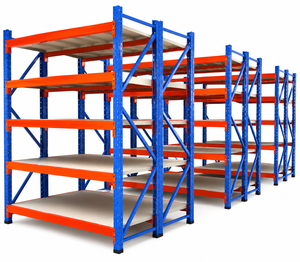
Multi-Tier 3-5 Layer Heavy-Duty Extra-Strong Load-Bearing Industrial Steel Storage Racks
- Steel Grade: High-Tensile Q235B
- Layer Capacity: 800–2,500 kg/tier
- Finish: Electrostatic Powder Coat
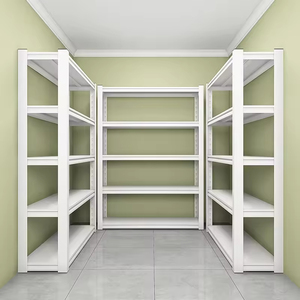
2000*500*2000mm Warehouse Racking Lightweight 100kg/layer Load Metal Assembled Storage Racking
- Modular Boltless Interlocking
- Load: 100kg UDL per level
- Rapid Knock-Down Assembly
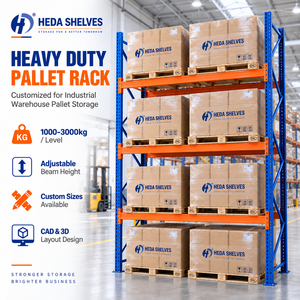
Heavy Duty Pallet Rack Industrial Warehouse Storage Racking System for High Load Storage
- 100% Direct Pallet Selectivity
- Beam Deflection: ≤ L/200
- Compatible with All Forklift Classes
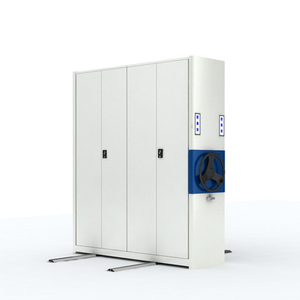
High Density Mobile Filing Shelving System Manual Compactor Movable Racking Compact Shelves
- Space Optimization: Up to +85%
- Low-Effort Mechanical Drive
- Anti-Tip & Gangway Central Locks
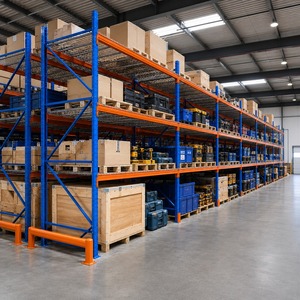
Factory Pallet Racks Industriales Steel Storage Rack Porta Paletes Q235B Steel for Logistics Hubs
- Certified Q235B Profiled Steel
- 5-Hook Precision Beam Connectors
- Logistics Hub High-Turnover Ready
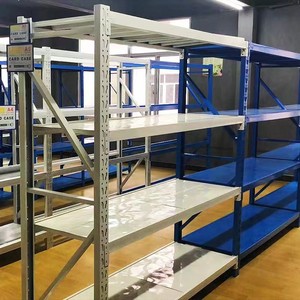
Warehouse Rack Stacking Rack Pallet Racking Garage Metal Storage Rack
- Nestable Post Stacking Pallet
- Dynamic Block Stacking 4-High
- Bulk Seasonal Buffer Solution
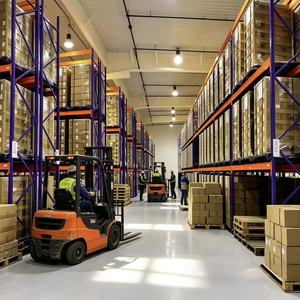
Drive-in Racking System High Density Warehouse Storage Rack Custom Industrial Heavy Duty Metal Rack
- High-Density LIFO Configuration
- Cold Chain & Batch SKU Design
- Heavy-Duty Continuous Pallet Rails
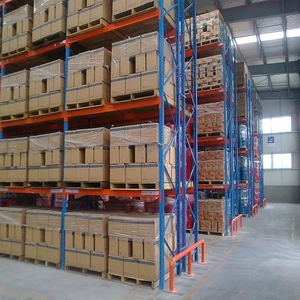
Heavy Duty 5-Layer High-Capacity Drive-In Selective Warehouse Storage Pallet Rack Anti-Rust ISO
- Hybrid Selective/Drive-In Matrix
- 5-Tier Vertical Expansion
- ISO 9001 Corrosion Resistance
Guangzhou HEDA Shelves: 25 Years of Heavy-Duty Structural Innovation
Founded in 2001, Guangzhou Heda Shelves Co., Ltd. operates an advanced 30,000 m² smart manufacturing base, providing worldwide wholesale buyers, logistics contractors, and regional distributors with certified storage infrastructure.
Industrial Manufacturing Capabilities & Structural Integrity
Operating across modern, fully automated steel production corridors in South China, HEDA Shelves maintains absolute in-house oversight of every manufacturing stage. From direct slitting and continuous precision roll-forming of high-yield coil steel (certified Q235B and Q355B grades) to multi-axis CNC punching and automated robotic CO2-shielded welding, our processes are certified under ISO 9001:2015 (Certificate No. 18624Q00169R0M) and carry direct CE compliance (Certificate No. 2435-CPR-8605159).
Unlike trading intermediaries, our factory engineering department conducts complete structural finite element calculations (FEA) for all international wholesale orders. We integrate client-specific seismic ground motion parameters (addressing seismic codes such as Chile's NCh 2369 / NCh 433, Peru's E.030, Colombia's NSR-10, European EN 16681, and North American RMI MH16.1). Baseplate geometries, anchor bolt tensile tolerances, column punch spacing (50mm/75mm increments), and diagonal bracing cross-sections are matched to site-specific dynamic loading realities.
Anatomy of Industrial Selective Pallet Racking Systems
A rigorous review of cold-formed steel engineering, structural stability limits, deflection tolerances, and seismic baseplate design for high-bay warehousing.
1. Structural Mechanics and Cold-Formed Steel Science
Selective pallet racking is the global benchmark for multi-SKU storage facilities, characterized by providing 100% immediate selectivity to every individual pallet bay without requiring double-handling or load consolidation. However, operating safely at working heights from 3 meters to beyond 14 meters demands uncompromising metallurgical discipline. At HEDA Shelves, upright frames are manufactured utilizing closed-loop continuous cold-roll forming lines from primary hot-rolled coil steel.
The critical element of the selective frame is the Omega (Ω) profile upright. Featuring a minimum of 11 to 13 strategic bends along the cross-section, the profile achieves high second moments of area ($I_x, I_y$) and torsional rigidity while reducing self-weight. Column profiles range from 80mm × 60mm × 1.8mm for standard light-to-medium pallet duties, up to 120mm × 95mm × 2.5mm/3.0mm heavy-duty configurations designed to sustain axial frame loads exceeding 25,000 kg.
Beams are engineered as dual-C interlocking step beams or continuous box beams welded to multi-tooth heavy-gauge connector claws (brackets). By utilizing a 4-hook or 5-hook bracket arrangement, bending moment redistribution across the beam-column joint is enhanced, elevating rotational stiffness ($C_d$). This joint rigidity is essential for ensuring frame stability under transient lateral forces, such as forklift docking impacts or low-frequency ground oscillations.
| Structural Parameter | Standard Duty Specification | Heavy-Duty Industrial Grade | Extreme / Seismic Reinforced |
|---|---|---|---|
| Raw Material Specification | Certified Q235B Structural Carbon Steel | Certified Q235B / Q355B Low-Alloy | High-Yield Q355B (Yield Strength ≥ 355 MPa) |
| Upright Column Dimensions | 80mm × 60mm × 1.8mm / 2.0mm | 90mm × 70mm × 2.0mm / 2.3mm | 100/120mm × 70/95mm × 2.5mm / 3.0mm |
| Beam Cross-Section Style | Interlocking Twin-C Box (80 × 50mm) | Heavy Step Beam (100–120 × 50mm) | Heavy Box Profile (140–160 × 50 × 2.0mm) |
| Maximum Working Bay Load | Up to 1,500 kg per tier (UDL) | Up to 3,000 kg per tier (UDL) | Up to 4,500 kg per tier (UDL) |
| Vertical Deflection Limit | $\le L / 200$ under full test load | $\le L / 200$ strictly verified | $\le L / 250$ for automated integration |
| Surface Protection Protocol | Pickling + Phosphating + Powder (60-80μm) | 10-Stage Electrostatic Coating (80-100μm) | Hot-Dip Galvanized (HDG) / Marine Powder |
2. Surface Chemistry: 10-Stage Anti-Corrosion Treatment
Premature steel degradation due to ambient humidity, coastal salinity, or condensation in cold storage environments represents a leading cause of racking failure worldwide. HEDA Shelves rejects simplified single-dip painting methods in favor of a closed-loop 10-stage pre-treatment and electrostatic thermoset powder-coating matrix:
Degreasing & Acid Pickling
Hot alkaline cleaning followed by multi-tank acid pickling to eliminate rolling scale, oil residues, and iron oxidation.
Neutralization & Water Rinse
Cascading dual-stage demineralized water washing prevents ionic dragover and readies the steel surface for conversion coating.
Zinc Phosphating Conversion
Micro-crystalline zinc-iron phosphate layer crystallization converts steel surfaces into a dense, non-conductive bonding foundation.
High-Temp Dehydration
Passing through an automated convection drying oven at 140°C–160°C ensures zero moisture entrapment prior to powder application.
Electrostatic Powder Deposition
Robotic reciprocator spray guns deposit high-grade polyester-epoxy powders at 60–90 kV, achieving uniform 70–110 micron film thickness.
Thermosetting Polymer Curing
Cross-linking curing at 180°C–200°C for 25 minutes yields extreme surface hardness (≥ 2H), zero pinholing, and high impact resistance.
Macro Purchasing Trends Shaping Global Racking Supply (2025–2030)
Navigating landed cost analysis, structural compliance, containerized logistics, and material optimization when sourcing direct from China tier-1 factories.
Total Landed Cost (TLC) Modeling
Procurement directors are shifting focus away from ex-factory base price to comprehensive landed cost calculations. By designing beam profiles and upright lengths that nest into standard 40ft High Cube (HQ) shipping containers, HEDA Shelves optimizes container cubic fill rates above 92%, saving between $18 and $35 per pallet position on transoceanic routes.
Freight OptimizationSeismic Code Compliance Verification
Third-party insurance underwriters and municipal building authorities increasingly require site-specific structural verification before warehouse occupancy permits are granted. Direct Chinese manufacturers must deliver verifiable FEA reports compliant with European EN 15512 or Chilean NCh 2369, complete with engineer-stamped calculation dossiers.
Risk MitigationHigher Steel Grades (Q355B vs. Q235B)
The transition toward cold-formed micro-alloy steels (Q355B with yield strength $\ge 355 \text{ MPa}$) allows a 12% to 18% reduction in structural deadweight without sacrificing total carrying capacity. This reduction decreases raw material consumption, eases installation handling, and minimizes seismic mass accelerations during tremor events.
Material ScienceFuture-Proof Storage: Automation, AMRs, and Digital Twins
Selective pallet racking is evolving from passive steel shelving into an integrated component of automated, sensor-monitored, and software-synchronized logistics hubs.
AMR & AGV Floor Clearance Integration
With the rise of Autonomous Mobile Robots (AMRs) operating underneath bottom pallets, modern selective racking incorporates elevated bottom beam levels or cantilevered ground guide brackets. This clearance enables under-pallet tunnel traversal, dynamic optical QR barcode scanning on floor surfaces, and automated drop-and-swap workflows.
IoT Structural Health Monitoring
Next-generation mega distribution centers integrate digital deflection sensors and tri-axial impact monitoring transponders directly onto high-risk upright bases. When an accidental forklift strike exceeds safety thresholds, immediate alerts are transmitted to maintenance teams via WMS dashboards, preventing catastrophic progressive collapses.
BIM (Revit) & Digital Twin Design
Standard 2D drawings are being replaced by native Building Information Modeling (BIM) components. HEDA Shelves provides engineering clients with fully parametric 3D CAD/Revit models, allowing MEP clashes (fire sprinklers, HVAC ducting, structural columns) to be identified and eliminated prior to factory roll-forming.
Frequently Asked Questions: B2B Wholesale & Direct Factory Supply
Clear, technical, and commercial answers for project managers, supply chain directors, and commercial racking importers.
How do you ensure pallet rack safety during seismic events?
Our engineering team performs dynamic response spectrum analysis according to your local site seismic acceleration coefficients ($S_s, S_1$). We configure heavier baseplate profiles (up to 12mm thick), high-embedment anchor studs (such as M12/M16 chemical or mechanical wedge anchors), enhanced diagonal bracing ratios, and reinforced upright section thicknesses to absorb and dissipate lateral ground motion.
What is your typical production lead time for full container orders?
Supported by a continuous monthly production volume of 30,000 tons, standard 40ft HQ container orders (approx. 20–22 tons of finished steel) are fabricated within 14 to 21 working days after final CAD approval. Large projects (5,000 to 20,000 pallet positions) are produced in phased batches to align with construction timelines and ocean container shipping schedules.
What packaging protocols are used to avoid ocean transit damage?
Upright frames and beams are nested with high-density corrugated padding, corner edge protectors, and secured using heavy-duty polyester strapping to eliminate metal-on-metal abrasion. Small accessories (safety pins, footplates, bolts) are packed in reinforced, palletized wooden crates. Every container is systematically floor-blocked and cross-braced to prevent load shifts at sea.
What essential information is required to generate a 3D CAD layout?
To produce an optimized CAD layout and structural quotation within 24 hours, our engineers require: (1) Warehouse architectural drawings indicating clear ceiling height and obstacle locations; (2) Pallet dimensions (Length × Width × Height including product overhang); (3) Gross weight per pallet; (4) Forklift model, mast collapsed height, and maximum lift reach.
Can your factory supply custom RAL colors for distributor OEM orders?
Yes. We offer complete OEM customization. While industrial orange (RAL 2004) for beams and gentian blue (RAL 5010) for uprights are standard, our dual automated powder-coating lines accommodate any specific RAL shade, metallic finish, or custom client branding requirements with zero impact on production throughput.
How do you support overseas installation and assembly?
Each container shipment is accompanied by detailed assembly manuals, piece-marked component maps, and high-resolution 3D step-by-step schematics. Furthermore, our senior bilingual engineering support team provides remote live-video installation audits or on-site supervisor dispatch for complex mega-projects.
Accelerate Your Warehouse Capacity with Direct Factory Pricing
Connect directly with HEDA Shelves structural engineers. Request your comprehensive selective racking catalog, detailed technical specifications, and a free 3D warehouse layout calculation.