Factory-Engineered Industrial Pallet Racks & Storage Systems
Explore our certified range of high-capacity warehouse racking frameworks, precision roll-formed teardrop assemblies, and automated dense storage platforms manufactured to global structural safety thresholds.
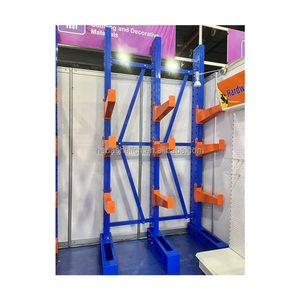
Wholesale Industrial Shelves Storage Racks Double Sided Heavy Duty Cantilever Racking System Cantilever Racks
Custom-profile cantilever racking engineered for non-palletized inventory including steel pipes, structural timber, extrusion profiles, and sheet packs.
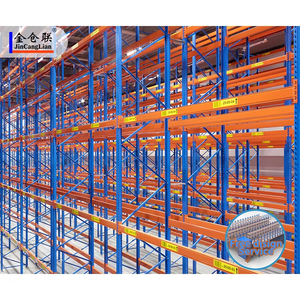
JCL Rack Logistics Selective Steel Pallet Rack Warehouse Shelves Heavy Duty Vna 5 Layer Corrosion Protection ISO9001/CE
Standard 2-inch pitch teardrop profile delivering immediate accessibility for high-throughput distribution hubs, logistics 3PL facilities, and multi-tier picking towers.
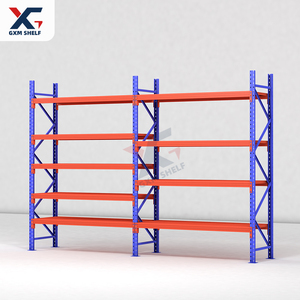
Heavy Duty Pallet Racking Heavy Duty Warehouse Racks Pallet Storage Rack System Pallet Shelving Industrial Rack
Reinforced roll-formed upright frames fitted with heavy-duty box/step beams and automatic spring-loaded lock safety pins for industrial bulk cargo handling.
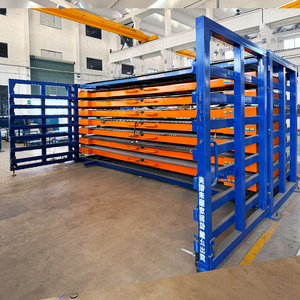
Industrial Steel Sheet Storage Rack with Roll-Out Shelves for Metalworking Shop, Factory Warehouse
Specialized mechanical roll-out drawer system designed for CNC laser cutting facilities and heavy fabrication shops requiring overhead crane retrieval.
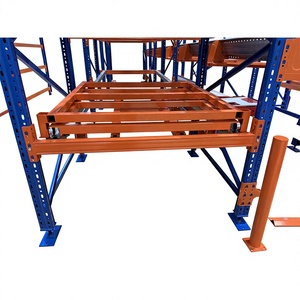
Factory Industrial Push Back Rack For Storage LIFO Rack Warehouse Racking System
Nested inclined carriage carts rolling on structural steel channels, providing high-density cubic storage while maintaining individual lane selectivity.
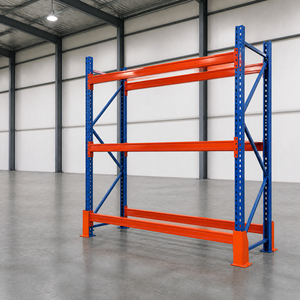
Warehouse Storage Rack 4000kg High Density Pallet Racking Maximize Space Free 3D Design for Logistics
Engineered high-bay storage configuration with calculated seismic base plates and diagonal structural bracing optimized for FMCG and retail fulfillment centers.
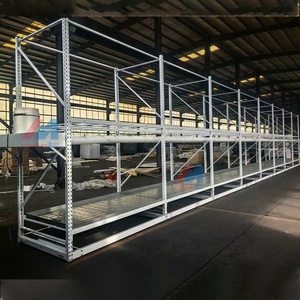
Commercial Grow Rack with Waterproof Shelves
Multi-tier vertical agricultural shelving featuring food-grade powder coatings or hot-dip galvanization with drainage-ready containment surfaces.
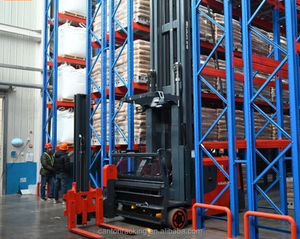
Very Narrow Aisle Racking Is Similar to Standard Rackingsystem Design, but the Aisles Are Minimized to Maximize Storage Capacity
High-tolerance narrow aisle construction paired with floor-mounted wire or mechanical guide rails, scaling warehouse usable cubic volume up by 45%.
Engineering Architecture of the Teardrop Pallet Rack System
Why the universal teardrop punch design remains the cornerstone of North and South American warehouse intralogistics, and how precision cold-forming engineering ensures operational longevity.
The teardrop pallet rack system is globally recognized as the most versatile, cost-effective, and operationally reliable selective racking configuration in modern distribution centers. Originating in the North American industrial landscape and codified under Rack Manufacturers Institute (RMI) ANSI MH16.1 specifications, the teardrop connection features a signature inverted conical punch slot punched precisely along the front face of vertical upright columns at standard 2-inch (50.8 mm) vertical increments.
Unlike legacy slotted, bolted, or hook-lug systems, the teardrop mechanism operates on an engineered gravity-wedging principle. The beam end connector features tapered industrial pins (rivets) that slide downward into the narrower throat of the teardrop punch. As vertical load from palletized merchandise is applied to the horizontal step beam, the downward gravitational force physically wedges the connector tighter against the cold-rolled column face. This self-tightening connection eliminates longitudinal play, resists horizontal frame deflection, and simplifies reconfigurability without requiring special impact tooling or mechanical hardware.
Metallurgical Quality and Structural Yield Strength (Q235B vs. Q355B / ASTM A1011)
Structural reliability begins at the molecular level. High-volume export manufacturing requires certified, mill-tested steel coils. Our manufacturing facilities utilize high-tensile Q235B (yield strength $F_y \ge 235 \text{ MPa}$) and Q355B (yield strength $F_y \ge 355 \text{ MPa}$, equivalent to ASTM A572 Grade 50) cold-rolled structural steel coils. The material chemistry is strictly monitored for phosphorus and sulfur content to avoid post-weld embrittlement, especially when racking is deployed in sub-zero cold-chain cold stores (-30°C).
Frame columns are manufactured via continuous 20- to 24-station automated roll-forming mills. By cold-forming the steel strip gradually through sequential sets of roller dies, residual stress concentrations are minimized, yielding an upright column with multi-ribbed returns that drastically boost the radius of gyration ($r$) and critical buckling stress thresholds ($F_{cr}$) under full axial compressive loading.
| Engineering Attribute | Standard Roll-Formed Teardrop Rack | Heavy-Duty Structural C-Channel Rack | HEDA High-Tensile Teardrop Hybrid |
|---|---|---|---|
| Hole Punch Pattern | 2-inch (50.8mm) Inverted Teardrop Pitch | Bolted Structural Holes (2" to 4" pitch) | Universal 2-inch RMI Universal Teardrop |
| Steel Grade Specification | ASTM A1011 / Q235B Cold-Rolled | ASTM A36 Hot-Rolled Structural C-Channel | Q355B High-Yield Cold-Rolled Carbon Steel |
| Beam Connection Type | Tool-less 3 or 4-Pin Gravity Drop Wedge | Grade 5 Structural Bolts and Flange Nuts | High-Shear Rivets + Spring Safety Plungers |
| Beam Deflection Threshold | $L/180$ Maximum per RMI ANSI MH16.1 | $L/240$ Maximum per AISC Manual | Engineered $L/200$ Structural Redundancy |
| Reconfiguration Speed | Fast (~2 mins/level) | Slow (Requires pneumatic unbolting) | Tool-less Instant Adjustment |
| Impact Resistance (Forklift) | Moderate (Requires Post Protectors) | Extremely High (Thick structural web) | High (Reinforced internal column stiffeners) |
| Freight & Tare Weight Ratio | High Efficiency (Optimized container cube) | Heavy (Substantially higher ocean freight) | Optimized Load-to-Weight Strength Metric |
Beam Design Dynamics: Step Beams vs. Box Beams in Pallet Support
A critical consideration during teardrop procurement is the cross-sectional geometry of the horizontal beams. Step beams feature an indented internal ledge (commonly 1-5/8 inches or 41.3 mm) specifically engineered to cradle drop-in wire mesh decking panels, corrugated steel panels, or drop-in cross ties flush with the top surface of the beam. This configuration creates a snag-free loading plane that prevents pallet boards from catching during forklift insertion or retrieval.
For heavy industrial applications where concentrated point loads or specialized slip-sheets are used, closed box beams roll-formed from dual interlocking C-sections continuously seam-welded provide superior torsional resistance against eccentric beam twisting. Every connector end-piece is equipped with automated factory-fitted safety lock pins that withstand up to 1,000 lbs (4.45 kN) of accidental upward forklift uplift force without dislodging, meeting OSHA and RMI safety mandates.
Direct Factory Capabilities & Export Infrastructure
Backed by over two decades of high-capacity steel fabrication, Guangzhou Heda Shelves Co., Ltd. delivers engineered racking direct from our 30,000 m² automated production facility to global distribution hubs.
CE & ISO 9001 Certified Quality
Production operates under strictly audited ISO 9001:2015 (Cert No. 18624Q00169R0M) and structural European CE Certification (Cert No. 2435-CPR-8605159), satisfying stringent third-party insurance audits and government building codes worldwide.
30,000 Ton Monthly Output
Operating high-speed continuous punching arrays, automated cold-forming roll lines, and dual-track electrostatic powder coating ovens to fulfill large distribution center rollouts (100+ shipping containers) on guaranteed timelines.
Free 3D Layout & Seismic Design
Our 30+ full-time structural engineering department supplies complimentary CAD drawings, 3D photorealistic architectural renderings, and structural dynamic calculation reports tailored to local seismic zones (ASCE 7, NSR-10, E.030).
Optimized Container Load Planning
Pre-engineered nesting bundles and computer-modeled FEU container packing plans maximize volume and weight allowances, preventing transit rubbing scratches, reducing ocean freight costs per pallet position by up to 28%.
10-Stage Quality-Controlled Manufacturing Protocol
Chemical composition analysis and thickness caliper verification on all incoming Q235B/Q355B coils.
Automated precision leveling to eliminate coil camber and mechanical surface stress before punching.
Continuous hydraulic die punching achieving ±0.1mm dimensional precision across 2-inch teardrop spacing.
Progressive 24-pass roll lines shaping column ribs, returns, and structural flanges with zero cracking.
High-speed flying shear cutoff guaranteeing clean burr-free upright and beam ends to exact project lengths.
CO2 shielded multi-axis robotic welders joining end connectors to step beams with full root penetration.
Immersion degreasing, acid rust descaling, and nano-zirconium silane phosphating for maximum paint adhesion.
Automatic reciprocating spray guns applying heavy-duty thermosetting polyester powder coating (60–80 μm).
200°C convection baking ensuring uniform cross-linking polymer cure, high impact resilience, and scratch resistance.
Cross-hatch adhesion testing, load deflection validation, and protective edge board bundling for containerization.
Future Procurement Trends in Industrial Pallet Racking (2025–2030)
Strategic market shifts are redefining warehouse storage procurement. Understand the key micro- and macro-economic factors influencing international logistics infrastructure planning.
1. AMR & Robotic Automation Symbiosis
Traditional selective racking is transitioning toward AMR (Autonomous Mobile Robot) compatibility. Buyers are procuring teardrop structures featuring heightened bottom clearance levels, flush floor plates, and laser-guided navigation targets integrated directly into the upright profile frames to facilitate hybrid human-robot replenishment workflows.
2. Seismic Resiliency & Stringent Building Codes
Municipal zoning authorities across seismic belts (Pacific Rim, Latin America, Western US) are enforcing strict verification under updated building codes. Procurement focuses on upgraded wide-flange seismic footplates, high-ductility anchor stud embeds, and dynamic Finite Element Analysis (FEA) computer simulations submitted prior to factory fabrication.
3. Accelerated Cold-Chain & Humidity Protection
With pharmaceutical and perishable agro-export booms, buyers are shifting away from standard indoor coatings in humid environments. The demand for continuous hot-dip galvanized (HDG) steel components and specialized zinc-rich anti-corrosion barrier coatings capable of withstanding constant thermal cycling (-30°C to ambient) has risen sharply.
4. Supply Chain Nearshoring & Interoperability
As global logistics operators establish multi-country fulfillment hubs, cross-brand compatibility has become a core procurement requirement. Universal teardrop systems that mate seamlessly with legacy North American inventories without proprietary connector constraints reduce asset obsolescence and elevate resale equipment valuation.
Standard Dimensioning & Upright Capacity Calculations
Accurate structural sizing guarantees regulatory compliance and mitigates warehouse catastrophe risks. Use this engineering guide to establish project design criteria.
Upright Frame Depth & Height
Standard 40" x 48" GMA pallets require a 42-inch deep frame to maintain a safe 3-inch overhang on the front and rear step beams. Frame heights are determined by taking building clear height, subtracting minimum 18-inch ESFR sprinkler clearances, and factoring in forklift mast maximum staging thresholds.
Beam Length & Deflection
A standard two-pallet bay utilizes 96-inch (8 ft) or 108-inch (9 ft) beam spans. Beam profile depths (3.5", 4.0", 4.5", 5.0", 5.5", 6.0") are selected such that under full design payload, the maximum vertical center deflection ($\delta$) never exceeds $\frac{L}{180}$ of total beam length ($0.53"$ on a 96" span).
Aisle Spacing & Flue Spaces
Selective counter-balance forklift aisles require 12 to 13 feet of clear aisle, whereas Reach Trucks operate efficiently in 9.5 to 10.5 feet. Very Narrow Aisle (VNA) designs reduce aisle width down to 5.5 to 6 feet. Standard NFPA 13 building fire codes mandate longitudinal flue spaces of 6 inches between back-to-back rack runs.
Critical Safety Accessories for Heavy-Duty Teardrop Installations
A turnkey racking system comprises more than uprights and horizontal beams. For maximum lifecycle reliability and compliance with OSHA and international safety inspections, integrate these engineered accessories:
Welded steel wire decks (3 or 4-channel support) providing fall-through protection for broken pallets and water penetration for ceiling sprinklers.
Floor-anchored heavy structural steel wraps that absorb low-speed forklift outrigger collisions at critical aisle intersections.
Rigid structural bolting connectors that link back-to-back racking rows, maintaining uniform flue spacing and stabilizing high slenderness ratios.
Pre-galvanized or painted bottom support cross rails designed for irregular or un-palletized point-load wooden bins and plastic totes.
Frequently Asked Questions for Wholesale Racking Buyers
Detailed technical, logistics, and quality assurance answers addressing high-volume racking manufacturing, container shipping, and regulatory verification.
FAQ 01 Are your teardrop pallet racks 100% compatible with North American brands?
Yes. Our standard teardrop tooling conforms rigorously to universal North American teardrop specifications with a 2-inch vertical adjustment pitch. Our beams and upright columns can be interconnected seamlessly with major brands including Interlake Mecalux, Ridg-U-Rak, Speedrack, SpaceRak, and Hannibal, allowing seamless facility expansion and component replacement without proprietary compatibility hurdles.
FAQ 02 What steel certifications and structural test reports accompany each shipment?
Every production batch includes complete Mill Test Certificates (MTC) documenting chemical analysis (C, Mn, Si, P, S) and mechanical yield, tensile, and elongation values. In addition, we supply European CE compliance declarations (EN 15512 / EN 15620) and factory ISO 9001:2015 tracking documentation. Third-party testing by SGS or Bureau Veritas can be coordinated upon request prior to container dispatch.
FAQ 03 How do you optimize ocean container packing to prevent finish damage?
Racking components are heavy and bulky, creating unique shipping challenges. Upright frames are nested with corrugated edge-protectors, plastic wrap separators, and heavy-duty steel strapping. Beams are stacked face-to-face on solid dunnage runners. We utilize custom loading software to balance container gross weight limits (typically 26–27 metric tons per 40ft HQ) against cubic volume, protecting the electrostatic powder coat from shipping scuffs.
FAQ 04 Can your engineering team calculate custom seismic racking parameters?
Yes. We possess dedicated structural engineering capabilities equipped with advanced FEA (Finite Element Analysis) simulation software. When supplied with your project location, site soil class, and local ground acceleration coefficients ($S_s, S_1$), we calculate baseplate surface dimensions, anchor bolt diameters, column gauge thicknesses, and diagonal frame bracing patterns to satisfy IBC, ASCE 7, or Latin American seismic standards (such as NCh 2369 or NSR-10).
FAQ 05 What is the standard factory lead time for wholesale high-volume orders?
With our 30,000 ton monthly capacity and automated production lines, standard teardrop selective orders ranging from 2 to 10 full container loads (FCL) require approximately 15 to 25 business days following technical drawing and color approval. Large-scale distribution projects (50+ containers) are staged in scheduled staggered manufacturing batches to align precisely with your warehouse civil construction and slab curing schedules.
FAQ 06 How does electrostatic powder coating compare to hot-dip galvanizing for cold storage?
Our standard automated electrostatic polyester powder coat (60–80 microns) is baked at 200°C, providing exceptional durability and scratch resistance in standard ambient or temperature-controlled facilities down to -10°C. For deep sub-zero cold stores (-30°C), coastal salt-air warehouses, or high-condensation vertical farming rooms, we recommend our hot-dip galvanized (HDG) finish or specialized epoxy-zinc primers which deliver permanent rust barrier protection.
FAQ 07 What information is required to receive a turnkey 3D warehouse layout?
To prepare a complimentary layout, our engineers require: (1) Warehouse CAD floor plan showing building column grids, dock doors, and obstruction points; (2) Building clear ceiling height; (3) Pallet dimensions (W x D x H) including goods overhang and gross weight per pallet; (4) Forklift specifications including model, turning radius, and maximum reach height; and (5) Project location for seismic validation.
FAQ 08 Do you support private-label OEM manufacturing for regional racking distributors?
Yes. We act as an OEM/ODM manufacturing partner for dozens of material handling equipment distributors, system integrators, and rack dealers across North America, Europe, Australia, and Latin America. We support customized punch patterns, private label embossing, bespoke RAL color powder-coating matching, customer-branded instruction manuals, and customized export bundling labels.
Ready to Engineer Your Warehouse Racking Infrastructure?
Consult directly with our structural engineering team in Guangzhou. We provide certified structural calculations, customized 3D CAD facility floorplans, and competitive factory-direct wholesale pricing within 24 business hours.