Architectural Specification & Global Procurement Guide for Pallet Racking Systems
Modern intralogistics ecosystems are undergoing radical operational transformations. As logistics square-meter costs escalate and supply chains compress handling cycles, the role of modern custom OEM pallet racking industrial systems shifts from passive warehouse fixtures to structural, load-bearing assets directly interfaced with autonomous material handling mechanisms. Sourcing industrial pallet racking systems on an international scale requires calculating mechanical ductility, dynamic stress distributions, seismic resilience tolerances, and long-term surface passivation against chemical degradation.
1. Structural Steel Metallurgy & Cold-Formed Engineering Standards
The durability of an industrial racking infrastructure depends on the metallurgical integrity of its raw steel coils. High-grade systems utilize certified Q235B and Q355B low-carbon micro-alloyed structural steels, characterized by yield strengths ranging between 235 MPa and 355 MPa, with minimum elongation properties exceeding 21% to ensure controlled plastic deformation under seismic acceleration.
Cold roll-forming lines punch and bend upright profiles through progressive roll stages, preventing micro-fractures along bend radiuses. Column profiles engineered with 55mm to 75mm continuous pitch hole patterns feature multi-flange return stiffeners, reducing buckling tendencies under severe vertical axial loads. Boxed step beams, formed via continuous automated seam-welding of interlocking C-profiles, yield superior resistance to lateral-torsional buckling when paired with structural connector brackets featuring 3 to 5 multi-point locking pins.
| Racking Topology | Access Ratio | Aisle Width Standard | Volumetric Efficiency | Optimum Operational Profile |
|---|---|---|---|---|
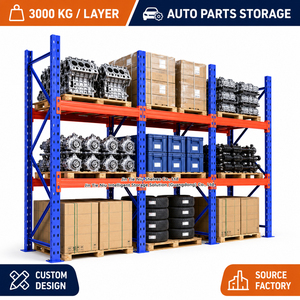
| Selective Pallet Racking | 100% Direct Picking | 3.2m – 3.8m (Counterbalance) | 40% – 45% Cube Density | High-SKU diversity, dynamic fulfillment hubs |
| Very Narrow Aisle (VNA) | 100% Direct Picking | 1.6m – 1.9m (Turret Truck) | 60% – 68% Cube Density | High vertical ceiling clearance, high-value SKUs |
| Drive-In / Drive-Through | Last-In First-Out (LIFO) | Internal Rail Lanes | 70% – 75% Cube Density | Uniform product batches, cold-chain storage |
| Radio Shuttle Automation | FIFO or LIFO Configurable | Consolidated Main Aisle | 80% – 85% Cube Density | High-throughput FMCG, automated buffer bays |
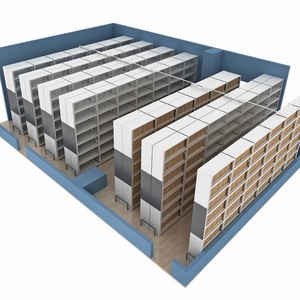
| Multi-Tier Mezzanine | Integrated Walkways | 0.9m – 1.2m Picking Paths | 90%+ Footprint Multiplication | E-commerce split-case order picking, assembly |
2. Surface Passivation & Heavy-Duty Powder Coating Protocols
Corrosion represents the primary vector of structural fatigue across maritime distributions, chemical facilities, and sub-zero refrigerated environments. Our manufacturing process enforces a rigorous multi-stage chemical pretreatment: full alkaline degreasing, ultrasonic water rinsing, acid pickling, and hot manganese-zinc phosphating. This establishes a micro-crystalline barrier providing optimal substrate adhesion for automated electrostatic powder deposition.
Finished with lead-free, RoHS-compliant thermoset epoxy-polyester coatings baked at 180°C–200°C, our upright frames and load beams maintain a dry film thickness (DFT) between 60 to 90 microns. This finish passes continuous neutral salt spray tests exceeding 500 hours without edge peel or blistering. For sub-zero cold chain deployments (-30°C) or highly corrosive marine atmospheres, hot-dip galvanization to EN ISO 1461 standards delivers an alloyed zinc-iron protective envelope exceeding 70 microns, eliminating maintenance cycles across multi-decade operating horizons.