Precision-Engineered Radio Shuttle Racking Systems
Compare our factory-direct radio shuttle pallet racking series. Manufactured with Q235B/Q355B structural steel, customized rail profiles, and German-calibrated optical sensors to meet both FIFO and LIFO automated handling requirements.
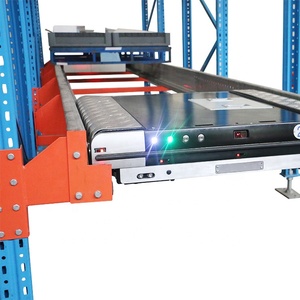
High Density Automated Warehouse Storage FIFO & FILO Pallet Radio Shuttle Racking System for Industrial Raw Material Storage
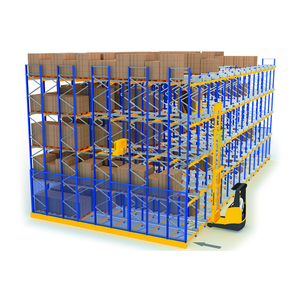
Durable Shuttle Heavy Duty Rack System Asrs 4-Way Shuttle Racking Automated Radio Shuttle Racking System for FIFO & LIFO
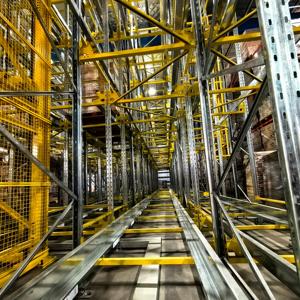
Jracking High-Load Warehouse Storage Rack CE Certified Four-Way Radio Shuttle Rack System for Cold Storage Warehouse Use
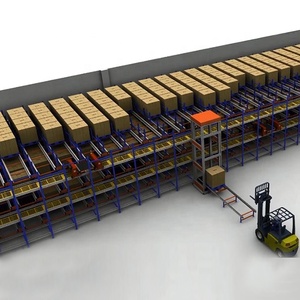
Automatic Radio Shuttle Rack System Heavy Duty Industrial Warehouse Storage Shelf Racking CE Certified
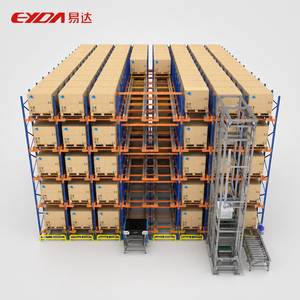
Custom Industrial Steel Adjustable Anti-Rust Radio Shuttle Racking System High Space Saving Shuttle Pallet Storage Rack
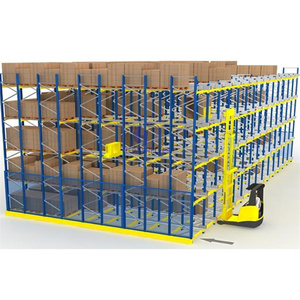
High-Density Shuttle Rack System Asrs 4-Way Shuttle Racking
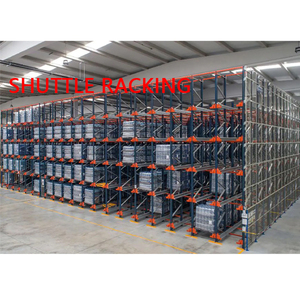
High-Density Ratio Shuttle Racks System Asrs 4 Way Shuttle Racking Radio Shuttle Pallet Rack
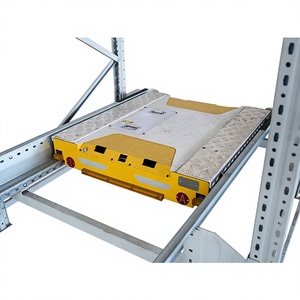
Pallet Shuttle Racking System Warehouse Rack Automatic 4-Way Shuttle Racking Four Way Cold Storage Shuttle Rack
System Architecture: High-Density Semi-Automated Physics & Mechanics
How structural cold-rolled steel profiling, multi-sensor shuttle telemetry, and seismic frame dissipation interact to deliver up to 85% volumetric utilization while driving forklift aisle traffic down to zero.
Cold-Rolled Structural Precision (Q235B & Q355B)
Our upright frames and guide rails are continuously roll-formed from certified high-tensile steel coils. Uprights feature an Omega (Ω) profile with multi-bend stiffening ribs, designed in strict compliance with EN 15512 and RMI ANSI MH16.1. Guide rails are manufactured with an integrated dual-flange lip that performs two simultaneous functions: supporting continuous pallet loads up to 1,500 kg per position and acting as an ultra-smooth running track for the radio shuttle cart wheels without structural deflection.
Ternary Lithium & LiFePO4 Energy Architecture
Each radio shuttle cart incorporates high-discharge Lithium Iron Phosphate (LiFePO4) or low-temperature ternary lithium battery packs with an integrated Battery Management System (BMS). Delivering 8 to 10 hours of continuous operations under heavy cycling, our shuttles feature dynamic regenerative braking to recuperate kinetic energy during decelerations. Fast magnetic charging terminals allow rapid swap-outs within 60 seconds or in-lane automated fast charging reaching 80% capacity in under 90 minutes.
Optical LIDAR & Safety Sensor Mesh
Operating autonomously inside tight racking tunnels requires fail-safe detection. Our shuttles are fitted with dual Sick/Banner photoelectric proximity sensors, ultrasonic pallet edge detectors, and mechanical anti-collision bumpers. If an obstruction, displaced pallet, or broken deckboard is detected within 300mm of travel, the shuttle performs an emergency closed-loop deceleration stop within ≤50mm, broadcasting a real-time fault signal to the wireless handheld tablet controller or central WMS console.
Radio Shuttle vs. Traditional Warehouse Racking Topologies
Compare space utilization metrics, equipment capital expenditure, pallet turnover velocity, and structural risk factors to make an informed engineering procurement decision.
| Evaluation Parameter | Semi-Automated Radio Shuttle | Drive-In Pallet Racking | Selective Pallet Racking | 4-Way Shuttle ASRS |
|---|---|---|---|---|
| Volumetric Space Utilization | 80% – 88% (Ultra High) | 65% – 72% (High) | 40% – 48% (Low) | 88% – 94% (Maximum) |
| Forklift Impact Damage Risk | Near Zero (Trucks stay in aisle) | Critical (Frequent upright collisions) | Moderate (Aisle driving) | Zero (Fully enclosed ASRS) |
| Throughput Velocity (Pallets/hr) | 35 – 50 Pallets / Truck Hour | 12 – 18 Pallets / Truck Hour | 20 – 25 Pallets / Truck Hour | 80 – 120+ Pallets / Hour (Automated) |
| Inventory Rotation Model | FIFO & LIFO Flexible Switching | Strictly LIFO Only | 100% Random Access FIFO | Fully Dynamic FIFO / LIFO Matrix |
| Channel Lane Depth Potential | Up to 40 Pallets Deep | Max 6 – 10 Pallets Deep (Safety limit) | Single or Double-Deep (1-2 Pallets) | Unlimited Multi-Deep Grid |
| Cold Storage Energy Efficiency | Superior (Compresses cube volume) | Average (High air leakage) | Poor (Large heated/cooled void volume) | Optimized (Unmanned dark warehouse) |
| Relative ROI Payback Cycle | 14 – 24 Months | 18 – 30 Months (High repair cost) | Benchmark Baseline | 30 – 48 Months (Higher CapEx) |
Future Procurement & Technological Evolution Trends
Warehouse automation is experiencing rapid disruption. Enterprise procurement directors must evaluate these four pivotal technology vectors before finalizing structural racking specifications.
1. The Shift from 2-Way Semi-Automation to Omnidirectional 4-Way Swarms
While traditional 2-way radio shuttles remain the gold standard for high-volume, low-SKU raw materials, modern procurement is aggressively shifting toward 4-way multi-directional shuttle platforms. By decoupling horizontal channel movement from vertical hoist transfers, 4-way systems eliminate the need for forklift mast insertion entirely. Shuttles traverse longitudinal storage lanes, transverse cross-aisles, and vertical continuous hoists, orchestrating autonomous multi-level pallet redistributions during off-peak night shifts to optimize picking readiness for the following operational morning.
2. Wireless Mesh Telemetry, Industrial 5G & Edge WCS Integration
Legacy radio-frequency remotes with 433 MHz single-band control are rapidly being phased out in modern distribution centers. Contemporary shuttle fleets now deploy dual-band 2.4/5.8 GHz Wi-Fi 6 or private Industrial 5G roaming modules featuring sub-millisecond handover latency. Shuttle micro-controllers report millisecond-grade health metrics—including motor thermal gradient, brake wear, rail vibration irregularities, and individual battery cell impedance—directly to cloud Warehouse Control Systems (WCS) via MQTT and OPC UA protocols, unlocking predictive preventive maintenance.
3. Modular CapEx Phasing vs. Rigid Crane-Based Monolithic ASRS
Capital expenditure flexibility is a key driver in current industrial equipment tenders. Unlike heavy Stacker Crane ASRS installations that demand massive upfront civil capital, specialized concrete foundations, and total warehouse commitment, Radio Shuttle Racking enables elastic, modular scaling. Supply chain managers can install 100% of the steel racking superstructure during Year 1, while deploying only 4 to 6 shuttle carts to meet initial volume requirements. As operational throughput scales over subsequent quarters, additional shuttle carts are injected into the grid in plug-and-play fashion.
4. Deep-Freeze Decarbonization & Green Cold Storage Footprints
With industrial refrigeration representing up to 60% of total electrical consumption in food and cold-chain hubs, reducing refrigerated building volume is the single most effective path toward sustainability. High-density shuttle racking consolidates cold storage into an ultra-dense envelope, cutting thermal envelope losses by 35% to 50% compared to wide-aisle configurations. Furthermore, our cold-rated shuttle carriages utilize low-temperature lubricants, self-heating electronic chambers, and energy-scavenging braking drives that perform reliably down to -30°C without condensation failure.
Why Global Importers Partner with Our OEM Export Facility
Founded in 2001, Guangzhou Heda Shelves Co., Ltd. controls a complete in-house manufacturing apparatus designed to deliver turnkey, seismically certified racking systems with zero subcontractor variance.
30,000 m² Production Complex
Equipped with 12 high-precision automated continuous cold-roll forming lines, high-speed CNC punching presses, and multi-axis laser cutting units capable of producing 30,000 metric tons of certified warehouse racking per month.
Full CE & ISO 9001:2015 Audited
Rigorous quality control spanning raw steel spectral chemical verification, cold tensile yield testing, weld ultrasonic inspection, and dimensional laser gauge validation to ensure 100% compliance with CE Certificate No. 2435-CPR-8605159.
Free 3D CAD & Structural FEA Modeling
Our 30+ senior structural engineers provide full finite element analysis (FEA), load distribution simulations, clear warehouse CAD layouts, and realistic 3D spatial renderings within 24–48 hours of initial parameter submission.
Seismic Engineering for Global Codes
Tailored structural calculations engineered for active seismic regions worldwide, factoring in ground acceleration spectral data according to Chilean NCh 2369, Peruvian E.030, Colombian NSR-10, European Eurocode 8, and US RMI specifications.
10-Stage Surface Treatment Line
Components undergo acid pickling, multi-stage rinsing, zinc phosphating, and automatic electrostatic powder curing at 200°C. For aggressive coastal or sub-zero conditions, hot-dip galvanized steel uprights and rails provide lifelong anti-corrosion protection.
Direct Export Seaworthy Packaging
Load optimization utilizing custom steel dunnage, protective foam edge protectors, and vapor-barrier wrapping ensures 40ft HQ shipping containers achieve 98%+ volumetric packing without shipping transit abrasion or container moisture corrosion.
Frequently Asked Technical & Purchasing Questions
Critical technical insights addressing battery duty cycles, cold-room condensation, structural tolerances, pallet specifications, and international project execution.
1. What are the critical pallet dimensional and structural tolerances for radio shuttle channels?
2. How does the radio shuttle system operate inside low-temperature (-25°C to -30°C) cold storage?
3. What is the typical operational cycle life of the LiFePO4 batteries and charging downtime?
4. Can the system seamlessly switch between First-In, First-Out (FIFO) and First-In, Last-Out (FILO)?
5. What floor slab flatness and soil bearing capacities are required for tall shuttle racking?
6. How are replacement parts, firmware upgrades, and on-site technical maintenance handled overseas?
Accelerate Your Warehouse Automation Project Today
Connect directly with our senior structural and automation engineering department. Submit your warehouse architectural CAD drawing, pallet dimensions, and operational throughput targets to receive a comprehensive 3D spatial layout, structural calculation report, and factory-direct quotation.