Engineered Industrial Warehouse Racking & Shelving Systems
Direct-from-manufacturer heavy and medium-duty storage architectures fabricated from mill-certified cold-rolled steel. Each configuration accommodates custom bay clearances, beam cross-sections, seismic base plates, and powder-coat finishes tailored to commercial fulfillment centers and logistics hubs.
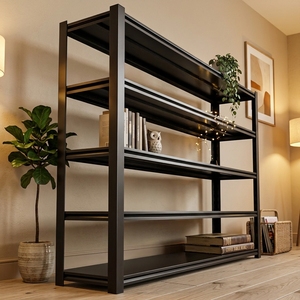
Multi Layer Steel Storage Shelf Boltless Assembly Metal Shelving Rack
Designed for rapid manual installation without hardware fasteners. Features concealed keyhole upright punchings and dual-layer reinforced steel deck panels.
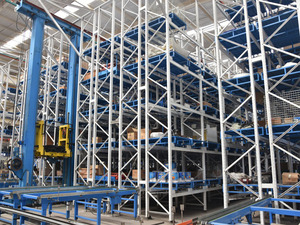
Heavy Duty Double Deep Steel Pallet Racking with Shuttle Drive-in
Ultra-dense pallet matrix integrated with radio shuttle rails, suitable for low-temperature food refrigeration down to -30°C and multi-deep SKU buffering.
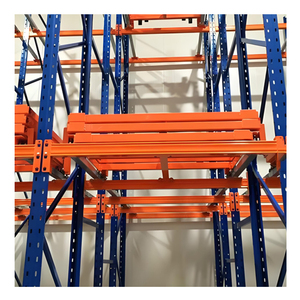
Gravity Push Back Roller Sliding Rack System with Corrosion Shield
High-throughput nested trolley tracks powered by gravity. Eliminates dedicated picker aisles and delivers single-aisle operational simplicity.
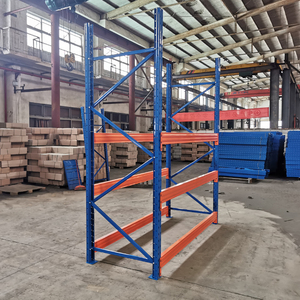
Selective Heavy Medium Duty Deep-Reach Pallet Rack System
Universal distribution racking enabling immediate access to every pallet bay. Adjustable 75mm/50mm pitch punchings with safety locking shear pins.
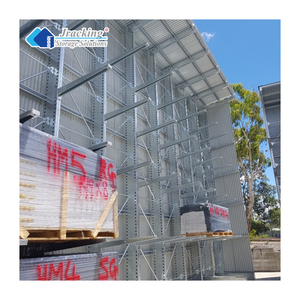
Industrial Cantilever Storage Racking for Long Pipe & Timber
Engineered for unhindered lateral loading of long bars, extrusions, and heavy sheet panels. Column arm pivots protect structural integrity against forklift impacts.
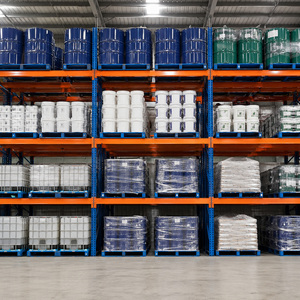
Industrial Heavy Duty Pallet Racking System for Auto Parts Logistics
Reinforced box-beam geometry with ribbed step decks, specifically fabricated to withstand point-load stresses from automotive dies, transmissions, and crates.
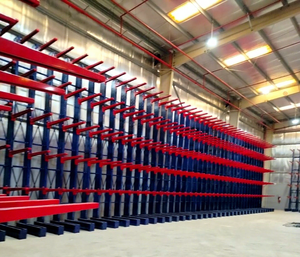
OEM Freight Warehousing Storage Shelving Heavy Duty Cantilever System
Built from heavy hot-rolled H-beam sections. Dual or single-sided columns paired with high-tensile connection brackets for heavy fabrication yards.
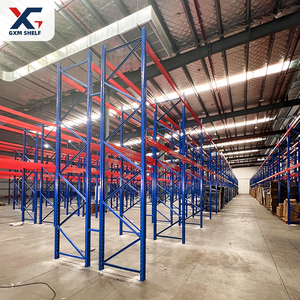
Heavy-Duty Stacking Selective Pallet Racking for Industrial Hubs
Optimized roll-formed omega upright posts paired with high-moment connector claws. Incorporates vertical diagonal truss bracing to absorb dynamic seismic lateral loads.
Structural Integrity & Cold-Formed Steel Metallurgy
Industrial warehouse racking requires meticulous adherence to structural mechanics. When engineering OEM rack profiles, material yield strength ($f_y$) and tensile strength ($f_u$) dictate load stability, beam deflection quotients, and life safety in automated distribution hubs.
Our manufacturing framework uses high-grade carbon structural steel certified under Chinese standard GB/T 700 (Q235B) and GB/T 1591 (Q355B), directly equivalent to international grades ASTM A36 / A572 Gr. 50 and European EN 10025 (S235JR / S355JR). Selecting the correct metallurgical specification protects distribution facilities from catastrophic progressive collapses caused by forklift impacts and dynamic pallet loading.
Through Finite Element Analysis (FEA) and cyclic push-over load testing, column profile geometries are optimized to maximize the radius of gyration ($r$), delivering superior torsional stiffness and resistance to local wall buckling under maximum axial compression.
| Mechanical Property | Standard Grade (Q235B) | High-Capacity Grade (Q355B) |
|---|---|---|
| Yield Strength ($R_eH$) | ≥ 235 MPa | ≥ 355 MPa (+51%) |
| Tensile Strength ($R_m$) | 370 – 500 MPa | 470 – 630 MPa |
| Elongation at Break ($A$) | ≥ 26 % | ≥ 22 % |
| Standard Application | Medium-Duty / Standard Pallet | High-Bay AS/RS, Cold Storage, Seismic |
| Applicable Design Codes | EN 15512, RMI MH16.1 | FEM 10.2.02, ASCE 7-22 |
* Every batch of hot-rolled coils undergoes spectrometer chemical analysis and raw tensile bench testing. Mill Test Certificates (MTC) according to EN 10204 Type 3.1 are provided with all export container manifests.
Calculated Structural Safety for High-Risk Environments
International logistics infrastructure demands strict compliance with regional seismic codes and corrosive microclimates. Our engineering team utilizes proprietary 3D layout simulation to calculate moment resistances, anchor shear, and deflection margins.
Seismic Force Dissipation
Engineered baseplate footings, high-ductility anchor embedments, and spine-bracing matrices customized for active seismic zones (e.g., Chile NCh 2369, Peru E.030, US ASCE 7).
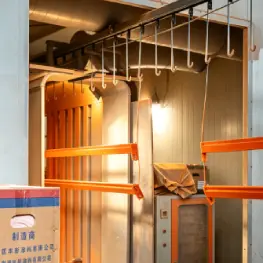
7-Stage Surface Pretreatment
Automated continuous acid pickling, ultrasonic degreasing, and silane/phosphate nano-passivation ensure corrosion resistance surpassing 500 hours of neutral salt spray (ASTM B117).
Thermoset Powder Coating
Electrostatic application of non-toxic, lead-free epoxy polyester powders. Cured at 180°C–200°C to achieve film thicknesses of 70–100 μm, providing scratch and impact durability.
Sub-Zero Hot-Dip Galvanizing
For coastal warehouses, chemical storage, and blast freezers, complete hot-dip zinc coatings (ISO 1461 / ASTM A123) deliver lifelong rust protection against high condensation.
Strategic Sourcing Trends in Warehouse Automation
Supply chain volatility and rising warehouse real estate costs are altering global industrial shelving procurement. Key purchasing shifts are driving modern OEM specifications:
1. Automation-Ready Tolerances
Traditional manual racks permitted millimeter-level installation variances. The rapid deployment of Autonomous Mobile Robots (AMRs) and AS/RS cranes requires tighter beam-level deflection ratios (≤ L/300) and strict plumb line tolerances under FEM 9.831.
2. Modular High-Cube Densification
Operators are verticalizing inventory to capture underutilized overhead cubic footage. Sourcing multi-tier rack-supported platforms and structural mezzanines yields double or triple the operational footprint without commercial footprint expansion.
3. Landed Cost Logistics Engineering
Global freight costs necessitate compact modular component design. Custom nesting of uprights, modular bolt-on connectors, and optimized packing algorithms ensure sea containers achieve >95% spatial utilization factor, lowering the per-bay freight tariff.
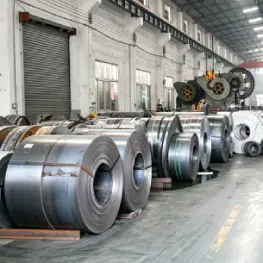
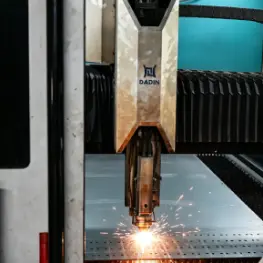
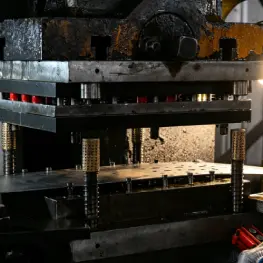
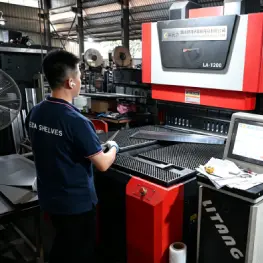
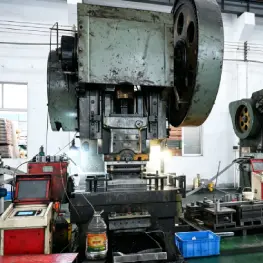
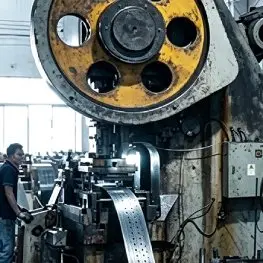
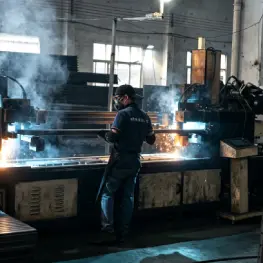
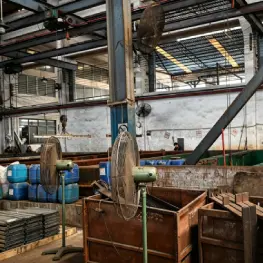
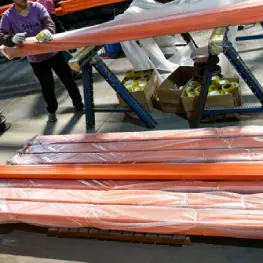
10-Stage Precision Manufacturing Process
From raw coil slitting to protective ocean export packing, our fully integrated production facility eliminates subcontracting risks, enforcing strict geometric tolerances across every component.
Frequently Asked Questions for B2B Racking Importers
Clear, technically detailed answers to common inquiries from procurement heads, project engineers, and supply chain operators regarding our OEM shelving systems.
What engineering standards and structural calculation codes do you design your racking systems to?
Can your production line support custom OEM dimensions, hole patterns, and private branding?
What is the standard production lead time for full-container ocean orders?
How do you protect high-volume rack components against transit damage and corrosion during sea freight?
What specific warehouse details are required to receive a formal 3D layout design and quotation?
Request Your Free 3D Warehouse Layout & Project Cost Analysis
Consult with our engineering team today to review structural load calculations, receive custom OEM production quotes, or generate optimized CAD floor plans for your next facility expansion.