In high-throughput global supply chains, industrial pallet racking has ceased to be merely passive steel framing; it is now an integral structural component of intralogistics kinematics. Choosing an OEM/ODM manufacturing partner requires technical verification beyond standard steel pricing per metric ton. This technical white paper examines high-capacity selective configurations, dynamic push-back lanes, pallet flow gravity mechanisms, and heavy-duty structural platforms, setting a benchmark for material yield strength, anti-corrosive chemical coatings, seismic compliance (RMI MH16.1, EN 15512, AS 4084), and total cost of ownership (TCO).
Precision Industrial Racking & High-Density Storage Systems
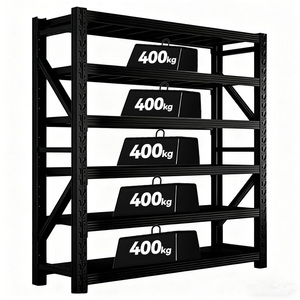
Factory-direct OEM/ODM manufacturing engineered with Q235B/Q355B structural steel, computerized automatic punching lines, and durable powder-coat finishes designed to handle loads from 400 kg to over 5,000 kg per beam level.
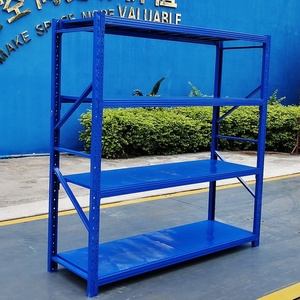
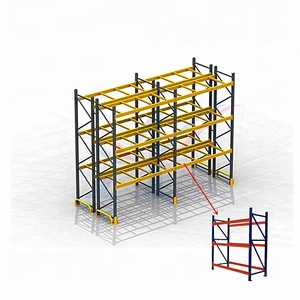
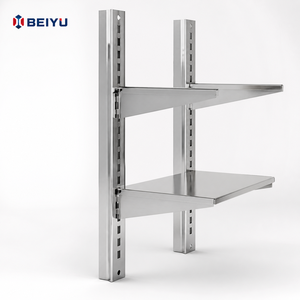
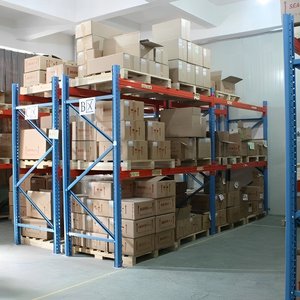
System Kinematics & Structural Architecture Comparison
Selecting the ideal pallet rack configuration demands analyzing the trade-off between direct pallet selectivity and cubic space volumetric efficiency. The following engineering comparison guides OEM/ODM specification.
| Storage Topology | Direct Selectivity | Floor Space Utilization | Rotation Principle | Aisle Clearances Required | Structural Load Rating | Primary Industrial Fit |
|---|---|---|---|---|---|---|
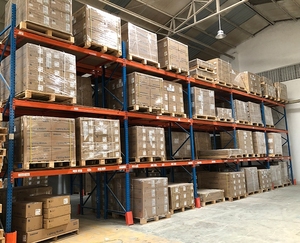
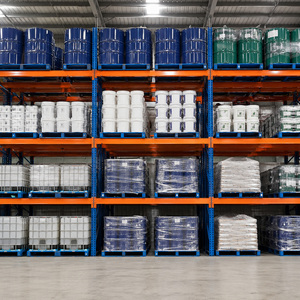
| Selective Pallet Racking Standard teardrop / slotted uprights | 100% Direct | 40% – 50% Volumetric | FIFO / LIFO Flexible | 3,000mm – 3,800mm (Counterbalance) | Up to 4,500 kg / beam pair | FMCG, 3PL Warehousing, Retail Distribution |
| Double-Deep Pallet Rack Panted pantograph reach truck access | 50% Direct | 60% – 65% Volumetric | LIFO Priority | 2,800mm – 3,200mm (Reach Truck) | Up to 3,500 kg / beam pair | Cold Storage, Dry Groceries, Paper Mills |
| Drive-In / Drive-Through Continuous rail cantilever brackets | 20% – 30% | 70% – 80% Volumetric | Strict LIFO / FIFO | Drive-in lane (1,400mm carriage) | 1,000 – 1,500 kg / pallet slot | Seasonal Bulk, Beverage Bottlers, Frozen Produce |
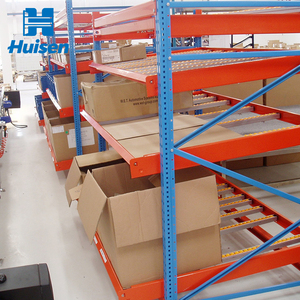
| Gravity Pallet Flow Rack Sloped roller beds with centrifugal brakes | Lane Frontage 100% | 75% – 85% Volumetric | Guaranteed FIFO | Dedicated entry & exit aisles | Up to 1,500 kg / pallet lane | Perishable Foods, Pharmaceuticals, Chemical Batches |
| Radio Shuttle Cart Racking Semi-automated deep lane lithium carrier | Programmed Batch | 80% – 90% Volumetric | Software Managed FIFO/LIFO | Forklift transfer aisle only | Up to 2,000 kg / carrier cycle | Ultra-Low Temp Cold Chain (-25°C), High-Throughput Hubs |
| Rack-Supported Mezzanines Multi-tier structural floor platforms | Multi-Tier Pick | 150% – 200% Floor Multiplier | Piece / Carton Flow | Integrated catwalk aisles (1,000mm) | 300 – 1,200 kg / m² deck capacity | E-Commerce Fulfillment, Spare Parts, Garment Sortation |
Cold-Rolled Steel Metallurgy & Structural Mechanics
The mechanical performance of industrial storage systems relies heavily on the quality and thickness of the underlying cold-rolled steel coils (CRC). In our manufacturing facility, cold-formed Omega (Ω) upright profiles and stepped beam sections are rolled primarily from certified Q235B and Q355B structural steel grades. Q235B provides an optimal balance between ductility and a minimum yield strength of 235 MPa, making it resilient against localized impact shocks caused by forklift operations. For high-bay applications exceeding 12 meters in height or demanding seismic acceleration conditions, Q355B steel (with a yield threshold of 355 MPa) is deployed to maintain cross-sectional slenderness while resisting severe axial column loads and second-order lateral drift forces (P-Delta effects).
Structural deflection limits must adhere strictly to international intralogistics standards, including the American RMI (Rack Manufacturers Institute) MH16.1 and European EN 15512 norms. Horizontal load-bearing beams are designed such that the maximum vertical deflection under full design working load does not exceed:
δmax ≤ L / 200 (Standard RMI calculation) or δmax ≤ L / 300 (Automated ASRS and robotic picking tolerances), where L represents the clear span distance between upright frames. Our welded 3-claw and 4-claw connector plates incorporate engineered safety spring pins that resist vertical accidental dislodgement forces exceeding 5.0 kN.
Upright frame bracing combines diagonal and horizontal structural channels arranged in triangular truss patterns. By using automated CNC punching matrices, pitch increments are kept precisely at 50mm or 75mm along the entire length of the upright profile. This precision avoids accumulated hole-pitch errors across 15-meter cold-formed runs, providing uniform contact pressure at beam-to-column connector ears and preventing premature torsional buckling under heavy eccentric loads.
Strategic Procurement & Technological Trends in Pallet Racking
Procurement directors and warehouse supply chain architects are balancing storage density against capital expenditure and lifecycle resilience. Over the next decade, four technological shifts are transforming the OEM/ODM industrial racking procurement landscape:
Finite Element Analysis (FEA) & Seismic Design
Standard static load tables are rapidly being replaced by rigorous non-linear finite element structural simulations. In high-risk seismic regions across the Pacific Rim, the Mediterranean, and South America (governed by codes such as NCh 433, NCh 2369, NSR-10, and ASCE 7), racking must be treated as a flexible structural frame. Seismic procurement now mandates verified baseplate ductility, heavy-duty floor anchor chemical shear evaluations, and moment-rotation hysteresis data for beam-end connectors.
Sub-Zero Cold Chain & Corrosion Metallurgy
With global perishable cold-chain distribution centers expanding, structural steel must withstand temperatures down to -30°C without ductile-to-brittle transitions. Buyers are abandoning standard flash-painting in favor of nine-stage zinc phosphating pre-treatments followed by thermosetting polyester powder coatings (70–90 μm thickness) or hot-dip galvanization (HDG according to ISO 1461). This prevents micro-cracking caused by cyclic condensation, thermal contraction, and aggressive chemical cleaning agents.
Autonomous Mobile Robot (AMR) & AS/RS Interfacing
The integration of Autonomous Mobile Robots (AMRs), automated pallet shuttles, and stacker cranes (ASRS) demands stricter manufacturing tolerances. Traditional racking tolerated frame plumbness deviations of 1:500; contemporary robotic handling systems specify tolerances down to 1:1000. Upright profiles must accommodate floor-level docking recesses, wireless inductive charging channels, and safety photoelectric reflective targets without compromising structural floor slab load transmission.
Guangzhou Heda Shelves: Comprehensive OEM/ODM Manufacturing
Established in 2001, Guangzhou Heda Shelves Co., Ltd. operates an advanced 30,000 m² smart manufacturing plant equipped with continuous roll-forming lines, robotic welding workstations, and fully automated electrostatic powder-coating tunnels.
Automated Roll-Forming Lines
Over 20 continuous cold roll-forming production lines handle sheet thicknesses from 1.5mm to 3.5mm, delivering precision-formed profiles without internal structural stress concentrations or micro-fractures.
Robotic CO₂ Shielded Welding
Beam-end connectors and heavy baseplates are welded using multi-axis industrial robots, creating uniform penetration beads without slag inclusions, cold laps, or dimensional warpage.
9-Stage Surface Pre-Treatment
Steel surfaces undergo high-pressure degreasing, acid pickling to remove mill scale, and zinc phosphating to provide rust resistance and long-lasting powder adhesion in coastal humidity.
Certified Quality Control (CE/ISO)
Manufacturing adheres strictly to ISO 9001:2015 standards (Cert No. 18624Q00169R0M) and European CE Factory Production Control (Cert No. 2435-CPR-8605159), verifying material mill certificates for each batch.
Free 3D Layout & BIM Engineering
Our dedicated engineering team of 300+ technical personnel provides free 3D CAD space modeling, forklift turning radius simulations, and structural load calculations within 24 hours of receiving site drawings.
Optimized Global Container Loading
Components are bundled with nested profiling, protective edge corners, and custom steel strapping, maximizing 40ft HQ container cubic utilization to protect finishes and reduce ocean shipping costs.
Frequently Asked Questions by Industrial Buyers
Detailed technical answers addressing engineering standards, structural load limits, anti-corrosive coatings, and international logistical verification for industrial pallet racking.