Precision Heavy-Duty Pallet Racking & Material Handling Equipment
Standardized with cold-rolled Q235B/Q355B high-tensile steel, robotic multi-point seam welding, and certified under global structural benchmarks (ANSI MH16.1, EN 15512, AS 4084).
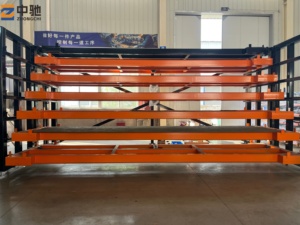 High Bay Multi-Tier
High Load Capacity 8-Layer Anti-Rust Powder Coated Steel Rack Heavy Duty Warehouse Storage System
- 1,000–5,000 kg / Beam Tier
- Up to 14 m Continuous Upright Heights
- Dual-Pin Drop-In Beam Connectors
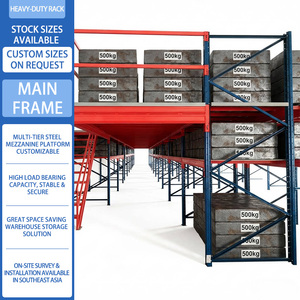 Cold-Rolled Steel
China Manufacturer Heavy Duty Cold Rolled Steel Pallet Rack System 300kg/sqm Load Boltless/Beam Type
- Certified Q235B Structural Grade
- 50 mm / 75 mm Adjustable Pitch Range
- Phosphated Epoxy Electrostatic Finish
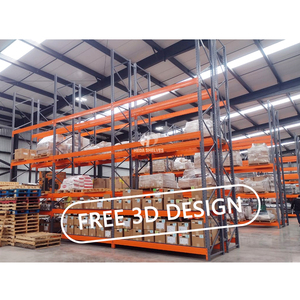 High Density VNA / Push-Back
Customization Pallet Racking System Beams Metal Pallet Storage Racking Push Back / Narrow Aisle
- Space Maximization: Up to 85% Footprint
- Dynamic Gravity-Feed Nested Carts
- VNA Turret Truck Guide Rails Built-In
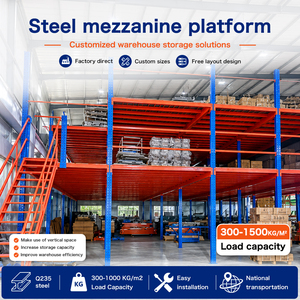 Modular Mezzanine
Heavy Duty Industrial Steel Mezzanine Floor Storage System Multi Level Warehouse Rack Shelving
- 300–1,200 kg / m² Floor Deck Rating
- Integrated Pallet Safety Gates & Stairs
- Doubles or Triples Usable Cubic Footage
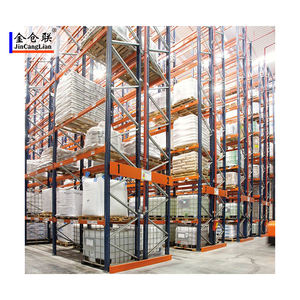 Teardrop Standard
Longspan High Bay Industrial Pallet Rack Wire Mesh Deck Cold Rolled Steel Q235 Teardrop Design 1500-4500kg
- North American Teardrop Universal Fit
- Heavy-Gauge Galvanized Wire Mesh Deck
- NFPA Fire Sprinkler Water Clearance
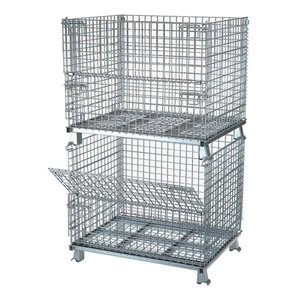 Stackable & Folding
Collapsible Galvanized Wire Mesh Container With Forklift Pocket Heavy Duty Storage Cage Stackable
- 800–2,000 kg Dynamic Stacking Load
- 4-Way Entry Forklift Pockets
- Electro-Galvanized Anti-Corrosion (8+ Yr)
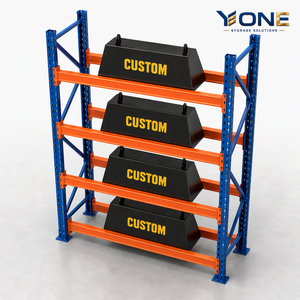 Selective Racking
Selective Pallet Racking System Steel Storage Rack Heavy Duty Boltless Adjustable 5-Tier Industrial
- 100% Direct Selective Access to Pallets
- Boltless Wedge Connector Design
- Compatible with Reach Trucks & Counterbalance
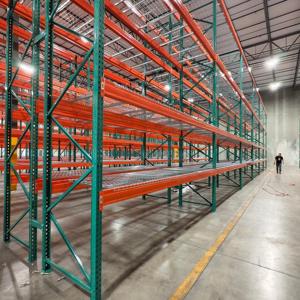 Logistics Hub Grade
Jracking US Inventory Warehouse Stacking Shelves Heavy Duty Teardrop Pallet Racking for Logistics Hub
- RMI ANSI MH16.1 Verified Structural Integrity
- Heavy-Duty Step Beam Cold Roll-Formed
- Rapid Knock-Down for Fast Container Stuffing
How Tier-1 Chinese Pallet Rack Factories Out-Engineer Commodity Suppliers
In heavy industrial storage engineering, safety margins are defined at the microscopic level: raw coil chemical compositions, cold-roll residual stresses, robotic weld penetration, and electrostatic cross-linking polymer densities.
Prime Raw Steel: Q235B vs. Q355B
Leading Chinese factories procure primary strip coils exclusively from premium state-level mills such as Baosteel, Shougang, and Ansteel. For standard selective configurations, Q235B mild structural carbon steel delivers yield strengths ($f_y$) exceeding 235 MPa with uniform ductility. For super-tall high-bay automated warehouses exceeding 12 meters, Q355B micro-alloyed steel ($f_y \ge 355\text{ MPa}$) provides superior torsional stiffness and compressive strength under heavy dynamic loads.
Continuous Roll-Forming & Laser Punching
High-precision multi-pass cold roll-forming lines shape omega-profile upright columns without causing micro-fissures along bends. Fully automated servo-controlled hydraulic or fiber laser punching guarantees consistent teardrop, diamond, or hex pitch tolerances within $\pm0.1\text{ mm}$ across the entire 12-meter shaft. This precision prevents beam-end connector binding and eliminates structural looseness under variable loading.
10-Stage Pretreatment & Coating
Structural longevity depends on the adhesion of surface coatings. Premier facilities incorporate automatic multi-stage chemical pretreatment: alkaline degreasing, clean water cascades, zinc phosphating or silane nanotech conversion, and deionized water rinsing. The thermosetting epoxy-polyester powder is cured at 180°C–200°C to achieve 60–90 $\mu\text{m}$ dry film thickness (DFT), withstanding 500+ hours of continuous salt-spray testing per ASTM B117 standards.
Comparison of International Structural Design Specifications
Procuring pallet racking internationally requires navigating conflicting national codes. Tier-1 Chinese exporters engineer their systems to satisfy, cross-reference, and exceed the structural load and deflection criteria of major global markets.
| Jurisdiction / Standard | Governing Specification | Permissible Beam Deflection | Seismic & Lateral Dynamic Provisions | Factor of Safety (FoS) |
|---|---|---|---|---|
| United States / Americas | ANSI MH16.1 (RMI Specifications) | $L / 180$ Maximum allowable under service pallet weight | ASCE 7 equivalent ground acceleration factors; baseplate ductility validation | 1.65 to 1.95 |
| European Union / UK | EN 15512 / FEM 10.2.02 Standards | $L / 200$ (Eurocode 3 base calculation) | EN 16681 dynamic design of racking systems under seismic ground motion | 1.40 (Partial Safety Factor $\gamma_M$) |
| Australia / New Zealand | AS 4084:2023 Steel Storage Racking | $L / 200$ with strict vertical torsional stiffness criteria | AS 1170.4 seismic response spectra; mandatory post-impact testing | 1.50 to 1.80 |
| South American Pacific Ring | Chilean NCh 2369 / Peruvian E.030 | $L / 250$ to reduce secondary damage in high-magnitude earthquakes | High ductility anchors, reinforced back-to-back ties, oversized floor baseplates | Upgraded Anchorage $\ge 2.0$ |
Strategic Procurement Trends Shaping Industrial Racking Investments
Purchasing warehouse racking has moved beyond comparing initial steel cost per metric ton. Forward-thinking enterprise buyers look at full life-cycle economics, automated pallet compatibility, seismic compliance, and supply chain decarbonization.
Automation & 4-Way Radio Shuttle Convergence
Driven by skyrocketing commercial real estate prices and warehouse labor shortages, modern storage is shifting from conventional wide-aisle forklift operations to semi-automated and fully automated high-density systems. Chinese factories are engineering heavy-duty racks with integrated high-precision guide rails for autonomous 4-Way Radio Shuttles and AMR pallet carriers, cutting operating aisle widths to near zero.
Cold Chain & Sub-Zero Metallurgical Stability
Global demand for fresh food exports, pharmaceuticals, and biologics is fueling cold storage expansion. Standard carbon steel experiences ductile-to-brittle transitions when temperatures drop below zero. Modern China rack manufacturing solves this by using low-temperature impact-tested steel grades alongside hot-dip galvanizing (HDG) or zinc-flake coatings, keeping steel ductile down to -30°C without crack propagation.
Seismic Resilience in Earthquake Zones
Warehouses across the Pacific Rim (Chile, Peru, California, Japan, New Zealand) demand specialized rack engineering. Chinese structural engineering teams use Finite Element Analysis (FEA) software to simulate seismic response spectra. By upgrading to heavy ductile baseplates, double-bolted upright bracing, and oversized mechanical anchors, they protect facilities against catastrophic rack collapse during seismic events.
Total Landed Cost (TLC) Container Optimization
Ocean freight volatility makes packaging engineering a key competitive factor. Tier-1 factories optimize container loading through nested upright profiling, custom modular steel skids, and automated packaging lines. This engineering maximizes 40ft High Cube (40HQ) container utilization above 92%, protecting finished powder coatings from transit abrasions while reducing landed shipping costs per pallet position.
Guangzhou HEDA Shelves: 25 Years of Engineering Leadership
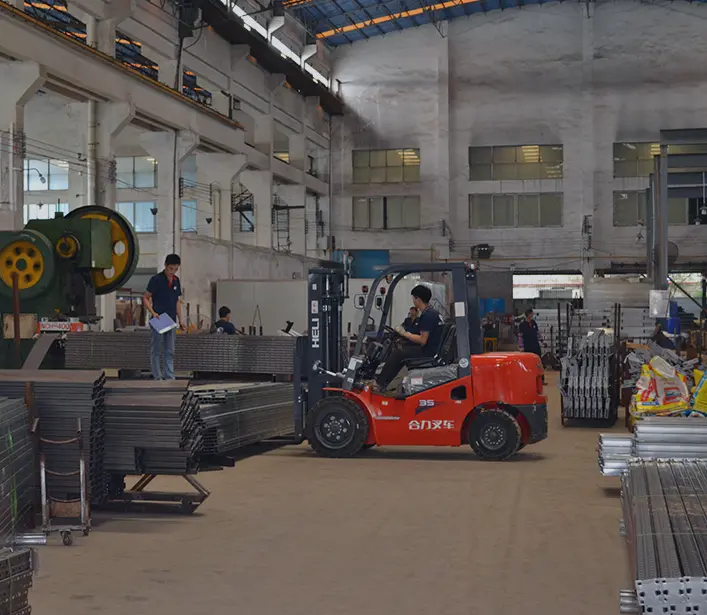
Founded in 2001, Guangzhou HEDA Shelves Co., Ltd. has grown from a regional steel shelving fabricator into an internationally certified material handling exporter. Operating a modernized 30,000 square meter production facility equipped with high-speed automated roll-forming lines, laser welding stations, and an environmentally compliant powder coating facility, the company manufactures over 30,000 metric tons of engineered storage equipment each month.
Our in-house structural engineering department partners with global 3PL operators, industrial distributors, and EPC general contractors to provide full-cycle engineering support—from initial site measurement and free 3D CAD/BIM floorplan layout design to finite element static load verification, export-compliant manufacturing, and remote assembly guidance.
- Free 3D CAD & BIM Engineering Layouts
- CE Certified (EN 15512 Harmonized)
- ISO 9001:2015 Quality Management
- Seismic Structural Calculations (IBC/NCh)
- 30,000 Tons Monthly Output Capacity
- OEM & ODM Private Label Capabilities
Frequently Asked Questions on Importing Industrial Racks from China
Detailed technical answers addressing weld integrity, deflection criteria, corrosion protection, container freight packing, and local code compliance.
Request Your Custom Warehouse Layout & Static Load Calculation
Send your warehouse floor plans, ceiling height clearances, forklift parameters, and pallet load configurations. Our structural engineering department will prepare a complimentary 3D rendering, CAD layout, and detailed export quotation within 24 business hours.