Explore factory-direct engineered pallet racking, shuttle platforms, dynamic storage lanes, and structural safety components manufactured to ISO 9001 and CE standards.
Executive Engineering Overview: The Mechanics & Value Architecture of Push Back Racking
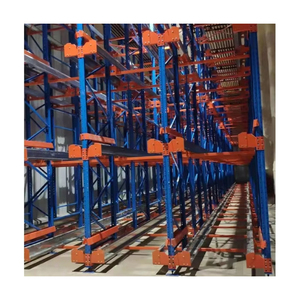
In modern supply chain management and cold-chain logistics, achieving optimal volumetric floor-space utilization without sacrificing operational throughput is the ultimate engineering challenge. The Push Back Pallet Rack System stands at the forefront of high-density dynamic storage technologies. Operating on a Last-In, First-Out (LIFO) inventory management framework, push back racking utilizes nested telescoping carts that glide smoothly along inclined structural steel rails.
Unlike static drive-in racking systems, which require forklift drivers to physically navigate deep inside storage channels—thereby creating significant collision hazards and slowing cycle times—push back racking allows operators to perform all loading and unloading maneuvers exclusively from the front aisle. When a new pallet is loaded, the forklift gently pushes the preceding pallet back onto the next underlying cart. Upon retrieval, gravity automatically moves the remaining pallets forward to the pick face at a controlled speed.
Volumetric Density
Increases storage floor space efficiency by up to 75% compared to standard selective pallet racking by eliminating internal access aisles.
Telescoping Cart Physics
Engineered with heavy-duty precision steel bearings and inclination gradients (typically 1.5° to 2° tilt) to prevent cart jams and ensure effortless pallet travel.
Operational Safety
Forklifts remain outside the racking structure at all times, reducing rack upright damage by over 90% compared to traditional drive-in systems.
Comparative System Matrix: Evaluating High-Density Storage Engineering
Procurement directors and facility design managers must carefully balance initial capital expenditure (CapEx), operational expenditure (OpEx), SKU selectivity, and floor space utilization. The engineering table below presents an objective performance comparison across key high-density warehouse storage topologies:
| Racking Topology | Space Efficiency | Selectivity Rate | Forklift Risk Level | Rotation Method | CapEx Index |
|---|---|---|---|---|---|
| Push Back Pallet Rack | 75% - 85% | Medium (1 SKU per lane) | Low (Aisle loading only) | LIFO | Moderate |
| Selective Pallet Rack | 40% - 50% | 100% (Direct access) | Low | FIFO / LIFO | Low |
| Drive-In Racking | 70% - 80% | Low (1 SKU per bay) | High (Drive-inside danger) | LIFO | Low-Moderate |
| Radio Shuttle System | 85% - 90% | Medium-High | Very Low (Automated) | FIFO or LIFO | High |
| Gravity Pallet Flow | 80% - 85% | Medium | Low (Dedicated picking face) | FIFO | High |
*Note: Technical metrics compiled from global industrial logistics benchmarking studies and HEDA Shelves project performance databases.
Enterprise Manufacturing Capabilities: Why Global Importers Trust HEDA Shelves
Established in 2001, Guangzhou HEDA Shelves Co., Ltd. has developed into a premier Chinese manufacturer and exporter of heavy-duty warehouse storage infrastructure. Operating a 30,000 m² state-of-the-art production base equipped with automated cold-roll forming lines, robotic laser welding cells, and electrostatic powder-coating lines, HEDA delivers structural steel racking systems that meet the rigorous operational requirements of clients in South America, North America, Europe, Southeast Asia, and the Middle East.
Custom Engineering & Seismic Zone Compliance
Push back rack systems deployed in seismic regions—such as Chile, Peru, Colombia, California, or Japan—require rigorous finite element analysis (FEA) and customized structural reinforcement. HEDA’s engineering team integrates site-specific ground acceleration parameters (e.g., NCh 433 / NCh 2369 in Chile, E.030 in Peru, or NSR-10 in Colombia) directly into structural designs. Base plates are upsized, anchor bolts are high-tensile rated, and heavy-duty horizontal and diagonal bracing columns are incorporated to guarantee structural resilience during seismic events.
Surface Treatment Engineering for Sub-Zero Cold Storage
For cold-chain logistics hubs, meat processing facilities, and agricultural export centers operating at temperatures as low as -30°C, ordinary powder coatings and standard steel alloys can suffer from cold embrittlement and corrosion due to moisture condensation. HEDA provides specialized cold-storage push back racking solutions utilizing high-grade structural Q355B steel, low-temperature synthetic synthetic bearing lubricants, and dual-layer epoxy-rich powder coating or hot-dip galvanizing options to prevent rust and mechanical seizing.
Strategic Procurement Trends: The Next Decade of Push Back Racking Technology
As supply chains lean into automation, sustainability, and real-time inventory visibility, push back racking systems are evolving rapidly. Procurement managers sourcing from China must align their technical specifications with several key macro trends shaping the market:
1. Hybrid Automation & AMR Integration
While push back racks have traditionally relied on human-operated counterbalanced or reach forklifts, leading Chinese exporters are now designing cart entry interfaces engineered specifically for Autonomous Mobile Robots (AMRs) and automated forklift fleets equipped with precise laser-guided sensors.
2. Modular Telescoping Cart Engineering
Future-proof warehouses demand flexibility. Modern push back systems utilize modular, bolt-together cart frameworks that allow quick adjustments between 2-deep, 3-deep, 4-deep, 5-deep, and 6-deep lane configurations as tenant SKU profiles shift over time.
3. Smart IoT Sensor Monitoring
Sensors embedded within cart guide rails monitor real-time pallet movement, kinetic velocity, cart return verification, and structural impact alarms. This data streams directly to the facility’s Warehouse Management System (WMS) to maximize worker safety.
4. Low-Carbon Green Steel Manufacturing
With global ESG regulations tightening, tier-1 Chinese factories are transitioning to eco-friendly closed-loop pickling, zero-VOC powder coatings, and recycled low-carbon steel billets, enabling overseas buyers to meet scope 3 carbon reduction goals.
Procurement FAQ: Critical Questions Asked by Industrial Buyers
Detailed technical answers to help engineering and purchasing teams evaluate push back racking installations:
How does a push back pallet rack system actually operate during daily loading and unloading?
What is the maximum depth and load capacity available for push back racking?
How do push back racks compare with drive-in racking regarding speed and forklift safety?
What type of forklifts are required for push back rack systems?
Can push back racking be deployed in freezing or cold storage facilities?
What information does HEDA Shelves need to provide a free 3D layout and pricing quote?
Technical Sourcing Checklist for International B2B Buyers
Before finalizing a contract with any Chinese push back pallet rack manufacturer, ensure your procurement team verifies the following critical engineering criteria:
- Steel Quality Compliance: Verify mill test certificates for mill-certified Q235B or Q355B structural steel profiles.
- Bearing Integrity: Ensure cart wheels feature double-sealed, maintenance-free precision bearings designed to prevent kinetic jamming.
- Safety Bumper Hooks: Confirm that telescoping carts include built-in anti-jump stops and mechanical rear safety stops to prevent cart derailment.
- Testing & Certification: Require factory load-testing documentation and third-party ISO 9001:2015 and CE certification records.
Optimize Your Warehouse Density Today
Contact the senior engineering team at Guangzhou HEDA Shelves Co., Ltd. for a complimentary 3D CAD warehouse floor plan, structural load calculations, and competitive factory-direct pricing within 24 hours.