Top China Industrial Heavy-Duty Racking Systems
Direct-from-factory high-density steel warehouse racking, custom-configured for high-bay stability, automated turret guidance, and optimal pallet accessibility across global distribution hubs.
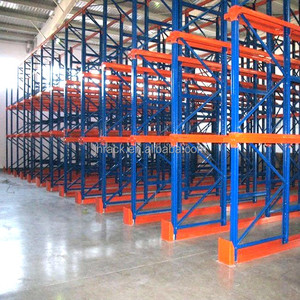
Drive-In Heavy Duty Storage Racking System
- Access Method: FILO / FIFO Drive-Through
- Density Yield: Up to 75% Floor Efficiency
- Load Rating: 500 – 2,000 kg/Pallet
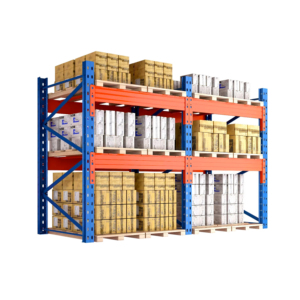
Heavy Duty Space-Saving Narrow Aisle Racking
- Aisle Width: 1,600 – 1,800 mm Clearance
- Height Ceiling: Engineered to 16+ Meters
- Surface Tech: Electrostatic Epoxy Finish
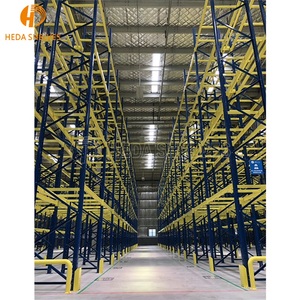
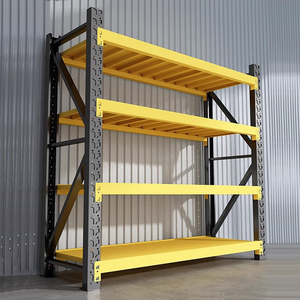
4-Layer Anti-Corrosion Industrial Shelving
- Shelf Loading: 100 – 800 kg / Layer
- Assembly: Boltless Rivet Adjustment
- Application: Fast SKU Picking & Retail
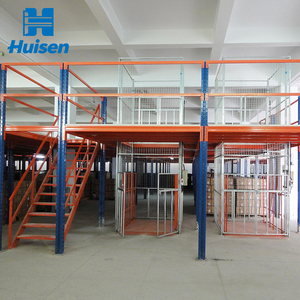
Industrial Attic Loft Steel Mezzanine Platform
- Deck Load: 300 – 1,200 kg/m² Rating
- Flooring: Perforated Steel or Chequered
- Integration: Rack-Supported Structure
Collapsible Heavy-Duty Stacking Tire Stillage
- Stacking: 4 to 6 Units High Dynamic
- Mobility: Forklift Portable & Foldable
- Capacity: 1,000 kg Tier Rating
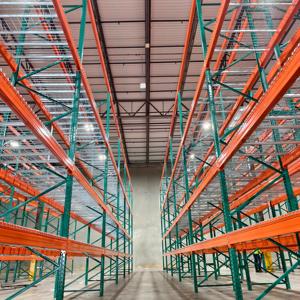
RMI Certified Teardrop Pallet Rack System
- Hole Pattern: 2-inch Incremental Teardrop
- Certification: RMI MH16.1 & ISO Compliant
- Safety Factor: Engineered Column Locking Pin
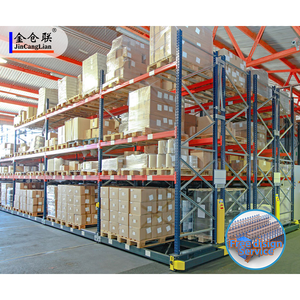
Modular Selective Pallet Racking Frame
- Selectivity: 100% Direct Pallet Picking
- Beam Heights: 75mm / 50mm Adjustable Pitch
- Corrosion Proof: 8-Stage Chemical Washing
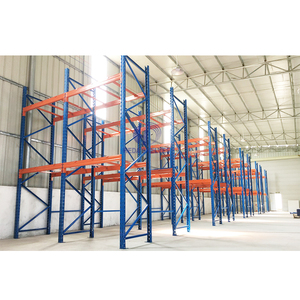
Extreme Capacity 1,000–5,000kg Beam Rack
- Beam Capacity: Up to 5,000 kg / Tier
- Upright Profile: Cold-Formed Omega Section
- Steel Grade: High-Yield SS400 / Q355B
Engineering Precision in Very Narrow Aisle (VNA) Systems: A Strategic Guide for International Procurement
In modern industrial supply chains, real estate expenses and industrial land scarcity have driven warehousing professionals to rethink volumetric efficiency. Traditional Wide Aisle (WA) pallet racking infrastructures typically require operating corridors spanning between 3,200 mm and 3,800 mm to accommodate standard counterbalanced or reach trucks. This legacy layout compromises space optimization, dedicating up to 60% of total facility floor space purely to circulation rather than revenue-generating cargo storage.
As a leading China Very Narrow Aisle pallet racking exporter, Guangzhou Heda Shelves Co., Ltd. re-engineers this structural balance. By compressing aisle widths down to an aggressive 1,500 mm to 1,800 mm and scaling storage upright heights up to 16 to 18 meters, VNA configurations deliver a net storage capacity gain of 45% to 60% within the exact same structural footprint. However, achieving this high vertical concentration requires extreme structural tolerance control, specialized floor flatness engineering, and rigorous compliance with international safety codes including EN 15512, FEM 10.2.02, and ANSI/RMI MH16.1.
Aisle Geometry: Mechanical Rail Guidance vs. Inductive Wire Guidance
Because turret trucks (man-up or man-down VNA forklifts) operate with mere millimeters of clearance between the mast carriage and pallet overhangs, high-precision guide systems are non-negotiable. Exporters in China fabricate two primary guidance methodologies based on facility investment horizons and operational throughput:
Low-Profile Steel Floor Guide Rails
Formed from continuous hot-rolled structural steel angle (typically $100 \times 75 \times 8\text{ mm}$ or $125 \times 75 \times 10\text{ mm}$), anchored rigidly to the slab using M12/M16 chemical expansion studs at 500 mm pitch. Structural steel lead-in horns are positioned at row entries to ensure smooth turret truck alignment without mast impact.
Inductive Frequency Wire Guidance
Eliminates physical steel perimeter obstacles by embedding a continuous copper signal emitter wire into a 15–20 mm floor slot, sealed with high-tensile epoxy polymer. Turret trucks detect low-frequency electromagnetic currents to steer autonomously inside aisles, speeding up order picking.
Autonomous AGV/AMR Interface Ready
Our upright designs include laser-calibrated end-of-aisle datum reflectors, fiducial markers, and tight tolerance floor beam positioning designed to match automated guided turret truck (AGV) laser guidance systems without structural modification.
Critical Floor Flatness Specification: VDMA 15251 / DIN 18202 Class F2
In high-bay VNA installations reaching 12m to 18m, minor sub-millimeter floor deviations are dramatically multiplied at the truck's mast peak. Global purchasers must ensure their concrete flooring fulfills VDMA 15251 (or TR34 'Superflat' DM2 criteria). If floor grinding is not feasible, HEDA Shelves provides customized oversized leveling shims ($2.0\text{mm} - 6.0\text{mm}$) and CNC laser-milled leveling baseplates to guarantee strict plumb line tolerances within $\pm 1/1000$.
Technical Parameter Matrix: VNA vs. Conventional Racking Systems
Direct quantitative comparison of structural metrics, clear aisle footprints, and capital economics across major warehouse racking formats.
| System Classification | Typical Aisle Width (mm) | Max Usable Height (m) | Floor Space Utilization (%) | Selectivity Ratio | Equipment Capital Focus |
|---|---|---|---|---|---|
| Very Narrow Aisle (VNA) | 1,500 – 1,850 | Up to 18.0 m | 85% – 90% | 100% Direct | Specialized Turret Truck / AGV |
| Standard Selective Racking | 3,100 – 3,600 | Up to 11.5 m | 40% – 50% | 100% Direct | Standard Counterbalance / Reach |
| Double Deep Pallet Racking | 3,000 – 3,300 | Up to 11.0 m | 55% – 65% | 50% Immediate | Pantograph Reach Truck |
| Drive-In / Drive-Through | Dedicated Channels | Up to 10.0 m | 70% – 80% | FILO / Low Selectivity | Standard Reach / Counterbalance |
| Automated Storage & Retrieval (ASRS) | 1,400 – 1,600 | Up to 30.0+ m | 90% – 95% | 100% Automated | Automated Crane / Stacker Crane |
Future Procurement Trends in Industrial VNA Racking Systems (2025–2035)
Global warehouse procurement is experiencing a major shift. The combination of rising global industrial rents, nearshoring initiatives, and automated material handling has transformed how logistics directors select racking suppliers. Leading enterprises are moving past simple FOB price comparisons toward holistic Total Cost of Ownership (TCO) assessments.
1. The Transition to Automated Turret Trucks (AMR/AGV)
Procurement contracts increasingly require racking to be "Automation-Ready." Modern VNA designs incorporate continuous vertical laser runout tolerances below $\pm 2\text{mm}$, tighter beam deflection allowances ($L/300$ upgraded from standard $L/200$), and recessed floor anchors to protect automated turret navigation sensors.
2. Carbon Border (CBAM) & Steel Traceability
European and American logistics conglomerates are beginning to mandate verified Environmental Product Declarations (EPD). Exporters must source prime high-grade Q235B/Q355B coil with certified metallurgical mill certs (MTC), utilizing low-emission electric arc furnaces (EAF) and eco-friendly heavy-metal-free powder coatings.
3. Modular High-Bay Hybrid Platforms
Rather than deploying isolated single-purpose systems, tier-1 operators are purchasing hybrid configurations: VNA lower tiers for ultra-dense pallet replenishment, integrated with upper mezzanine walkways or overhead automated pallet shuttle runs to streamline single-item picking.
Global Logistics Sourcing Analysis: Direct Chinese Export Advantages
Purchasing heavy structural racking systems directly from qualified Chinese manufacturing hubs like Guangzhou provides distinct economic and logistical benefits compared to local regional sourcing:
- Economies of Scale: High monthly coil processing capacities (exceeding 30,000 metric tons) stabilize steel procurement pricing, insulate against raw material swings, and shorten production lead times down to 2–4 weeks.
- Precision Roll-Forming Technology: Modern 30-station automated rolling mills produce custom omega upright profiles with precise hole pitch tolerances ($75\text{mm}$ European or $50.8\text{mm}$ US increments), ensuring seamless field assembly.
- Container Cube Packing Engineering: Expert exporters calculate tight component nesting configurations inside 40ft High Cube containers. By using custom-engineered steel crates, protective plastic separators, and automated bundle strapping, ocean freight utilization rates climb past 94%, significantly lowering landed cost per pallet position.
VNA Deployment Architectures Across Key Industrial Verticals
Tailored layout calculations, cold room engineering, and high-frequency picking frameworks designed for specialized operational environments.
1. E-Commerce & Multi-SKU Retail
For operations balancing full-pallet storage with high-frequency piece picking, VNA installations incorporate "man-up" order picker cranes. Pickers elevate directly to beam elevations up to 14 meters, executing individual carton picks alongside full-pallet replenishments.
2. Cold Chain & Deep-Freeze Storage
Refrigerated air carries significant energy expenses. Implementing VNA within $-25^\circ\text{C}$ to $-30^\circ\text{C}$ cold storage facilities cuts conditioned volume loss by up to 50%. Our low-temperature certified steel grades and specialized freeze-proof powder coatings resist micro-cracking and structural embrittlement.
3. Heavy Machinery & Automotive Spare Parts
Industrial assemblies and engine blocks demand extreme load capacities. Using reinforced box-beam sections and heavy structural row-spacers, our VNA designs support sustained static loads of up to 4,500 kg per level while holding center-span deflection under $1/250$ under full seismic test criteria.
4. Bonded Warehousing & 3PL Logistics
Third-party logistics providers require flexible racking geometry. Our modular upright punching allows beam levels to re-index at 50mm or 75mm increments without torch-cutting or welding, adjusting smoothly to seasonal pallet profile shifts.
Why International EPCs & Warehouse Operators Rely on HEDA Shelves
Founded in 2001, Guangzhou Heda Shelves Co., Ltd. provides 25+ years of dedicated structural steel expertise to warehouse automation distributors, logistics investors, and multinational retailers across 120+ countries.
30,000 m² Facility
Equipped with 32 automated continuous roll-forming lines, automated laser plate-cutting systems, and robotic welding stations delivering sub-millimeter repeatable tolerances.
Certified Compliance
Certified to CE standard (Certificate No. 2435-CPR-8605159), ISO 9001:2015 Quality Management System (No. 18624Q00169R0M), and fully compliant with EU RoHS and REACH finishing directives.
FEA Structural Design
Our engineering team delivers structural finite-element static and dynamic load simulations, calculating second-order P-Delta frame buckling effects to meet regional seismic criteria (e.g., Chile NCh 2369, Peru E.030, US IBC).
24h CAD & 3D Modeling
Send your architectural clear-height DWG drawings to receive complete 2D layout configurations, capacity distribution analyses, and 3D architectural renders within 24 working hours at no extra charge.
Frequently Asked Engineering & Export Inquiries
Direct answers to technical, commercial, and shipping questions on sourcing VNA systems from China.
What are the exact aisle clearance tolerances required between the VNA turret truck and racking beams?
How does HEDA Shelves account for local seismic zone requirements (e.g., South American Andes, US West Coast)?
What concrete floor specifications are required to prevent high-bay mast sway and tip-overs?
How are oversized upright frames bundled and packed to prevent transit damage in ocean containers?
What surface treatment methods protect against maritime oxidation and humid industrial environments?
What is the standard production lead time and FOB/CIF shipping protocol for full container loads?
Transform Your Warehouse Volume with Engineered VNA Precision
Submit your architectural floor plan, clear ceiling dimensions, and target pallet parameters. Our certified structural engineers will generate an optimized 3D CAD layout, load-capacity profile, and competitive factory-direct quote within 24 hours.