Heavy Duty Warehouse Storage Solutions & Handling Systems
Explore our heavy-duty industrial storage systems, precision-engineered from prime structural carbon steel. Each profile is load-calculated for dynamic forklift impacts, seismic lateral acceleration, and optimized warehouse throughput.
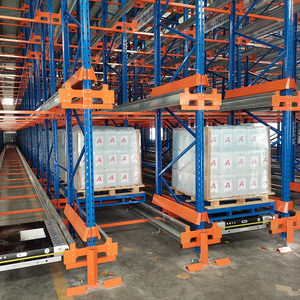
Automatic Warehouse Mobile Pallet Shuttle Racking System
- High-density radio shuttle carrier automation
- Load Capacity: 500 – 1,500 kg per pallet
- Configurable for FIFO & LIFO logistics
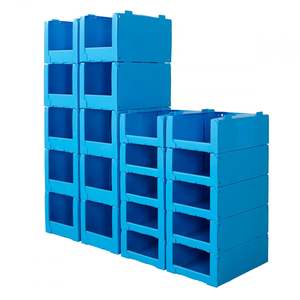
Foldable Stackable Heavy Duty Warehouse Picking Boxes & Bins
- High-impact virgin polypropylene polymer
- Space-saving nested folding return ratio: 4:1
- Automated conveyor & racking compatible
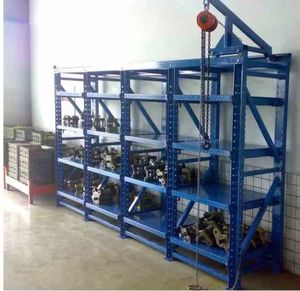
Industrial Pallet Pull-Out Drawer Units (Up to 1,000kg Capacity)
- Transforms static pallet beam into smooth drawer
- Extends 70% to 100% for effortless manual picking
- Heavy-duty steel ball-bearing roller guides
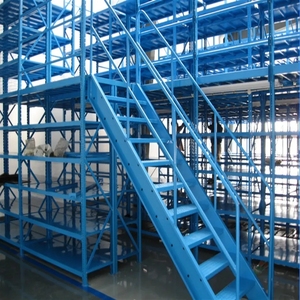
Structural Steel Multi-Tier Mezzanine Floor & Racking System
- Doubles or triples usable warehouse square footage
- Floor Uniform Live Load: 300 – 1,200 kg/m²
- Anti-rust galvanized or perforated steel decking
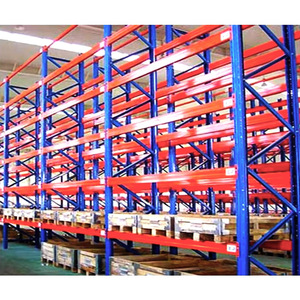
Heavy Duty Modular Pallet Racking System (ISO / CE Standard)
- 100% direct accessibility to every SKU position
- Upright beam levels adjustable by 50mm / 75mm pitch
- Beam Load Capacity: 1,000 – 4,500 kg per tier
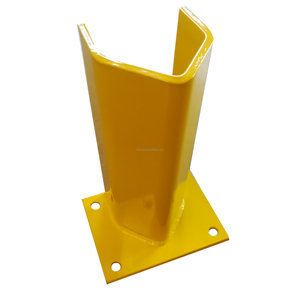
Impact-Resistant Upright Post Protectors & Frame Guards
- Heavy gauge 4.0mm – 6.0mm reinforced carbon steel
- Absorbs frontal and lateral forklift kinetic impact
- High-visibility OSHA safety yellow powder coating
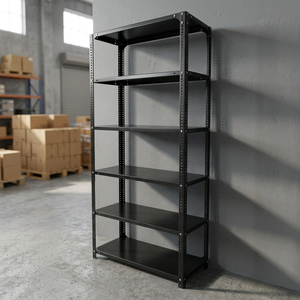
FinePunch Slotted Angle Industrial Steel Storage Shelving
- Modular bolted construction for versatile layouts
- Load Capacity: 80 – 250 kg per shelf tier
- Anti-scratch electrostatic powder treatment
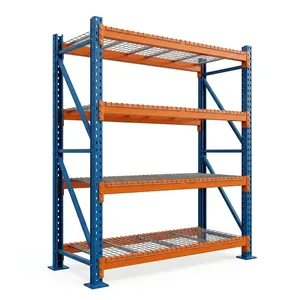
Engineered Heavy Duty Steel Pallet Racking Industrial System
- High-tensile cold-rolled Q235B / Q355B structural steel
- Frame Load Rating up to 24,000 kg total capacity
- Compatible with counterbalanced, reach & VNA trucks
Structural Engineering Standards for Industrial Storage Racks
When sourcing heavy-duty warehouse racks directly from China manufacturing facilities, enterprise procurement directors must evaluate certified metallurgical tensile thresholds, weld integrity standards, and structural deflection factors to avoid catastrophic upright buckling and floor-slab failure.
Cold-Formed Thin-Walled Steel Design: FEM 10.2.02 vs. RMI MH16.1
Industrial warehouse racking profiles are cold-formed steel sections subject to complex buckling phenomena: local buckling of thin flange walls, distortional buckling of perforation lip stiffeners, and global flexural-torsional buckling under extreme axial frame loads. As a tier-1 Chinese exporter, our manufacturing processes strictly conform to EN 15512:2020, FEM 10.2.02, and American RMI MH16.1-2012.
Unlike general commercial shelving, heavy-duty beam profiles utilize double-C nested interlocked sections or omega box beam profiles roll-formed through 18 to 24 sequential roller stations. This guarantees residual stress minimization, exact hole pitch alignment (±0.15mm tolerance), and guaranteed yield strength exceeding nominal standard baselines.
- Prime Steel Coil Certification: Direct mill-sourced high-yield carbon steel coils with complete 3.1 chemical & physical mill test certificates (MTC).
- Beam Deflection Strict Limit: Engineered to hold $L/200$ (Standard) or $L/300$ (ASRS & Automated Shuttle) maximum vertical displacement under full design static load.
- Upright Frame Safety Factor: Built with a minimum 1.65 to 1.95 structural safety factor against ultimate yield collapse under uniform floor load distribution.
Structural Steel Specification Matrix
*Every rack design undergoes FEA (Finite Element Analysis) simulating dynamic pallet placement, aisle seismic base shear force, and anchor shear load pullout capacity before production tooling.
| Storage Racking System Type | Typical Beam Span (mm) | Upright Profile (mm) | Floor Space Utilization | Stock Rotation Logic | Seismic & Lateral Dynamic Rating |
|---|---|---|---|---|---|
| Selective Pallet Racking | 2,300 – 3,900 | 80×60 / 90×70 / 100×70 / 120×95 | 40% – 45% (Standard Aisles) | 100% Direct FIFO Access | Standard ASCE/IBC |
| Radio Pallet Shuttle System | Up to 40 Pallets Deep | 90×70 / 100×70 / 120×95 (Heavy) | 75% – 85% (High Density) | Configurable FIFO or LIFO | Enhanced High-Bay Tie |
| Drive-In / Drive-Through Rack | Pallet Rail Profiled | 90×70 / 100×70 / 120×95 | 65% – 75% (Aisleless Deep) | Strict LIFO (Drive-In) / FIFO | Requires Top Bracing |
| Heavy Duty Cantilever Rack | 1,000 – 1,800 Arm Length | 200×100 to 400×150 H-Beam | Flexible for Linear Stock | Instant Open Direct Crane/Fork | Engineered Base Weldment |
| Structural Multi-Tier Mezzanine | 3,000 – 6,000 Column Grid | SHS 120×120 to 200×200 Column | 200% – 300% Floor Area Gain | Manual / Pallet Jack / Conveyor | Full Rigid Moment Frame |
Future Procurement Trends in Warehouse Heavy Duty Racking
Global logistics procurement has fundamentally transitioned from comparing simple FOB raw steel metric ton prices to calculating total lifecycle landed cost, structural reconfigurability, carbon footprint documentation, and automated system adaptability.
1. Nearshoring & Seismic Regionalization
International supply chain hubs located across Latin America (Chile NCh 433/2369, Peru E.030, Colombia NSR-10), the Pacific Rim, and the Mediterranean demand project-specific seismic response spectra calculations. Buyers are moving away from stock generic racking in favor of direct-from-factory engineered upright footings with oversized ductile baseplates, double heavy anchors, and diagonal seismic truss bays.
- Site-specific spectral acceleration $S_s$ and $S_1$ matching
- Thicker footplate anchors preventing catastrophic base pullout
- Pre-approved PE/structural calculation packages for city permits
2. Automation-Ready Hybrid Infrastructure
Procurement teams are actively future-proofing conventional warehouses. Selective racking bays purchased today are pre-engineered to host AMR (Autonomous Mobile Robots), radio shuttles, or vertical AGVs tomorrow. This eliminates the massive financial penalty of dismantling entire warehouses when automating picking routines over a 5-to-10-year facility lease horizon.
- Standardized guide rail mounting brackets pre-punched on uprights
- Tighter deflection tolerance ($L/300$) specified as baseline
- Integrated wire decking capable of handling irregular plastic bins
3. Low-Carbon Steel & Eco-Coatings
ESG compliance mandates from multinational logistics operators (DHL, Maersk, Walmart) are driving direct factory audits of steel production carbon footprints. Modern Chinese manufacturing leaders are deploying low-VOC, heavy-metal-free thermosetting polyester powder lines, utilizing EAF (Electric Arc Furnace) recycled content scrap steel, and reducing container volume packaging waste through robotic nested strapping.
- RoHS compliant TGIC-free electrostatic powder coatings
- Traceable mill certificates verifying green steel origin
- 100% recyclable structural steel alloy components
Technological Evolutions in Racking Architecture
Modern heavy-duty racks have evolved from simple passive steel structures into precision-engineered, dynamic logistical frameworks integrated with smart sensors, robotic shuttles, and advanced surface nanotechnology.
Micro-Alloy High-Tensile Steel Profiles
By shifting from conventional commercial-grade steel to high-tensile niobium-vanadium micro-alloyed steel (such as Q355B and high-yield cold-rolled coils), modern rack profiles achieve a 25% higher yield point while reducing dead structural weight. This translates directly to reduced container freight shipping costs and increased net usable pallet load capacity per linear meter.
- Reduced deadload on existing building concrete foundation slabs
- Higher elasticity absorption under dynamic forklift impact
- Superior cold-temperature impact toughness at -30°C in blast freezers
Advanced Anti-Corrosion Surface Engineering
In humid tropical climates, coastal logistics ports, or sub-zero food cold storage centers, standard paint fails through microscopic blistering and subsurface corrosion. Progressive factories implement a rigorous 9-stage pre-treatment process: hot alkaline degreasing, multi-stage acid pickling, zinc-iron nanoceramic phosphating, followed by 70–90 micron electrostatic cured thermoset powder, or full ISO 1461 hot-dip galvanization.
- Over 1,000 hours ASTM B117 neutral salt spray corrosion resistance
- Continuous moisture condensation immunity inside walk-in freezers
- High mechanical abrasion hardness preventing pallet friction gouges
IoT Smart Load & Deflection Telemetry
High-bay mega-warehouses are beginning to implement non-destructive telemetry: wireless strain gauges and tilt-monitoring sensor chips mounted on critical upright nodes. These IoT beacons monitor micro-deflections caused by accidental forklift strikes or structural overload in real-time, streaming maintenance alerts directly to WMS (Warehouse Management Systems) before dangerous frame failure occurs.
- Immediate alerts when upright vertical tilt exceeds 1/200
- Dynamic overload identification across multi-tier beam spans
- Preventative structural health maintenance logging for OSHA audits
Why Global Importers Partner with Guangzhou Heda Shelves
Founded in 2001, Guangzhou Heda Shelves Co., Ltd. has expanded into a world-class manufacturing powerhouse, combining in-house structural engineering, automated high-precision roll-forming, and complete global shipping logistics support.
30,000 m² Modern Industrial Base
Equipped with advanced CNC punching presses, automated beam welding robots, and high-capacity continuous roll-forming lines delivering over 30,000 tons monthly output.
300+ Engineering & Production Specialists
Over 300 skilled technical personnel, certified CAD/3D structural engineers, and dedicated cross-border logistics specialists ensuring end-to-end project accuracy.
Free 3D Layout & Structural Load Design
Submit your warehouse floor plans and receive full CAD layouts, 3D photorealistic renderings, and seismic load capacity calculations within 24 to 48 business hours at zero cost.
Strict CE & ISO 9001:2015 Accreditation
Certified under CE Certificate No. 2435-CPR-8605159 and ISO 9001:2015 No. 18624Q00169R0M, fulfilling rigorous European, American, and Australasian engineering criteria.
Optimized Export Container Packaging
Component nesting algorithms maximize 40ft HC ocean container cubic utilization, utilizing heavy corrugated wraps and steel flitching to eliminate shipping transit abrasion.
Comprehensive Global Installation Support
Every shipment includes numbered components, precise assembly CAD manuals, detailed video walkthroughs, and optional on-site engineering supervision worldwide.
Frequently Asked Questions by Industrial Racking Buyers
Direct, technical answers addressing structural calculations, ocean container logistics, seismic compliance, steel certifications, and factory lead times.
How do you calculate structural load capacity and beam deflection for heavy-duty pallet racks? +
Can your engineering team adapt racking designs to high-risk seismic zones? +
What are the exact production lead times and monthly manufacturing capacities? +
How do you protect pallet racks against corrosion in cold storage and high-humidity environments? +
How do you optimize export packaging to prevent ocean shipping damage and reduce landed freight costs? +
What specific warehouse data is required to generate a complimentary 3D layout and formal quotation? +
Ready to Engineer Your High-Efficiency Warehouse?
Consult directly with senior structural racking engineers from China's premier heavy-duty rack manufacturing facility. Send your architectural floor plans to receive a custom 3D design, structural load calculation sheet, and full container landed cost estimate.