Industrial Aisle Racking & Pallet Storage Systems
Explore high-throughput, structural steel aisle systems fabricated to international FEM 10.2.02, EN 15512, and ANSI MH16.1 specifications for modern automated and conventional distribution facilities.

Aisle Racking Architecture: Structural Dynamics, Space Optimization, & Design Criteria
In modern logistics hubs, intralogistics performance is inherently constrained or empowered by the geometrical topology of storage aisles. Aisle racking is not merely a steel shelving framework; it is an engineered static structure subject to continuous dynamic load stresses, material fatigue, mast sway harmonic frequencies, and seismic ground accelerations. Specifying the correct aisle racking configuration requires reconciling the physical footprint of material handling equipment (MHE) with vertical cube space utilization, floor loading tolerances (slabs on ground per ACI 360R), and operational pallet velocity.
Aisle Topologies: From Wide Aisle (APR) to Very Narrow Aisle (VNA)
Industrial aisle designs fall into distinct spatial and operational categories:
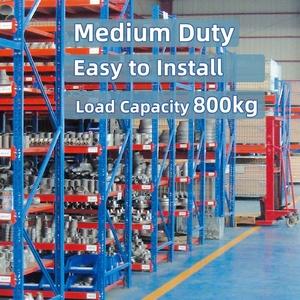
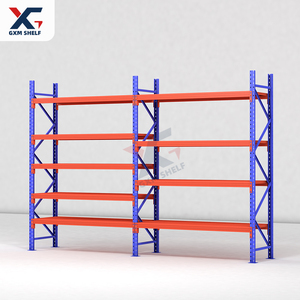
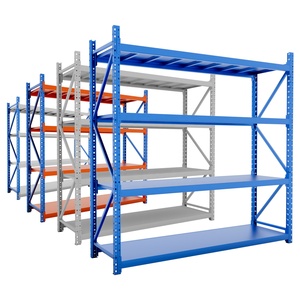
- Wide Aisle (Adjustable Pallet Racking - APR): Operating with clear working aisle widths between 3,000mm and 3,800mm, APR systems facilitate standard counterbalance forklift access and two-way travel. While delivering 100% immediate pallet selectivity, APR consumes up to 60% of floor space purely in transit aisles, capping total warehouse volumetric storage efficiency below 40%.
- Narrow Aisle (Reach Truck Operations): Compressed into aisle widths of 2,600mm to 2,900mm, reach truck systems utilize pantograph or moving-mast kinematics to access heights up to 11.5 meters. Space efficiency improves by 20% to 25% over conventional wide aisle layouts while preserving single-pallet selectivity.
- Very Narrow Aisle (VNA): Operating within razor-thin margins of 1,600mm to 1,900mm aisle clearance, VNA racking leverages specialized turret trucks, order pickers, or articulated forklifts. Mast guidance is executed via inductive low-frequency wire guidance embedded in the concrete slab or structural floor-mounted steel guide rails (L-profile or C-profile). VNA vertical heights routinely reach 16 to 18 meters, yielding cubic utilization factors exceeding 65%.
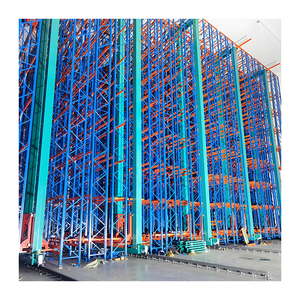
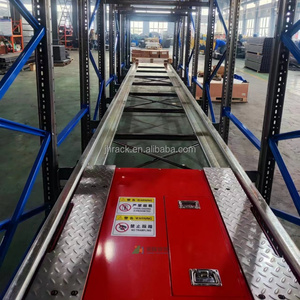
- Automated Deep-Lane Aisle Corridors (Radio Shuttle & AS/RS): Eliminating internal operating aisles entirely, these dynamic frameworks rely on high-bay shuttle carriers moving along embedded cold-rolled running rails. A dedicated exterior transfer aisle houses the reach truck or stacker crane, transforming warehouse density to 80%+ volumetric occupancy.
Comparative Engineering Matrix: Warehouse Aisle Topologies
| Aisle Configuration | Aisle Width (mm) | Vertical Reach (m) | Floor Utilization (%) | Selectivity | MHE Compatibility | CapEx / Pallet |
|---|---|---|---|---|---|---|
| Wide Aisle (APR) | 3,200 – 3,800 | Up to 9.0m | 35% – 42% | 100% Direct | Standard Counterbalance Forklift | Low Base |
| Narrow Aisle | 2,600 – 2,900 | Up to 12.0m | 48% – 55% | 100% Direct | Pantograph / Moving Mast Reach Truck | Low-Medium |
| Very Narrow Aisle (VNA) | 1,600 – 1,900 | Up to 18.0m | 62% – 70% | 100% Direct | Turret Truck / Man-Up Tri-Lateral VNA | Medium-High |
| Drive-In / Drive-Through | 1,050 – 1,150 (Lane) | Up to 11.0m | 65% – 75% | LIFO / Last-In | Counterbalance / Narrow Chasis Reach | Low-Medium |
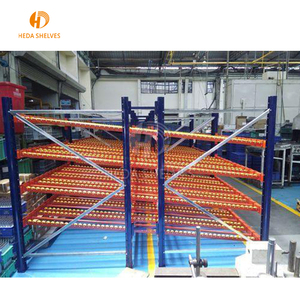
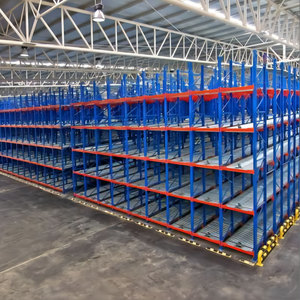
| Pallet Flow (Gravity Roller) | Continuous Deep Bed | Up to 12.0m | 70% – 80% | Strict FIFO | Standard Forklift at Pick/Drop Faces | High (Roller Beds) |
| Radio Shuttle High-Density | Corridor + Lane Array | Up to 24.0m+ | 78% – 88% | Flexible Batch | Pallet Runner Shuttle + Standard Mast | Medium-High |
Upright Frame Mechanics, Perforation Geometry, & Seismic Deflection
Aisle racking structural safety hinges upon upright frame stiffness ($EI_x, EI_y$) and beam-end connector moment-rotation characteristics ($M-\theta$). Standard column sections produced by tier-1 manufacturers utilize continuous cold roll-formed omega profiles featuring up to 12 longitudinal bending folds. Each bend introduces work-hardening along the bend radius, substantially increasing localized yield strength over the flat parent steel sheet.
Furthermore, column perforations (typically teardrop, square, or hexagonal slots punched at precise 50mm or 75mm increments) reduce the effective steel cross-sectional area. Advanced structural certification under RMI Specification MH16.1 mandates experimental testing to verify stub-column compressive resistance, upright torsional buckling limits, and cyclic seismic performance. In active seismic zones (such as Chile's NCh 2369, Peru's E.030, or the American West Coast ASCE 7), aisle racking must incorporate enlarged heavy-duty base plates with chemical resin capsule anchoring, reinforced horizontal/diagonal bracing trusses, and top-tie bracing beams spanning across opposite aisle frames to absorb dynamic spectral accelerations without structural catastrophic collapse.
Future Procurement Trends in Warehouse Aisle Racking
Global supply chain shocks, escalating industrial real estate lease rates, and automated intralogistics mandates are radically reshaping enterprise racking procurement criteria through 2030.
1. High-Bay Verticality & Micro-Footprints
Industrial rent rates per square meter have escalated globally by over 38% since 2021. Procurement directors are systematically abandoning sprawling low-clearance warehouses in favor of 14m to 24m+ clear-height facilities. High-bay aisle racking capable of bearing 30-ton upright frame loads without permanent deflection is now the central standard for urban e-commerce fulfillment hubs.
2. Autonomous AMR & Shuttle Readiness
Static racks that cannot transition to automated materials handling are rapidly becoming obsolete. Procurement engineers now demand hybrid aisle designs featuring bottom-track bolt locations for Autonomous Mobile Robots (AMRs), optical reflector mounting points on aisle portals, and pre-engineered tolerances compatible with retrofittable radio shuttle fleets.
3. Cold Chain Brittle Fracture Resilience
Refrigerated agricultural, pharmaceutical, and meat export logistics require structural steels rated for extreme temperatures (-25°C to -40°C). Conventional structural steel undergoes brittle ductile-to-brittle transitions under sub-zero conditions. Future sourcing mandates certified Charpy V-notch impact-tested Q355D steel with specialized low-temperature powder coatings.
4. Total Landed Cost (TLC) Densification
Skyrocketing ocean freight and containerized transportation rates mean that racking buyers calculate purchasing efficiency on a landed-per-pallet-position basis. Suppliers must provide nested upright profile geometries and modular KD (knocked-down) bolted frames that achieve 98%+ cubic container fill efficiency without damaging factory powder coatings.
Technological & Engineering Evolution in Aisle Systems
From structural telemetry sensors to closed-loop finite element modeling, the technical boundary between civil engineering, metallurgical science, and automated software is merging.
IoT Structural Telemetry & Impact Sensing
Forklift impact against upright aisle frames accounts for over 85% of structural racking degradation. Emerging aisle architectures integrate 3-axis MEMS accelerometer sensors and Bluetooth mesh beacons on vulnerable aisle entry columns. Real-time telemetry alerts facility directors instantly when an impact exceeds allowable plastic deformation thresholds, preventing sudden frame failure.
Digital Twin Spatial Simulation (BIM / FEA)
Bespoke aisle engineering now deploys complete 3D Building Information Modeling (BIM) to integrate racking geometry with fire sprinkler clearance (NFPA 13 in-rack sprinkler drops), lighting photometrics, and concrete floor slab joints. Finite Element Analysis simulates frame deflection under localized 1.5x seismic dynamic accelerations prior to raw coil punching.
Eco-Galvanizing & Closed-Loop Pretreatment
Tightening ESG governance has accelerated the retirement of traditional heavy-metal chemical phosphating. Tier-1 manufacturers are deploying automated multi-stage zirconium nano-ceramic immersion lines coupled with high-efficiency electrostatic powder cure ovens, eliminating VOC emissions while increasing salt spray corrosion resistance past 500 hours (ASTM B117).
Why Global Logistics Leaders Partner with HEDA Shelves
Since 2001, Guangzhou Heda Shelves Co., Ltd. has delivered turnkey engineering, ISO 9001 certified manufacturing, and global ocean freight delivery across 120+ countries.
Accountable Engineering from Coil to Anchor Bolt
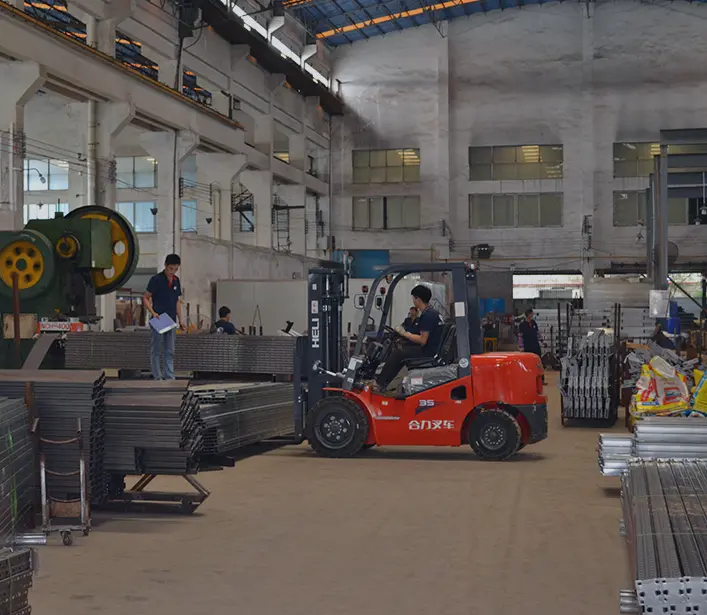
When procuring heavy-duty industrial aisle racking, intermediaries and trading brokers create structural liability risks and markups. HEDA Shelves maintains complete vertically integrated control over raw structural coil procurement, continuous cold profiling, precision punching, robotic welding, and automated surface finishing in our 30,000 m² state-of-the-art facility.
- Free 3D Layout & Seismic Static Calculations: Complete CAD architectural drawings, MHE aisle clearance validation, and structural verification delivered within 24 to 48 hours.
- Certified International Quality Compliance: Fully verified by CE Certificate (2435-CPR-8605159), ISO 9001:2015 quality management systems, and RoHS environmental directives.
- Specialized Global Port Logistics: Container packaging densification and ocean freight dispatch optimized for major global hubs across the Americas, Europe, Middle East, and Southeast Asia.
10-Stage Quality-Controlled Fabrication Process
Raw Steel Testing
Spectrometric & tensile yield testing of Q235B/Q355B coils.
Precision Slitting
High-speed CNC coil uncoiling and laser width calibrating.
Auto Punching
Synchronized multi-die punching for precision 50/75mm pitches.
Roll Forming
Multi-stand continuous profiling with cold-work hardening.
Beam Forming
Interlocking box-beam roll forming with robotic seam welding.
Connector Welding
Multi-prong heavy connector robotic jig welding.
Surface Pickling
Acid immersion bath removing all rolling scale & mill rust.
Phosphating
Zinc phosphate chemical wash for maximum coat adhesion.
Electrostatic Coat
Automated powder spray cured in 200°C thermal tunnels.
Export Packing
Shock-proof bundled crating with moisture vapor barriers.
Frequently Asked Questions by Industrial Racking Buyers
Detailed engineering, operational, and commercial answers addressing common technical queries encountered in large-scale warehouse racking procurement.
How do clear aisle dimensions dictate forklift choice and overall cube storage capacity?
Aisle dimensions establish an engineering trade-off between warehouse throughput speed and volumetric storage density. Standard Counterbalance forklifts require 3.5m to 3.8m clear aisles, resulting in approximately 35% floor utilization. Transitioning to Reach Trucks compresses aisles to 2.7m–2.9m, lifting space efficiency to ~50%. Specifying Very Narrow Aisle (VNA) turret trucks tightens aisles to 1.65m–1.85m, elevating floor space utilization above 65%. Our engineering team calculates the Right-Angle Stacking Aisle ($A_{st}$) dimension directly from your MHE fleet turning radius ($W_a$) and pallet dimensions: $A_{st} = W_a + \sqrt{(l_x - x)^2 + (b/2)^2} + a$, where $a$ represents mandatory 200mm safety clearance.
What steel grades and structural coatings are specified for cold chain warehouses (-25°C)?
Cold storage environments induce micro-structural changes in carbon steel, causing ordinary Q235B structural profiles to experience low-temperature embrittlement. For temperature regimes below -10°C, HEDA specifies Q355D or Q355E high-yield micro-alloyed structural steels subjected to certified Charpy V-notch impact tests at -20°C and -40°C. For humidity condensation cycles, components are pre-treated through full immersion degreasing and pickling, followed by hot-dip galvanizing (minimum 60-80 microns coating thickness conforming to ISO 1461) or specialized thermal-setting epoxy powder coatings formulated to resist embrittlement and micro-cracking.
What specific engineering inputs are required to generate a certified 3D CAD layout?
To prepare a structural calculation report and CAD plan, our engineering office requires: (1) Warehouse building DWG drawing showing column grids, expansion joints, wall offsets, and clear ceiling height under roof trusses; (2) Concrete slab specification (thickness, compressive strength $f'_c$, rebar mesh, and maximum allowable point load in kN); (3) Complete pallet parameters (width, depth, height including cargo overhang, and gross pallet weight); (4) MHE model cut-sheet detailing mast collapse height, maximum lift height, and minimum aisle width requirement; and (5) Site location geographical parameters to calculate wind and seismic coefficients ($S_s, S_1$ under ASCE 7 or zone factors under regional standards).
What are the structural beam deflection limits under EN 15512 and ANSI MH16.1 codes?
Allowable vertical deflection of racking load beams under full rated design load is strictly regulated to prevent pallet displacement and connector disengagement. Under ANSI MH16.1, maximum beam deflection ($\delta$) must not exceed $L/180$, where $L$ is the clear span distance between upright columns. Under European code EN 15512, the standard design criterion is capped at $\delta \le L/200$, with specialized automated and AS/RS high-bay systems enforcing $\delta \le L/300$ or a strict absolute maximum limit of 4.0mm to preserve sensor and shuttle travel tolerances.
Can conventional wide-aisle selective racking be converted to semi-automated shuttle systems?
Yes, subject to structural engineering load verification. Selective racking upright frames are typically engineered for uniform floor-level beam loads. Converting to a deep-lane Pallet Shuttle configuration concentrates cumulative lane pallet weights onto frame columns and foundation base plates. Our engineering department reviews existing frame steel thickness, bracing configurations, and slab anchor shear ratings. Where structural integrity permits, existing frames can be retrofitted with specialized heavy-duty shuttle rail support brackets, running tracks, and pallet entry guides, increasing storage capacity by 40% to 70%.
What is the typical production and ocean dispatch lead time for high-bay projects?
Backed by a 30,000-ton monthly manufacturing capacity, standard project orders (e.g., 2,000 to 5,000 pallet positions) are completely fabricated, powder coated, quality inspected, and packaged within 15 to 25 business days following structural drawing sign-off. Major infrastructure projects (10,000+ positions or multi-tier mezzanine floors) are manufactured in phased container batches scheduled to arrive sequentially at the destination port, matching the EPC project site erection schedule without creating yard congestion.