High-Capacity Double Deep Systems Engineered for Peak Throughput
Double-deep configurations eliminate up to 40% of standard aisle consumption compared to conventional selective racking by staging pallets two-deep per bay. Review our factory-tested industrial models built to international standards (RMI, EN 15512, and FEM 10.2.02).
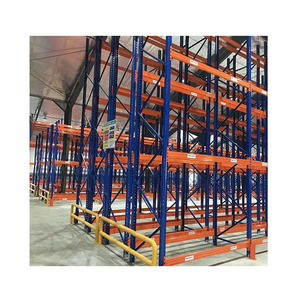
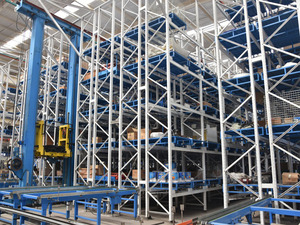
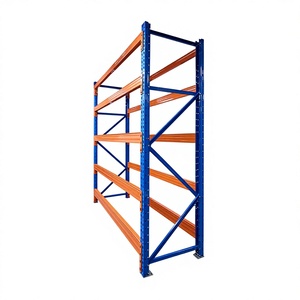
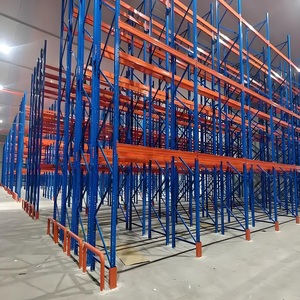
Structural Engineering: Why Double Deep Unlocks Maximum Floor Economics
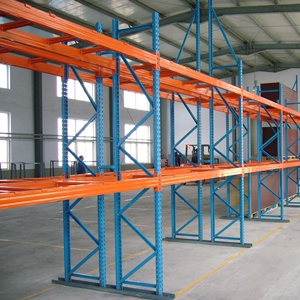
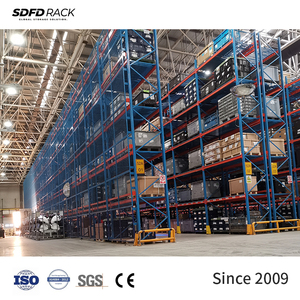
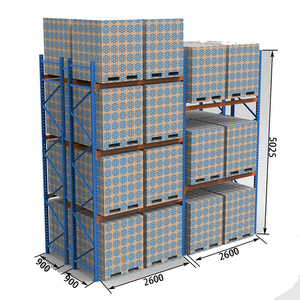
Double deep pallet racking operates by placing two single pallet racks back-to-back, accessed via pantograph or telescopic fork reach trucks. This architecture eliminates alternate operating aisles, generating a 30% to 40% density boost over standard selective racking while curbing the astronomical initial CAPEX of fully automated crane-based AS/RS setups.
Kinematic Reach Dynamics
Requires double-reach pantograph trucks or specialized telescopic forks. Structural calculations account for mast deflection and eccentric moment loading when extending past front beams into the second pallet position.
LIFO SKU Stratification
Operates under Last-In, First-Out logistics per dual-slot pair. Optimal inventory turnover is achieved when storing 2 to 4 pallets per SKU, curbing honeycomb losses while preserving 50% immediate pallet access.
Deflection & Seismic Criteria
Beams adhere to strict Class 1 deflection limits (maximum L/200 or L/250 under uniformly distributed load). Baseplates, shims, and anchoring are dynamically modeled to resist local spectral acceleration (PGA).
| Racking Topology | Floor Area Utilization | Pallet Accessibility | Reach Truck Aisle Width | Stock Rotation Logic | Relative CAPEX / Pallet |
|---|---|---|---|---|---|
| Selective Pallet Racking | 35% - 42% | 100% Direct Pick | 3,000 - 3,400 mm | FIFO (First In, First Out) | Baseline (Low) |
| Double Deep Storage (HEDA) | 55% - 65% | 50% Immediate Access | 2,800 - 3,200 mm | LIFO / Batch FIFO | +15% - 20% vs Selective |
| Drive-In Racking | 65% - 75% | 15% - 25% Limited | Internal Drive Lanes | Strict LIFO Only | +30% - 45% vs Selective |
| Radio Shuttle Cart | 75% - 85% | Automated Lane Access | 2,600 - 3,000 mm | FIFO / LIFO Switchable | High (Robotic Carts) |
| Very Narrow Aisle (VNA) | 50% - 60% | 100% Direct Pick | 1,650 - 1,900 mm | FIFO Direct Access | Medium-High (Wire/Rail) |
Guangzhou HEDA Shelves: 25+ Years of Export Manufacturing Prowess
As a specialized high-tonnage manufacturer and exporter founded in 2001, Guangzhou Heda Shelves Co., Ltd. operates a vertically integrated 30,000 m² industrial manufacturing complex. We guarantee metallurgical precision, structural compliance, and turn-key export execution.
Two and a half decades dedicated exclusively to heavy structural warehouse fabrication and international EPC supply.
Continuous automated roll-forming lines, automated laser profiling, and multi-axis CNC punching stations.
Automated pre-treatment phosphating and dual-tunnel electrostatic powder coating lines with AkzoNobel polymers.
Accredited under CE 2435-CPR-8605159, ISO 9001:2015 (No. 18624Q00169R0M), and independent tensile testing.
★ Certified Prime Mill Cold-Rolled Coils
We refuse the use of re-rolled or uncertified strip steel. HEDA systems utilize certified prime cold-rolled Q235B and high-yield Q355B coils sourced directly from top-tier state mills (Baosteel, Shougang). Mill test certificates (MTC) with full chemical analysis and Charpy impact tests accompany every export batch.
- Upright Columns: Continuous 11-13 fold omega profiles engineered to maximize moment of inertia.
- Step Beams: Dual-C interlocking robotic laser seam welding delivering torsional rigidity.
- Safety Pins: Cold-forged, high-tensile safety locking pins preventing accidental upward dislodgement.
★ Turn-Key Engineering & Export Packaging
Export projects require rigorous packing integrity to prevent transport scarring, deformation, and moisture intrusion across 30 to 45 days of ocean transit. HEDA executes tailored 40HQ load optimization software plans to guarantee maximum weight and volume utilization.
- Bundle Protection: Heavy-gauge corrugated buffer pads, strapping edge protectors, and air-cushion dunnage.
- Anti-Corrosion VCI: Vapor Corrosion Inhibitor wrapping for long-haul maritime routes across equatorial climates.
- Free 3D Layout: Finite element structural check (FEM) and CAD plans provided prior to contract formalization.
Future Procurement & Technological Trends in High-Density Storage
As land valuation accelerates across major inland ports and industrial zones, logistics executives are re-engineering storage strategies. Understanding the technological shifts shaping the next procurement cycle is vital for maximizing 15-year return on assets (ROA).
AGV & AMR Deep Integration
Autonomous reach forklifts and optical vision-guided AMRs are replacing standard manual pantograph trucks. Next-generation double deep racks are precision-drilled for aisle reflectors, floor guidance wire channels, and optical barcode positioning targets on upright flanges.
- Laser tolerance: ±1.0mm per bay deviation
- Floor flatness compliance: DIN 18202 / VDMA 15635
- Automated battery-charging docking bays
Perma-Frost Thermal Efficiency
With refrigerated space costing 3.5x to 5x more per cubic meter to operate than ambient ambient warehousing, cold chain operators are aggressively transitioning from single selective to galvanized double deep racking to minimize cubic refrigeration waste.
- Pre-galvanized zinc coatings up to 275 g/m²
- Specialized low-temperature steel chemistry
- Elimination of thermal bridging at slab baseplates
Performance-Based Seismic Design
Global insurers and municipal building codes (such as Chile's NCh 2369, Peru's E.030, and US IBC/RMI MH16.1) mandate rigorous base-isolation and high-ductility frames capable of withstanding dynamic horizontal forces without progressive collapse.
- Thickened anchor plates with dynamic grout beds
- High-energy dissipation portal bracing
- Site-specific spectral response acceleration modeling
Steel Price Hedging & Decoupling
Global commodity volatility has led tier-1 warehouse contractors to prioritize tier-1 Chinese manufacturers with strong upstream billet stockpiles. Forward contracts and consolidated multi-project sea containers protect developers from sudden tariff and freight swings.
- Fixed-price rolling procurement agreements
- Staged multi-container phased deliveries
- Direct container stuffing at port of loading
Green Steel & EPD Environmental Proof
Multinational logistics conglomerates (such as DHL, Maersk, and DB Schenker) now require Environmental Product Declarations (EPD) for racking assets. Manufacturers are implementing scrap-recycled electric arc furnace (EAF) steel and zero-VOC electrostatic powder lines.
- RoHS-compliant heavy-metal-free finishes
- 100% recyclable cold-formed structural steel
- Verified low-carbon production life-cycle assessments
IoT Deflection & Impact Monitoring
Wireless acoustic-emission sensors and strain gauges mounted on critical upright base-ends and mid-span load beams offer real-time telemetry. Facility managers receive immediate alarms regarding forklift collisions or structural over-deflection.
- Early warning deflection detection
- Instant mobile notification of forklift mast impacts
- Reduced annual rack safety auditing inspection hours
Double Deep Engineering Specifications Master Reference
Engineered to match varied pallet footprint standards worldwide—including Euro (1200x800mm), ISO/US GMA (1200x1000mm), and Australian standard pallets (1165x1165mm).
| Structural Sub-Assembly | Standard Dimension / Gauge Range | Material Specification | Corrosion Protection / Coating |
|---|---|---|---|
| Upright Frame Columns | Width: 80, 90, 100, 120, 140 mm; Thickness: 1.8 - 3.0 mm | Q235B / Q355B Hot-Rolled Strip, Cold-Roll Formed | Electrostatic Powder (60-80μm) or Hot-Dip Galvanized |
| Double-Deep Box Beams | Height: 80 - 160 mm; Thickness: 1.5 - 2.5 mm; Span: up to 4,000 mm | High-Tensile Cold-Rolled Interlocking Twin C-Sections | AkzoNobel Pure Polyester Thermoset Powder |
| Bracing Diagonals & Horizontals | C-channel profile (32x20mm, 40x25mm); Thickness: 1.5 mm | Q235B Galvanized or High-Ductility Structural Steel | Zinc passivated, Pre-galvanized or Painted |
| Row Spacers (Tying Back-to-Back) | Length: 200 mm to 600 mm (Tailored to mast clear reach) | Heavy-gauge rectangular hollow section (RHS) | Powder coated matching frame or zinc plated |
| Pallet Guide & Support Bars | 50x50 Angle or flanged drop-in top hat channel | High-yield structural carbon steel | Zinc electroplate or safety warning yellow powder coat |
| Floor Heavy-Duty Anchor Studs | M12 × 100 mm to M16 × 150 mm chemical or mechanical anchors | Grade 8.8 / Grade 10.9 Carbon Structural Steel | Galvanized / Yellow dichromate plated |
Frequently Asked Technical & Procurement Questions
Direct engineering answers addressing reach mechanics, floor slab load capacity, inventory accessibility tradeoffs, and maritime delivery times.
What specialized forklift equipment is required for double deep racking?
Standard counterbalanced forklifts cannot operate in double deep layouts. Facilities require either a double-reach reach truck equipped with a pantograph scissor extension mechanism or a counterbalance/reach unit equipped with specialized hydraulic telescopic forks. Pantograph systems are favored across North America, while European operators frequently deploy telescopic fork systems. Camera systems installed on the fork carriage are strongly advised for pick heights exceeding 6 meters.
How does double deep racking impact inventory access and "honeycombing"?
Double deep offers 50% immediate pallet selectivity since back pallets are blocked by front positions. This layout is optimal when you store between 2 and 4 pallets per distinct SKU. "Honeycombing" occurs when back-row pallet locations remain empty because operators cannot mix disparate SKUs in the same front-and-back slot. With intelligent Warehouse Management System (WMS) batch allocation, overall storage fill efficiency consistently averages 85% to 90%.
Are bottom pallet guide rails or floor level beams mandatory?
In standard selective systems, floor-level pallets typically rest directly on concrete. In double deep systems, placing pallets directly on the floor in the second (rear) position can challenge forklift drivers to maintain clean alignment without guide aids. We recommend bottom support beams positioned 150-200mm above finished floor level, or bolted ground-mounted pallet guide channels to maintain precise alignment and prevent column impact.
What warehouse floor slab criteria are necessary for double deep loads?
Because double deep concentrates two rows of deep pallets on combined baseplate locations, point load (punching shear) demands on the concrete slab increase significantly. A standard 150mm slab is adequate for lighter pallets, but multi-tier high-bay systems carrying 1,500kg per pallet typically demand a minimum slab thickness of 200mm to 250mm, reinforced with welded wire fabric or steel fibers, designed for a minimum compressive strength of 25 to 30 MPa (C25/30 or 4,000 PSI).
How does HEDA design double deep systems for high seismic risk zones?
In earthquake-prone regions (such as Chile, Peru, Colombia, Japan, and the Western United States), our engineering department runs finite-element response spectrum analyses. Upright frame baseplates are enlarged and thickened (typically 12mm to 16mm thick), dual seismic wedge anchors or chemical anchors are designated, and back-to-back row spacers are engineered as heavy rigid tubular trusses to transfer horizontal ground acceleration through the rack matrix.
What is the typical production lead time and export container transit duration?
Standard production schedules at our Guangzhou facility run between 2 and 4 weeks following drawing and structural calculation approval. Global export shipping durations via major South China container ports (Guangzhou, Shenzhen, Hong Kong) range from 12-18 days to Southeast Asia and Australia, 20-28 days to the US West Coast and Europe, and 30-42 days to Latin America (Santos, Callao, Valparaíso, San Antonio). Complete load plans optimize 40HQ container utilization above 95%.
Request a Tailored Double Deep Warehouse Layout & Free Structural Load Plan
Supply our engineering team with your building architectural drawings, clear eaves height, pallet specifications, and forklift parameters. Our senior structural designers will provide a compliant 3D CAD proposal, container load simulation, and competitive factory-direct export quote within 24 business hours.
Speak Directly With Our Engineering Office
Certified engineers ready to assist with high-density storage planning.
Get a Quote