Engineered Density: The Evolution of Dynamic Pallet Accumulation
Push back pallet racking has surfaced as the engineering benchmark for distribution centers caught between the low selectivity of drive-in systems and the mechanical overhead of fully automated shuttle matrices. By integrating precision inclined cart assemblies, nesting gravity flow mechanics, and finite element stress analysis, our push back systems deliver unmatched LIFO high-density accumulation across North America, Europe, and Latin America.
In modern distribution hubs, industrial floor space represents an inflating operational liability. Standard selective racking systems allocate over 55% of floor surface purely to forklift operating corridors. In contrast, heavy-duty nested push back pallet racking captures up to 85% volumetric warehouse utilization by consolidating multiple pallet depths into a single accessible loading face. This dynamic accumulation method avoids the common structural impacts associated with forklifts entering deep rack lanes—radially lowering frame upright maintenance costs while expediting handling cycles by 40% or more.
As a globally certified manufacturing exporter, Guangzhou Heda Shelves Co., Ltd. (HEDA Shelves) produces structural roll-formed push back carts, structural rails, and integrated seismic-tolerant frames engineered to EN 15512, RMI (MH16.1), and CE quality specifications. Whether you are managing minus-degree cold logistics facilities in Chile, agricultural hubs in Brazil, or high-throughput retail fulfillment cross-docks in North America, our factory-direct engineering mitigates structural fatigue and guarantees dimensional stability across millions of dynamic loading cycles.
Recommended High-Performance Racking & Dynamic Systems
Explore our heavy-duty industrial storage components, manufactured with premier grade cold-formed structural steel, automated CNC punching, and corrosion-resistant electrostatic finishes.
Inside the Mechanism: How Cart-Based Dynamic Accumulation Works
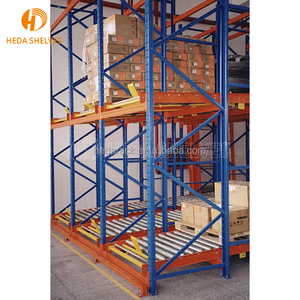
Push back pallet racking operates on an inclined rail profile (typically a 2% to 3% gradient) using a series of nesting steel carts. Understanding the kinematic physics and gravity feed dynamics is critical for system longevity and operator safety.
Nested Low-Profile Carts
Pallets rest upon precision-welded nested steel carts that ride along inclined structural channels. When the initial pallet is loaded on the top cart, the second pallet gently pushes that cart back, exposing the sub-level nesting cart beneath. This nested geometry guarantees low vertical height loss per level.
Controlled Gravity Deceleration
Upon pallet extraction, gravitational potential energy brings the remaining loads smoothly forward to the pick aisle. Heavy-duty sealed roller bearings with machined steel guides regulate speed, preventing velocity runaways and ensuring pallets never jar against front beam stops.
Impact Mitigation Architecture
Unlike drive-in systems where trucks maneuver within structural frames, operators interface solely with the exterior aisle face. This design virtually eliminates mast strikes, protecting column integrity, anchor embedments, and expensive warehouse concrete floors from shock shear.
Push Back vs Alternative High-Density Racking Configurations
Data-driven selection parameters comparing Push Back Pallet Racks with Selective, Drive-In, and Semi-Automated Radio Shuttle systems across operational metrics.
| Storage Racking System | Storage Density | Selectivity Level | Handling Velocity | Equipment Capital Cost | Risk of Forklift Collisions |
|---|---|---|---|---|---|
| Push Back Racking (2-6 Deep) | High (Up to 80%) | Medium-High (Per Lane) | Fast (Single Aisle) | Moderate (No Electronics) | Extremely Low |
| Standard Selective Racking | Low (40-50%) | 100% Direct Access | Moderate (Long Aisle Travel) | Lowest Initial Capex | Medium (High Traffic) |
| Drive-In / Drive-Through | Maximum (Up to 85%) | Low (Strict Batch) | Slow (Internal Driving) | Moderate | Very High (Drive-In Impact) |
| Radio Shuttle System | Maximum (85%+) | Medium (Lane Managed) | Fast (Automated Shuttling) | High (Batteries/Motors) | Low |
Future Sourcing & Procurement Trends in Push Back Racking Systems
Supply chain leaders, 3PL providers, and procurement managers are navigating dynamic macro challenges. Here is how advanced push back systems are evolving to meet tomorrow's logistics requirements.
High-Latitude Seismic Engineering
Global logistics facilities in seismic hazard zones (such as Chile's NCh 2369, Peru's E.030, and California IBC) demand dynamic finite-element response spectrum analyses. Future procurement emphasizes widened ductile baseplates, high-tensile column anchorages, and bracing connectors specifically calculated for dynamic cart oscillations during earthquake events.
Cold-Chain & Humidity Anti-Corrosion
With global cold chains expanding rapidly to satisfy frozen food and biopharma distribution, traditional paint coatings peel and corrode under deep refrigeration condensation. Sourcing trends favor heavy electro-galvanized cart assemblies, food-grade low-temperature bearing greases rated down to -30°C, and electrostatic epoxy-polyester hybrid powder coats.
Hybrid AGV & Forklift Integration
As distribution hubs transition from human-operated lift trucks to Automated Guided Vehicles (AGVs) and Autonomous Mobile Robots (AMRs), push back entry throats require tighter optical tolerances. Laser-cut target guides, integrated RFID pallet seating sensors, and precision alignment bumpers are becoming mandatory specifications in push back procurement tenders.
Why International Importers Partner with HEDA Shelves
Founded in 2001, Guangzhou Heda Shelves Co., Ltd. operates a 30,000 square-meter advanced manufacturing facility supported by over 300 experienced engineers, structural technicians, and international project managers.
Free 3D & CAD Engineering
We supply complimentary custom 3D simulations, CAD layout diagrams, and structural calculations including seismic load validation before contracts are initiated.
CE & ISO 9001 Certified
Strict quality oversight backed by CE Certificate No. 2435-CPR-8605159 and ISO 9001:2015 accreditation, ensuring compliance with international third-party audit standards.
Export Container Load Plans
Custom nested bundling and robotic container packing strategies prevent transit abrasions, optimizing ocean container volumetric capacity by up to 35%.
Complete Global Port Reach
Direct ocean freight handling to major ports including Santos, Paranaguá, Callao, San Antonio, Guayaquil, Rotterdam, and Houston with rapid shipping schedules.
Frequently Asked Questions on Push Back Racking Procurement
Clear, technical, and commercial answers addressing common engineering challenges faced by international storage racking importers and supply chain executives.
What is the maximum practical pallet depth for push back rack systems? +
Can push back racks accommodate variable pallet footprints in the same lane? +
How is structural safety ensured in high-risk seismic environments? +
What surface treatment is recommended for refrigerated or coastal warehouses? +
What production lead time should international project buyers anticipate? +
What technical data is required to generate a layout and quote? +
Ready to Maximize Warehouse Storage Capacity?
Send your facility floor layout to receive a complimentary 3D rendering, engineering load analysis, and factory-direct export quote within 24 hours.
Get a Quote