Engineered High-Bay & Heavy-Duty Storage Configurations
Certified high-altitude structural frames, narrow-aisle geometries, and high-tensile modular uprights manufactured to stringent EN 15512 and RMI standards.
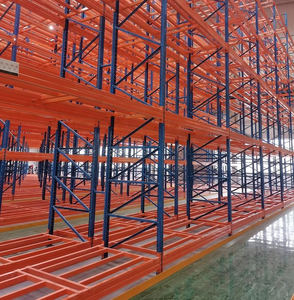
Industrial Warehouse Storage Steel Racking System Heavy Duty Very Narrow Aisle Racking
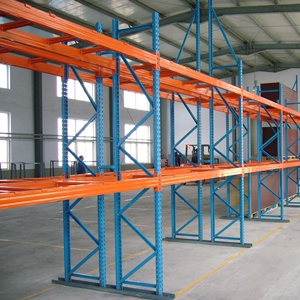
Adjustable Heavy Duty Pallet Rack Shelf Two Levels Custom High Load Capacity Industrial Warehouse Storage Pallet Racking System
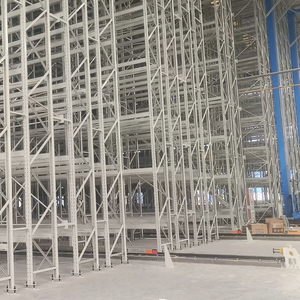
1000kg Warehouse Rack System with High Density Layout
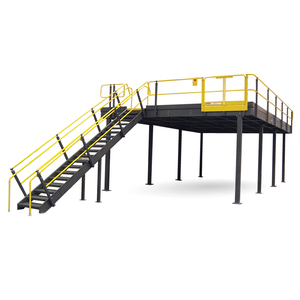
High Quality Rack-Supported Raised Platform Prefabricated Modular Steel Mezzanine Floor 1000kg/sqm Load Capacity Corrosion
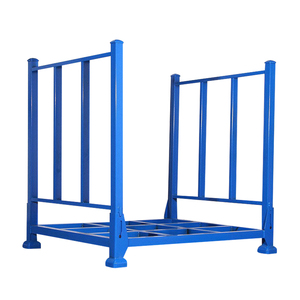
Wholesale Stacking Heavy Duty High Capacity Moveable Metal Welded Rack Logistics Industrial Transport Stable Pallet Rack
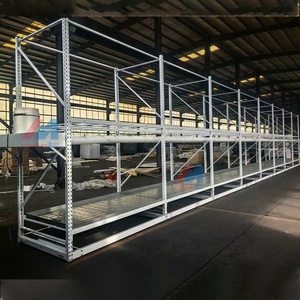
Commercial Grow Rack with Waterproof Shelves
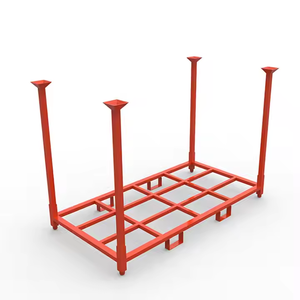
Industries Warehouse Customized Blue Pallet Steel Flat Plate Foldable Stack Fabric Storage Tire Rack Stacking Racks
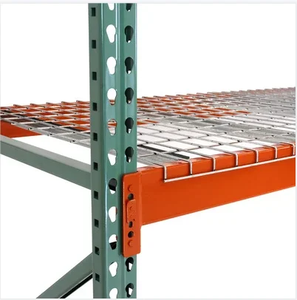
Teardrop Pallet Rack Mesh Vertical Storage Adjustable Shelves Unit Vna Racking System
Precision Fabrication Backed by 25 Years of Operational Authority
Operating out of Guangzhou with direct raw steel coil partnerships, Guangzhou Heda Shelves Co., Ltd. delivers engineered racking solutions engineered to withstand extreme torsional, vertical, and seismic forces.
In-House Roll-Forming Lines
Continuous precision roll-forming lines with multi-station tooling for cold-formed open profiles, ensuring zero micro-fracturing along column corners.
Tolerance ±0.5mmRigorous Seismic Engineering
Certified dynamic load analysis under Chilean NCh 2369, Peruvian E.030, Colombian NSR-10, and European Eurocode 8 standards.
Base Isolator ReadySurface Pre-Treatment & Coating
Multi-tank chemical pickling, non-toxic phosphating bath, and automated dual-side electrostatic epoxy coating providing up to 800 hours salt-spray resistance.
60-80 Micron FilmFull Container Load (FCL) Logic
Engineered bundling, structural nesting techniques, and custom hardwood skids ensure 100% component safety across global maritime trade routes.
Max Payload YieldStructural Integrity, Deflection Limits, and Stability in Tall Racking Design
When warehouse storage exceeds 12 meters in vertical height, standard static calculations no longer suffice. Second-order structural effects, horizontal dynamic sway, and connection semi-rigidity must govern material sizing.
1. Sizing Tall Upright Frames: Managing Second-Order P-Delta Mechanics
In ultra-tall warehouse installations (ranging from 12 meters to upwards of 30 meters in high-bay automated crane racking), tall pallet racking acts as an unbraced or semi-braced slender structural frame. The primary failure mode under extreme payload is not simply pure axial yield, but interactive elastic-plastic buckling coupled with lateral displacement. In structural engineering vernacular, this is categorized as the P-Delta (Δ) Effect, wherein axial vertical loads acting on a laterally deflected column generate severe secondary bending moments.
To prevent progressive buckling collapse, top manufacturers implement cold-formed omega and modified C-profiles featuring continuous stiffening ribs along both flanges and the web. Unlike generic light-gauge shelving, tall high-bay uprights require cold-rolled steel thickness ranging from 2.0 mm to 3.2 mm (Q355B yield strength ≥ 355 MPa). Perforation geometry is critically balanced: every punch-out pattern (whether standard teardrop, hexagon, or diamond shape) inherently decreases the net effective cross-sectional area ($A_{eff}$). Advanced finite element calculations according to EN 15512 allow HEDA engineers to optimize hole pitch (typically 50 mm or 75 mm) while maximizing structural torsional rigidity ($J$) and warping constants ($C_w$).
| Racking Type | Standard Clear Height | Aisle Width (Ast) | Recommended Truck Interface | Floor Flatness Spec | Volumetric Efficiency |
|---|---|---|---|---|---|
| Selective Pallet Racking | 3,000 – 10,000 mm | 3,200 – 3,800 mm | Standard Counterbalance / Reach | Class 300 (Flat) | 40% – 50% |
| Very Narrow Aisle (VNA) | 9,000 – 18,000 mm | 1,650 – 1,950 mm | Man-Up / Man-Down Turret Truck | DIN 15185 / Superflat | 65% – 75% |
| Radio Shuttle High-Bay | 6,000 – 22,000 mm | Direct Loading Aisle | Semi-Automated Pallet Carrier | Class 200 (Standard) | 80% – 88% |
| Automated AS/RS Silo | 18,000 – 40,000 mm | 1,400 – 1,600 mm | Automatic Stacker Cranes (SRM) | FEM 9.831 / Ultra-flat | 90% – 95% |
2. Beam-End Connector Semi-Rigidity and Rotational Stiffness ($C_d$)
A critical misconception in tall pallet racking procurement is treating the connection between the horizontal load beam and the vertical upright as either a frictionless pin or a completely rigid weldment. In reality, modern adjustable beam-lock connectors behave as semi-rigid joints. The rotational stiffness ($C_d$) of the connector claw directly determines the unbraced buckling length ($L_{cr}$) of the upright columns.
HEDA's heavy-duty high-bay box beams utilize 4-prong and 5-prong cold-stamped connector brackets fitted with secondary cold-drawn drop pins. This geometry prevents unseating during dynamic upward fork impact while maximizing moment-transfer efficiency. Under full rated design capacity, horizontal deflection along the longitudinal axis is constrained within the stringent $L/200$ limit (where $L$ represents clear beam length), with high-precision automated systems strictly held to $L/300$ to prevent mast collision during high-speed turret truck retrieval.
3. Dynamic Seismic Validation: Latin American & Global Pacific Rim Codes
Warehouses situated along active seismic belts (such as Chile, Peru, Colombia, Ecuador, California, and Japan) face extreme ground acceleration coefficients ($A_0$). In tall racking structures, the stored palletized goods constitute an immense dynamic inverted pendulum mass. Poorly engineered tall racks experience inter-story drift, sheared anchor bolts, and localized beam connector tear-out under seismic shear waves.
HEDA Shelves customizes structural baseplates, anchor embedment depths, and internal diagonal X-bracing to comply with specific territorial seismic building regulations:
- Chile (NCh 433 / NCh 2369): Engineering tall racking frameworks with enlarged footplates, high-ductility anchor rods (Grade 5.8 / 8.8), and specialized top-tie portal frames to counter severe subduction earthquakes.
- Peru (Norma Técnica E.030): Dynamic modal response spectrum analysis factoring in local soil amplification coefficients ($S$) and structure importance factors ($U=1.5$).
- Colombia (NSR-10): Ductile detailing of frame uprights to withstand high horizontal base shear without brittle connection failure.
The Future of Tall Pallet Racking: 2026–2030 Procurement Trends
Escalating metropolitan land values, supply chain volatility, and carbon mandates are rapidly reshaping commercial warehouse design. Sourcing directors must anticipate these structural and technological shifts.
1. Vertical Density vs. Footprint Expansion
Industrial land acquisition costs across global hub corridors have surged by over 45% in recent fiscal cycles. Modern procurement strategies prioritize cubic utilization rather than surface footprint. Warehouses once designed at standard 8-meter ceiling thresholds are being converted or built from greenfield at 14m to 24m clear heights. Tall pallet racking systems configured for VNA or automated guided cranes yield up to 180% more pallet positions per square meter of foundation concrete.
Cubic Volume Maximization2. Hybrid Automation Readiness (Brownfield to AMR)
Forward-thinking logistics operators avoid purchasing static "single-purpose" racking. Tomorrow's procurement specs demand structural modularity: racking purchased today for manual VNA turret trucks must possess the structural rigidity and laser-profile tolerances required for immediate future retrofits into autonomous mobile robot (AMR) high-reach pickers or automated radio shuttle mother-child carrier networks without dismantling uprights.
Modular Future-Proofing3. Cold-Chain Optimization & Green Metallurgy
With pharmaceutical and fresh agricultural exports driving cold-storage investments, high-bay racking must operate inside harsh -25°C to -30°C microclimates where thermal expansion and steel embrittlement occur. Sourcing specifications are aggressively shifting toward certified high-impact-toughness cold-rolled steels (tested to Charpy V-notch impact standards) and heavy-duty hot-dip galvanized finishes to eliminate condensation-induced oxidation.
Cryogenic Steel IntegrityState-of-the-Art Manufacturing Technology Driving High-Bay Reliability
How automated roll-forming lines, computerized structural FEA simulation, and precision chemistry transform raw steel coils into world-class high-bay storage assets.
Continuous Roll-Forming
Multi-roller CNC profiling lines cold-form up to 3.2mm structural steel into rigid 12-bend upright sections with zero internal micro-cracks along the critical bend radiuses.
Continuous Tolerance LoopAutomated Robotic Welding
Beam connector endplates are fused using pulse-MIG multi-axis robotic arms. Uniform weld penetration prevents cold-lap defects and ensures rated dynamic fatigue life.
100% Non-Destructive QCNano-Zirconium Pretreatment
Replacing conventional iron-phosphate with advanced silane/nano-zirconium conversion baths, boosting powder coating adhesion and rust prevention even in tropical ports.
RoHS Eco-CompliantFEA Stress Simulation
Every high-bay proposal undergoes full-scale computerized Finite Element Analysis (FEA) checking for buckling mode shapes, Von Mises stress peaks, and natural oscillation periods.
Certified Engineering Sign-offWhy Global Logistics Specifiers Select HEDA Shelves as Their Primary Manufacturer
Founded in 2001, Guangzhou Heda Shelves Co., Ltd. has grown from a specialized steel fabrication facility into an international warehouse engineering powerhouse. With over 30,000 square meters of specialized manufacturing facilities and an output exceeding 30,000 tons per month, we control every metallurgical phase from mill coil slicing to container dispatch.
- CE Certificate No. 2435-CPR-8605159: Documented execution class compliance providing structural traceability for European, American, and Pacific infrastructure projects.
- Free Structural 3D CAD & Seismic Sizing: Submit your architectural DWG files and pallet criteria; our structural engineering team delivers complete CAD layouts, clearances, and load calculation sheets within 24 hours.
- Latin American & Trans-Pacific Shipping Logistics: High-density nested container stuffing strategies customized for direct ocean shipments to Santos, Paranaguá, San Antonio, Valparaíso, Callao, and Buenaventura.
Direct Manufacturing Verification
Unlike commercial intermediaries, HEDA Shelves provides verifiable third-party test reports, steel mill certificates (MTC 3.1), and raw chemical compositions on every finished batch.
Frequently Asked Questions by Industrial Racking Buyers
Key considerations covering structural deflection limits, seismic retrofits, floor flatness criteria, and international export logistics.
What are the structural deflection tolerances allowable for tall pallet racking beams?
How does warehouse slab flatness (e.g., DIN 15185 / VDMA guidelines) impact tall racking installations?
How are tall pallet racks customized for seismic zones like Chile (NCh 2369) or Peru (E.030)?
What is the typical manufacturing lead time and ocean container stuffing strategy?
How do you protect tall racking against corrosion in humid or cold storage microclimates?
What project parameters are required to generate an exact CAD layout and structural quotation?
Optimize Your Warehouse Verticality with Certified High-Bay Engineering
Partner directly with the manufacturer. Our senior structural engineers deliver customized CAD floor plans, load calculation dossiers, and seismic verification for tall warehouse projects globally.
Talk with a Senior Structural Engineer
Connect with our industrial rack engineering department to review drawings, load parameters, and container schedules.