High-Efficiency Warehouse Racking & Shelving Portfolio
Engineered for Tokyo logistics hubs, third-party fulfillment centers, and temperature-controlled storage facilities requiring high volumetric density, seamless reconfigurability, and certified structural reliability.
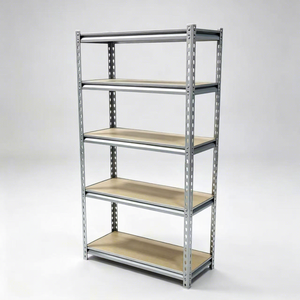
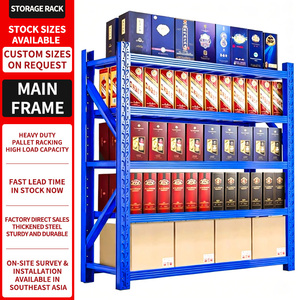
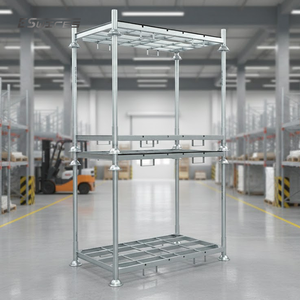
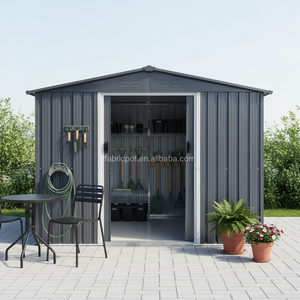
High-Density Longspan Systems for Tokyo's Spatial Constraints
A technical evaluation of storage architecture balancing extreme land costs, strict Building Standard Law compliance, and ergonomic manual-picking workflows in the Greater Tokyo Area.
The Greater Tokyo Logistics Reality: Vertical Cubic Optimization
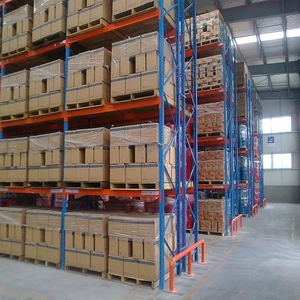
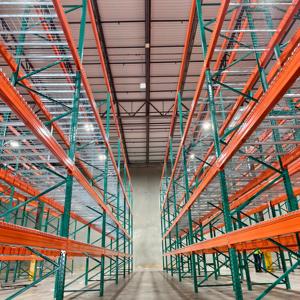
In Tokyo's premier logistics nodes—encompassing Koto-ku, Ota-ku, Shinagawa, and outer distribution zones along Tokyo Bay (Ichikawa, Funabashi, and Yokohama)—warehouse rents consistently reach ¥6,500 to ¥9,500 per tsubo (approx. 3.3 m²). Storage efficiency is strictly measured in volumetric utilization rather than mere floor footprint. Our CE-certified longspan shelving systems are deployed with modular vertical heights from 2,000 mm up to multi-tier installations surpassing 6,500 mm, transforming dead overhead air into active picking locations.
Mitigating the "2024 Problem" via Ergonomics
Following strict statutory overtime caps on heavy commercial drivers and distribution operators under Japan's revised labor legislation, Tokyo distribution hubs must accelerate manual order fulfillment speeds. Longspan shelving optimizes pick-face density for fast-moving consumer goods (FMCG), apparel, and pharmaceutical products, reducing worker travel distances by up to 42%.
- Clear span openings up to 2,500 mm without obstructive mid-posts
- Adjustable pitch at 50 mm increments for precise tote containment
- Compatible with digital pick-to-light (PTL) sensor bars
Advanced Seismic Dissipation & Base Anchoring
Tokyo sits within one of the world's most demanding seismic envelopes. Standard commercial shelving units fail rapidly under sinusoidal lateral ground acceleration. Our longspan uprights are engineered from premium high-tensile cold-rolled steel (yield strength FY ≥ 235–355 N/mm²), equipped with oversized anchor footplates engineered to anchor directly into 200 mm reinforced concrete slabs.
- Baseplates dimensioned for M10/M12 seismic expansion bolts
- SMRF cross-bracing frameworks absorbing spectral acceleration
- Compliant with EN 15512 calculation and JIS A earthquake safety
Coastal & Cold Storage Anti-Corrosion Finishing
Distribution centers proximal to Tokyo Bay (Shinagawa, Ariake, Toyosu) face elevated airborne salt contents, while inner cold-storage facilities operating at temperatures down to -25°C experience extreme thermal condensation cycles. We implement a rigorous 9-stage surface passivation protocol to eliminate micro-flaking and rust pitting.
- Automated degreasing, acid pickling, and zinc phosphating
- Electrostatic epoxy-polyester powder coat (60–80 μm thickness)
- Continuous hot-dip galvanized option for sub-zero freezer hubs
Technical Specification Matrix: CE Longspan vs. Conventional Shelving
Quantitative performance indices comparing structural integrity, deflection ratios, and seismic stability under simulated Japanese warehouse operating loads.
| Performance Characteristic | Guangzhou HEDA CE Certified Longspan | Standard Light Commercial Shelving | Japanese Market Procurement Relevance |
|---|---|---|---|
| Steel Grade Standard | Certified Q235B / Q355B (EN 10025 Equivalency) | Commercial Grade Mild Steel (Uncertified) | Guarantees predictable ductile elongation during seismic shifts. |
| Beam Deflection Limit | 1/200 (L/200) strictly tested under full static load | 1/100 or untested sagging profiles | Prevents jamming in high-density automated carton picking. |
| Load Rating Per Level | 300 kg to 800 kg uniformly distributed load (UDL) | 80 kg to 150 kg maximum | Accommodates heavy automotive components, metal tooling, liquids. |
| Upright Upright Profile | Continuous roll-formed 55×47 mm / 60×50 mm omega-section | Simple folded angle profile (30×30 mm) | Withstands torsional buckling from lateral warehouse impacts. |
| Connection Security | Multi-tooth bracket claws + Spring safety locking pins | Friction clips or low-grade bolt fixtures | Eliminates beam dislodgement under intense seismic vibration. |
| Shelving Deck Varieties | Steel drop-in decking, wire mesh decking, fire-rated MDF | Thin chipboard or flimsy sheet metal | Matches Tokyo Fire Department in-rack sprinkler penetration rules. |
High-Yield Deployment Scenarios Across the Kanto Region
Tailored structural configurations implemented across Tokyo's diverse industrial landscapes, from multi-tenant logistics facilities to high-tech manufacturing cleanrooms.
Automotive Aftermarket & Precision Machinery
Automobile manufacturers and component parts distributors in Kanagawa and Gunma supply lines integrate our wide-span systems with steel dividers and pull-out modular drawers. Clear spans accommodate awkward geometries—such as brake lines, exhaust tubing, and engine assemblies—with uncompromised floor-to-ceiling volume utilization.
Omnichannel E-Commerce & High-Frequency Fashion
Situated in modern logistics parks across Chiba and Saitama, third-party logistics (3PL) fulfillment giants leverage two-tier rack-supported mezzanine platforms built on our heavy longspan uprights. This effectively doubles or triples functional floorspace without expanding exterior building envelopes or incurring prohibitive land acquisition costs.
Pharmaceutical & Medical Consumables Storage
Operating under stringent Good Distribution Practice (GDP) standards, Tokyo medical supply depots mandate clean, dust-inhibiting storage mediums. Our anti-microbial epoxy powder formulations and non-combustible galvanized steel decks withstand continuous alcohol washdown and prevent particulate accumulation.
Engineering Precision Backed by Guangzhou HEDA Shelves Co., Ltd.
Combining 25 years of global fabrication heritage with bespoke design parameters for international logistics infrastructure.
30,000 m² Manufacturing Facility
Equipped with advanced multi-station automatic cold roll-forming lines, computerized CNC punching platforms, and robotic welding clusters producing over 30,000 tons of structural steel components monthly.
Free 3D Layout & Seismic FEA
Our in-house structural engineers supply complete 2D CAD architectural plans, photorealistic 3D visual walkthroughs, and finite element stress analysis within 24–48 hours of initial space submission.
Certified Compliance: CE & ISO
Full CE Certification (No. 2435-CPR-8605159) alongside ISO 9001:2015 quality management guarantees each profile delivers traceable chemical composition, certified tensile strength, and repeatable dimensional tolerances.
Optimized Tokyo Ocean Logistics
Consolidated direct shipping from South China ports straight into Tokyo Port (Aomi / Oi Container Terminals) and Yokohama Port. Optimized nesting packaging prevents scratching while maximizing maritime container volume.
Frequently Asked Questions by Japanese Procurement Teams
Comprehensive answers regarding compliance, seismic verification, installation workflows, and ocean logistics for warehouse professionals operating in Japan.
Does your CE Certified Longspan Shelving comply with Japanese Building Standard Law and seismic safety expectations? +
How does longspan shelving support fire prevention inspections and sprinkler clearances in Tokyo warehouses? +
What is the typical shipping timeline and port handling procedure from factory to Tokyo Port? +
Can the shelving be modified, extended, or integrated into a multi-tier mezzanine in the future? +
How is quality assurance maintained to prevent defective shipments or missing hardware? +
What documentation do you require to generate a free layout design and cost estimate? +
Accelerate Your Tokyo Facility's Storage Efficiency
Consult directly with our structural engineering team. We deliver custom 3D CAD layout proposals, complete static and seismic calculations, and door-to-port logistics quotes within 24 hours.
Connect with a senior racking engineer right now to discuss your Tokyo warehouse project specifications.
Contact Us