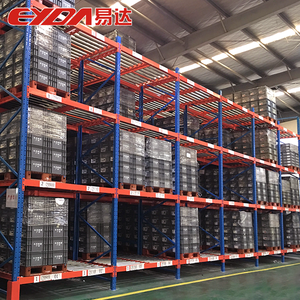
5 Layer Metal Pallet Flow Rack Gravity Storage Racks
Multi-Level Industrial
Heavy Duty Rollers
Braking Rollers
Engineered for seamless First-In, First-Out (FIFO) dynamic movement, high volumetric occupancy, and minimal internal handling overheads across warehouse facilities.
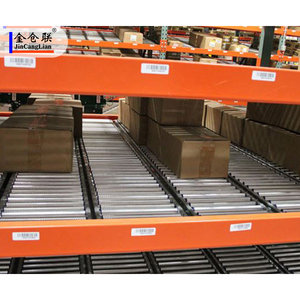
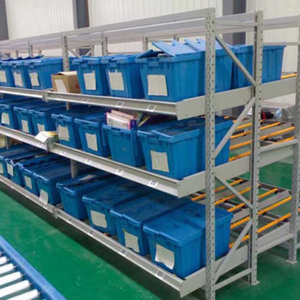
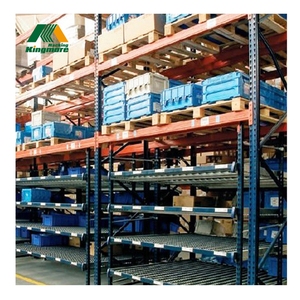
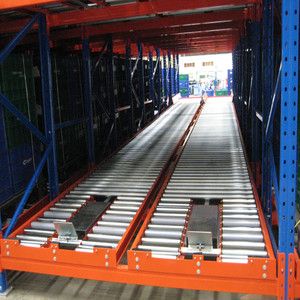
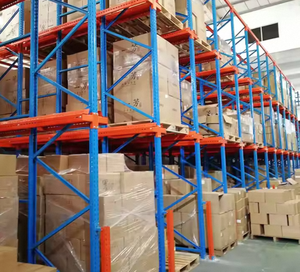
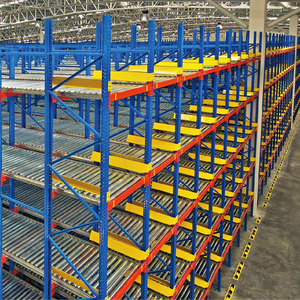
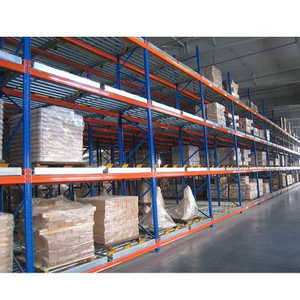
Pallet Flow Racking Systems—commonly designated as gravity live storage—represent a pinnacle engineering milestone for deep-lane intralogistics efficiency. Unlike standard static selective racking configurations that consume up to 60% of available warehouse cubic space in non-revenue forklift access aisles, a factory-engineered pallet flow installation condenses loading and offloading operations into separate perimeter interfaces. Utilizing an incline bed of precision-calibrated rollers set between 3% and 4% slope grade, pallets automatically glide under gravitational acceleration from the loading face (charging lane) to the retrieval interface (discharging point).
Within fast-accelerating logistics nodes across Greater Doha, including the Industrial Area, Birkat Al Awamer, Ras Bufontas Free Zone, and Umm Alhoul Free Zone, supply chain directors encounter stringent operating hurdles: steep square-meter real estate acquisition rates, soaring electrical refrigeration overheads in cold storage facilities, and rigorous food security turnover schedules mandated by state authorities. Pallet flow racking solves these systemic bottlenecks through absolute, mechanical First-In, First-Out (FIFO) stock compliance, ensuring inventory cannot become trapped or forgotten behind newly replenished pallets.
| Evaluation Parameter | Static Selective Racking | Drive-In Pallet Racking | Gravity Pallet Flow Racking (HEDA) |
|---|---|---|---|
| Inventory Turnover Logic | Random / Selective Access | Strictly LIFO (Last-In, First-Out) | Automated 100% FIFO |
| Warehouse Floor Footprint Utilization | 35% – 45% (Aisle Intensive) | 60% – 70% | Up to 85% Volumetric Density |
| MHE & Forklift Travel Mileage | High (Traversing deep aisles) | Moderate (Internal bay travel hazards) | Minimal (Loading & picking perimeter only) |
| Risk of Structural Frame Collision | Moderate | Extremely High (MHE operating inside bays) | Very Low (Zero MHE internal bay penetration) |
| Cold Storage Chilling Load Overhead | Excessive (Cooling dead aisle voids) | Moderate | Optimal (Maximum pallet cooling density) |
Customized structural profiles built for high thermal tolerances, air-conditioned distribution hubs, and rapid throughput corridors.
Doha's central cold stores require strict temperature management to preserve fruits, meat, seafood, and dairy imported through Hamad Port. Pallet flow eliminates hot air pockets by consolidating thermal mass, while dynamic FIFO ensures products move precisely according to batch expiry codes.
Qatar's Ministry of Public Health enforces strict traceability for temperature-sensitive medicine batches. Flow racks create clean, physically segregated staging zones for incoming QC inspection and outbound shipping, eliminating human picking errors.
Supply chain infrastructure in Umm Alhoul and Ras Bufontas handles high container throughput. Pallet flow systems maximize vertical clearance up to 12 meters, allowing rapid sorting of heavy industrial SKUs, petrochemical resins, and consumer goods.
In accordance with the infrastructure objectives of Qatar National Vision 2030, the state's warehouse market is pivoting away from labor-heavy manual handling toward streamlined, low-energy automation. Rising operating expenses in logistics operations have triggered three notable market shifts:
1. Energy-Zero Dynamic Handling: Automated Storage and Retrieval Systems (ASRS) require substantial electrical infrastructure and ongoing software maintenance. Gravity-driven pallet flow racks deliver high volumetric density without consuming electrical power, protecting cold storage operators against power outages and reducing overall utility costs.
2. Climate-Resilient Finishes: Ambient conditions in Doha regularly exceed 45°C with high coastal humidity. Standard paint systems can peel, oxidize, and fail under these conditions. Our systems feature acid pickling, multi-stage phosphating, and electrostatic epoxy-polyester powder coating cured at 180°C, providing long-term resistance to corrosion and wear.
3. Advanced Mechanical Safety Controls: Safety is central to our live storage design. Pallet loads between 500 kg and 1,500 kg gain significant kinetic momentum when rolling down deep lanes. Our systems integrate self-regulating eddy-current centrifugal brake rollers along each lane to maintain a safe sliding speed below 0.3 m/s, paired with heavy-duty end stops and mechanical pallet separation devices.
Direct factory control over raw steel selection, automated roll-forming lines, and export-grade packing reduces risk and lowers landed costs.
We use Q235B and Q355B structural steel certified under CE and ISO 9001:2015. Our uprights, box beams, and cold-formed roller beds are engineered to withstand continuous industrial use, forklift impacts, and heavy seismic loads.
We customize pitch angles, roller diameters, and braking systems to match your pallet dimensions (1200x1000mm, 1200x800mm, or custom skids) and payload ranges, ensuring reliable flow without stalling or product damage.
We provide full container load (FCL) shipping directly to Hamad Port (Doha). Every shipment includes detailed component numbering, assembly manuals, and comprehensive CAD drawings to streamline clearance and local installation.
Clear, direct answers regarding engineering standards, freight schedules, pallet specifications, and on-site assembly.
Direct ocean transit to Hamad Port typically ranges from 18 to 26 days. With an in-house monthly output of 30,000 tons, our factory standardizes production lead times to 2–4 weeks from final CAD layout sign-off.
Yes. Our roller tracks can be equipped with full-width steel rollers or heavy-duty staggered multi-track wheels to handle various bottom deck configurations, including wooden skids, Euro pallets, and industrial plastic containers.
For lanes deeper than 3 pallets, we integrate centrifugal speed controllers directly into the roller tracks. These maintain a uniform roll speed (approx. 0.25 m/s) and pair with mechanical exit separators to prevent back-pressure on the discharge pallet.
All steel components undergo a multi-stage pre-treatment process, including chemical degreasing, acid pickling, and phosphating, followed by electrostatic powder coating. Hot-dip galvanized structural profiles are also available for coastal and cold storage facilities.
Every shipment includes numbered components, precise assembly drawings, and bolt-torque specifications. Our engineering team provides real-time video guidance for local contractors, and on-site engineering supervisors can be deployed for major projects.
Simply provide your clear warehouse height, floor slab load capacity, pallet dimensions (W x D x H) including overhang, maximum loaded pallet weight, target lane depths, and your forklift mast lift specifications.