Featured Industrial Racking Systems & Storage Platforms
Manufactured from certified high-tensile Q235B and Q355B cold-rolled steel, each industrial rack is structurally validated under European standard EN 15512, RMI, and FEM guidelines for static load stability, seismic resilience, and extreme warehouse throughput.
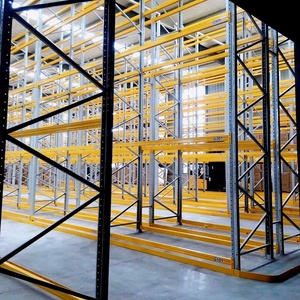
Selective Heavy Duty Industrial Pallet Shelf Narrow Aisle Warehouse Racking System
- Load Rating: 1,000 – 4,500 kg / Level
- Upright Pitch: 50mm / 75mm Adjustable
- Access Efficiency: 100% Individual Pallet Direct
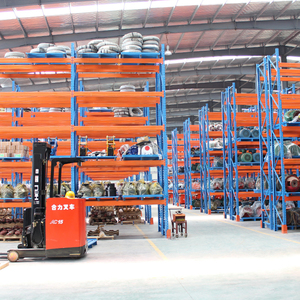
Customized Warehouse Drive in Rack Steel Pallet Racking System Industrial Steel Rack
- Space Utilization: Up to 80% Floor Density
- Pallet Depth: 2 to 10 Pallets Deep Rail
- Suitability: Cold Storage & Bulk SKUs
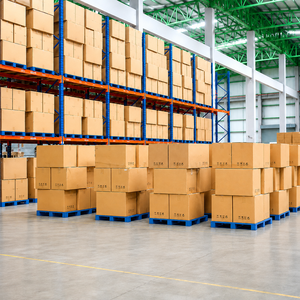
Steel Storage Rack 2000kg Heavy Duty Q235B Pallet Rack Industrial Shelving Solution
- Standard Capacity: 2,000 kg Uniform Load
- Surface Coating: Epoxy Polyester Powder 80μm
- Beam Profiles: Double-C Welded Box Beams
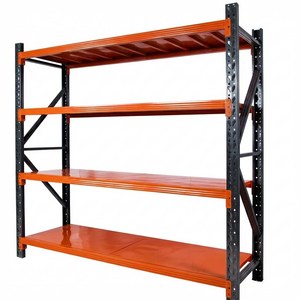
Durable Cold Rolled Steel Multi-Layer Pallet Rack High Loading Capacity Epoxy Racking
- Steel Specification: Cold-Formed High Tensile Steel
- Level Height: Customized up to 14 Meters
- Safety Factor: 1.5 Dynamic / Static Coefficient
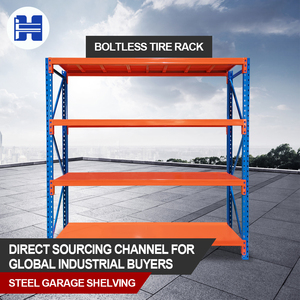
Long Span Medium Duty 5 Layer Steel Industrial Shelving Boltless Warehouse Storage Rack
- Shelf Capacity: 300 – 800 kg / Level (UDL)
- Assembly Mechanism: Interlocking Plug-in Boltless
- Decking Medium: Steel Panels or Wire Mesh
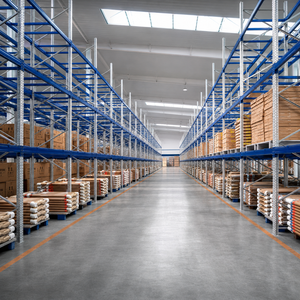
Schwerlastregal Steel Storage Rack Adjustable Multi-level Heavy Duty Pallet Shelving
- Design Standard: FEM 10.2.02 / DIN EN 15512
- Connector Type: 4-5 Hook Riveted Safety Brackets
- Protection: Column Protectors & Frame Barriers
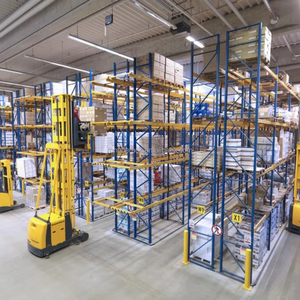
Custom Euro Very Narrow Aisle Racking VNA Galvanized Narrow Pallet Racking Solution
- Aisle Width: 1,600mm – 1,800mm Optimization
- Finish Specification: Hot-Dip Galvanized / Pre-Galv
- Guiding Interface: Floor Guide Rails or Wire Guidance
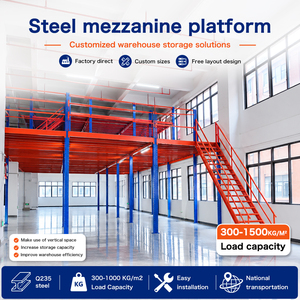
Industrial Warehouse Mezzanine Rack Heavy Duty Steel Storage Platform Space Saving
- Platform Loading: 300 – 1,000 kg / m² Floor Rating
- Flooring Medium: Perforated Steel, Grating, or Plywood
- Integration: Integrated Staircases & Pallet Gates
Guangzhou Heda Shelves Co., Ltd. – Engineered Reliability Since 2001
For over two decades, Heda Shelves has delivered structural engineering excellence across the global logistics equipment sector, combining vertically integrated steel profiling with strict international conformity assessments.
Full-Spectrum Compliance: Validated Under CE & ISO 9001:2015
Navigating the global material handling market demands verified conformity. Heda Shelves holds official CE Certificate No. 2435-CPR-8605159 and maintains certified ISO 9001:2015 Quality Management Systems (Certificate No. 18624Q00169R0M). Every batch of raw strip coil undergoes yield-point tensile testing, chemical spectrophotometric analysis, and coating adherence checks.
Our heavy-duty industrial racking conforms strictly to the European standard EN 15512:2020 (Steel static storage systems – Adjustable pallet racking systems – Principles for structural design) as well as FEM 10.2.02. This structural rigor guarantees that deflections under maximum safe working load (SWL) never exceed permissible engineering limits ($L/200$ for beams, $H/350$ for upright columns).
Mechanical Integrity: Steel Metallurgy, Beam Connections & Seismic Mechanics
Industrial racking systems are complex civil-structural frameworks operating under dynamic material handling loads. Understanding the engineering physics behind upright buckling, moment-resisting beam end-connectors, and seismic dissipation is critical for risk-free procurement.
Omega-Section Uprights & Cold-Work Hardening
The structural backbone of any high-bay racking system is the vertical upright column. Heda Shelves utilizes proprietary multi-bend Omega (Ω) profiles with up to 13 discrete rolling deformation passes. This cold-roll-forming process triggers uniform work-hardening in the steel corners, enhancing yield strength ($R_{eH}$) by up to 15% without sacrificing material ductility.
By engineering multi-flange profiles, our columns exhibit superior resistance against localized plate buckling and flexural-torsional buckling. In accordance with EN 15512 calculation methods, our structural engineers evaluate both global frame stability and perforated section modulus, compensating for teardrop or diamond slot punch-outs to ensure pristine load transmission down to the baseplate assemblies.
Moment-Rotation Characteristics of Beam End-Connectors
The beam-to-column connection serves as a semi-rigid joint that dictates the unbraced sway stability of the racking structure. Our engineered 4-to-5 tooth stamped connector clips fit snugly into the tapered column slots. Under gravitational loading, a dynamic wedge effect occurs, dramatically increasing rotational stiffness ($c_d$) and mitigating joint slackness.
To eliminate accidental beam uplift caused by forklift fork snagging, every connection is secured with high-grade, zinc-plated auto-locking safety spring drop pins rated to resist upwards shear extraction loads exceeding 5,000 N, comfortably surpassing international warehouse safety codes.
| Mechanical Property | Standard Q235B (ASTM A36 Equiv.) | High-Tensile Q355B (S355JR Equiv.) |
|---|---|---|
| Yield Strength ($R_{eH}$) | ≥ 235 MPa | ≥ 355 MPa |
| Tensile Strength ($R_m$) | 370 – 500 MPa | 470 – 630 MPa |
| Elongation at Fracture ($A$) | ≥ 26% | ≥ 22% |
| Charpy V-Notch Impact | +20°C ≥ 27 Joules | +20°C ≥ 34 Joules |
| Application Suitability | Standard Pallet Storage (up to 3.5t/lvl) | VNA High-Bay & Seismic Zones (>12m) |
| EN 15512 Compliance | ✓ Fully Certified | ✓ Fully Certified |
*Note: Material test certificates (MTR/EN 10204 Type 3.1) are supplied alongside physical container shipments, documenting heats, carbon equivalent values (CEV), and elongation metrics verified in our certified metallurgical lab.
Seismic Structural Modeling for Global Earthquake Belts
For logistics distribution centers constructed in seismically active regions—such as the Pacific Rim (Chile, Peru, California, Japan) or the Alpine-Himalayan belt—conventional static gravity calculations are hazardous. Heda Shelves executes advanced modal response spectrum analyses using customized finite element calculation routines.
We deliberately proportion vertical uprights and diagonal bracing systems so that cyclic seismic kinetic energy is absorbed through controlled inelastic yield zones, preventing cataclysmic frame collapse.
Baseplate thicknesses are augmented up to 12mm–16mm with dual chemical or mechanical anchor stud arrays to evenly distribute extreme dynamic shear and overturning tensile moments into the concrete slab.
High-bay seismic installations integrate reinforced heavy-duty wire mesh decking, rear safety backstop beams, and anti-collapse vertical mesh walls to safeguard picking aisles from falling inventory.
Future Procurement Trends in Industrial Storage Systems
Modern supply chain directors no longer procure warehouse racking as commodity steel. Over the next decade, technological integration, sustainability mandates, and warehouse automation interfaces are redefining global equipment specifications.
Automation & Shuttle-Ready Racking Tolerances
As logistics hubs transition toward 4-Way Radio Shuttle, AMR (Autonomous Mobile Robot), and ASRS mini-load architectures, allowable fabrication tolerances are shrinking from centimeters to millimeters. Procurement contracts now demand millimetric leveling accuracy, ultra-straight cold-formed shuttle runner rails, and optical reflector mounting flanges engineered directly into beam profiles.
Low-Carbon Green Steel & ESG Traceability
Global environmental mandates (such as the EU Carbon Border Adjustment Mechanism - CBAM) are compelling multinational corporations to source warehouse infrastructure with documented Scope 1, 2, and 3 emission audits. Future procurement relies heavily on suppliers utilizing electric arc furnace (EAF) scrap steel, heavy-metal-free zirconium coatings, and 100% recyclable powder compounds.
Structural Health IoT & Digital Twin Maintenance
The convergence of industrial IoT and warehousing has introduced smart structural health monitoring. High-risk transfer nodes, critical beam-column junctions, and forklift intersection protectors are increasingly outfitted with embedded strain gauges and 3-axis accelerometer sensors to detect hidden deflection overstresses and forklift impact damage in real-time.
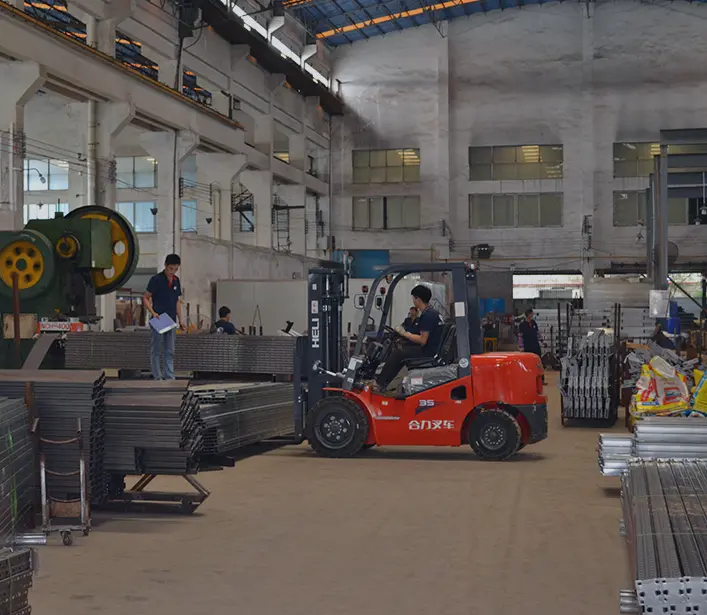
From High-Tensile Steel Coil to Containerized Export
Rigid mechanical tolerances and anti-corrosive finishes are guaranteed through our fully integrated 10-step production protocol, monitored under continuous ISO 9001:2015 traceability audits.
Coil Slitting & Punching
Prime Baosteel Q235B/Q355B strip coils undergo high-precision CNC multi-die continuous punching to form 50mm/75mm adjustable pitch slots within ±0.1mm dimensional tolerance.
Cold-Roll Section Profiling
Continuous 12-to-16 stand cold-roll forming mills contour the steel into rigid Ω-upright and double-C interlocking beam profiles, preserving metallurgical structural grain integrity.
Robotic MIG Welding
Multi-axis Panasonic robotic welders fuse beam end-connectors, baseplates, and cantilever arms with shielded active gas (MAG), ensuring deep penetration and zero weld porosity.
Nanotech Pre-Treatment & Coating
Components pass through automatic pickling, alkaline degreasing, and eco-friendly nano-zirconium phosphating before electrostatic powder curing at 190°C for exceptional salt-spray resistance.
Frequently Asked Technical & Logistics Questions
Expert answers directly from our structural engineering and export compliance department to assist supply chain managers during project budgeting and layout formulation.
What parameters are required to calculate structural racking capacity?
To produce an exact EN 15512 calculation and CAD floor layout, our structural engineering department requires: (1) Warehouse clear height to roof trusses and sprinkler drops; (2) Finished concrete slab compressive strength ($f'c$) and reinforcement depth; (3) Pallet outer dimensions including overhang ($L \times W \times H$); (4) Maximum gross load per pallet; (5) Forklift mast lift ceiling, minimum aisle turning radius (AST), and chassis model; (6) Project geographical site location to determine seismic hazard coefficients ($S_s$, $S_1$).
How do you verify genuine CE conformity on imported racking systems?
Genuine European Union CE certification for steel structural frameworks falls under the Construction Products Regulation (CPR 305/2011/EU) and EN 1090-1 / EN 15512. Heda Shelves supplies formal Declarations of Performance (DoP), factory production control certificates (FPC No. 2435-CPR-8605159), and full mill test reports detailing steel chemical chemistry and mechanical yield curves with every shipment.
What surface finishes are recommended for sub-zero cold chain and marine ports?
For standard dry distribution centers, our 80–120μm electrostatic epoxy-polyester thermosetting powder coating offers superior scratch resistance and aesthetic longevity. However, for cold storage rooms (-30°C) subject to thermal condensation, or port facilities subject to saline maritime air (e.g., Santos, Callao, Hamburg), we strongly advise pre-galvanized upright frames or Hot-Dip Galvanizing (HDG according to ISO 1461), yielding up to 60–85μm zinc thickness to permanently eliminate rust creep.
What is the standard production lead time for large industrial export orders?
Backed by our 30,000 square meter facility and 30,000-ton monthly capacity, standard pallet racking projects comprising 5 to 20 full shipping containers (40' HQ) are typically manufactured within 15 to 25 working days post-approval of production drawings. Multi-tier mezzanine structures involving custom heavy structural steel I-beams or integrated staircase systems require 25 to 35 calendar days.
How do you optimize container stowage and prevent ocean-transit corrosion?
Ocean freight efficiency is fundamental to total landed cost. Our export logistics engineers generate 3D container packing load plans (using 40' High Cube units) to maximize container weight and volumetric cube density. All structural beams are bundled on customized steel skids with protective corrugated cardboard spacers, edge corner guards, and hermetically sealed bubble shrink wrap. Upright frames are nested efficiently, and desiccants are positioned throughout the container to absorb moisture during trans-equatorial maritime crossings.
Can your structural racking integrate with third-party automation systems?
Yes. Our industrial racking systems are fully engineered to integrate with robotic automated storage and retrieval systems (ASRS), automated guided vehicles (AGV), continuous vertical reciprocating conveyors (VRC), and automated pallet flow gravity separators. We provide exact digital CAD and STEP models to system integrators, guaranteeing that beam deflections and sensor reflector target locations comply seamlessly with automated crane tooling tolerances.