High-Capacity Industrial Racking & Modular Shelving Systems
Engineered to FEM 10.2.02 and RMI standards, our heavy-duty racking portfolio maximizes vertical clear-height capacity while guaranteeing strict dynamic load safety across commercial distribution hubs.
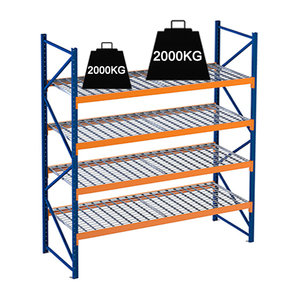
Stackable Heavy-Duty Pallet Racking System
- Payload: 1,000kg – 3,000kg / Tier
- Material: High-Yield Cold-Rolled Q235B
- Finish: Electrostatic Powder Coated
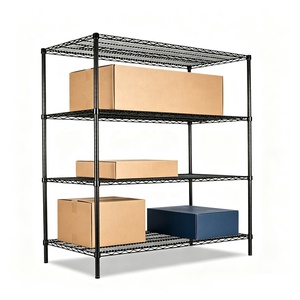
NSF 4-Layer Industrial Wire Storage Rack
- Payload: 800 lbs (363 kg) / Shelf
- Standard: NSF Food-Grade Hygiene
- Suitability: Cleanroom & Cold Storage
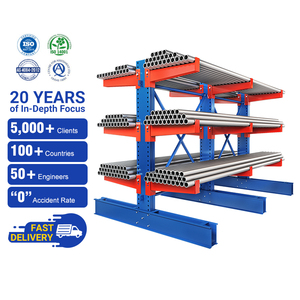
Heavy-Duty Adjustable Cantilever Arm Racks
- Capacity: 500kg – 1,800kg / Arm
- Profile: Structural Hot-Rolled I-Beam
- Target: Pipes, Timber, Extrusions
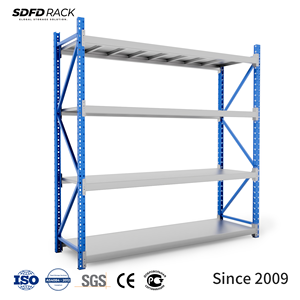
Adjustable Long Span Shelving for Fulfillment
- Payload: 200kg – 500kg / Deck
- Decking: Galvanized Steel / Plywood
- Pitch: 50mm Height Adjustable
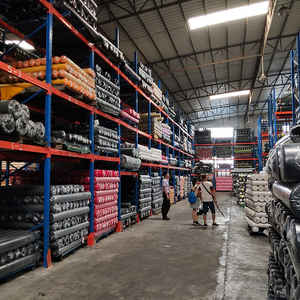
Engineered Selective Heavy Pallet Rack
- Payload: Up to 4,500kg / Beam Level
- Upright Profile: 90/100/120mm Omega
- Engineering: Free 3D CAD & FEA Load
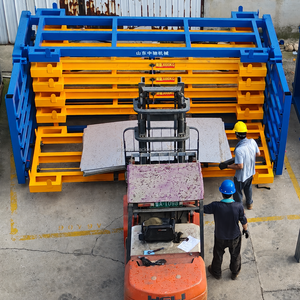
Drawer-Style Sheet Metal & Die Mold Rack
- Mechanism: 100% Pull-Out Rollers
- Loading: 2,000kg / Drawer Level
- Safety: Interlocking Anti-Tip Brake
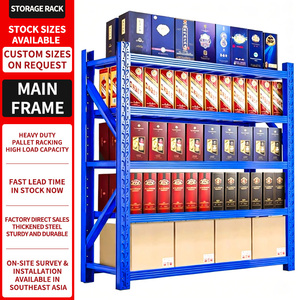
Multi-Tier Medium Duty Warehouse Racking
- Payload: 300kg – 800kg / Tier
- Assembly: Boltless Plug-In Connection
- Expansion: Modular Add-On Bays
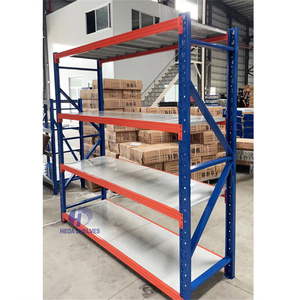
Customized Industrial Workshop Iron Shelves
- Structure: Cold-Rolled Angle Iron
- Application: Assembly Lines & Garages
- Finish: High-Scratch Powder Coating
Structural Engineering Comparison: Specifying Industrial Racks
Selecting the correct structural configuration requires cross-evaluating beam deflection ratios (L/200 vs L/250), steel yield strength tolerances (Q235B vs Q355B), and pallet access density. The matrix below defines the mechanical thresholds verified by our structural testing labs.
| Racking Topology | Structural Steel Grade | Unit Load Capacity | Aisle Clear Width | Volumetric Efficiency | Inventory Access Speed | Seismic Adaptability |
|---|---|---|---|---|---|---|
| Selective Pallet Racking | SS400 / Q235B Cold-Rolled | 1,000 – 4,500 kg / level | 3.0m – 3.8m (Counterbalance) | 40% – 50% | 100% Immediate (High) | NCh 2369 / NSR-10 Compliant |
| Radio Shuttle Automation | Q355B High-Yield Alloy | 1,500 kg / pallet carrier | Lane depth up to 40 pallets | 80% – 90% | FIFO / LIFO Automated | FEM 10.2.02 Deep-Lane Bracing |
| Cantilever Racks | Hot-Rolled Structural I-Beam | Up to 1,800 kg / arm | Variable (Sideloader / Multi-way) | 65% – 75% | 100% Free Linear Access | Heavy Anchor Shear Plates |
| Drive-In Storage | Q235B Cold-Formed Channel | 1,200 – 2,000 kg / pallet | Continuous Forklift Bay | 70% – 85% | LIFO Rotation (Batch) | Top & Back Portal Cross-Ties |
| Structural Mezzanines | ASTM A36 / Q355B H-Steel | 300 – 1,200 kg / m² | Multi-Tier Clear Span | 200% (Area Multiplier) | Direct Manual Picking | Building Code IBC / EN 1993 |
Continuous Roll-Forming Precision
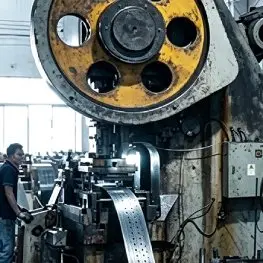
Our automated 24-station continuous roll-forming lines maintain a web thickness tolerance of ±0.05mm. Omega uprights feature a 7-bend structural profile that boosts resistance against torsional buckling under catastrophic seismic displacement.
Corrosion Pre-Treatment Chemistry
Components undergo a 9-stage surface treatment including high-pressure degreasing, zinc-phosphating, and electrostatic deposition of thermosetting polyester resin powder baked at 190°C. Certified salt-spray corrosion resistance exceeds 500 hours (ASTM B117).
Finite Element Analysis (FEA) Verification
Every custom high-bay installation is mathematically simulated utilizing ANSYS FEA software. Beam-connector stiffness tests (bending and shear moment capacity) are strictly calibrated to establish real-world structural stability prior to factory tooling.
Future Procurement Trends in Industrial Storage Infrastructure
Supply chain directors face tightening land availability, elevated seismic risks, and accelerated warehouse automation. Here are the macro procurement trends dictating industrial racking investments through 2030.
1. Shift Toward Automation-Ready Racking
Procurement teams are moving away from isolated static racking. Modern tenders specify tightened manufacturing tolerances (±1.0mm per 10m height) to allow seamless brownfield upgrades to Automated Storage and Retrieval Systems (AS/RS), Autonomous Mobile Robots (AMRs), and four-way radio shuttle shuttles without tearing down structural uprights.
2. Carbon Footprint & Metallurgical Tracing
Multinational operators under ESG mandates require certified mill test certificates (MTC) proving steel origins, Electric Arc Furnace (EAF) low-carbon steel production, and non-toxic powder coating chemistries. Full raw material traceability from slab to stamped component is fast becoming an essential tender prerequisite.
3. Total Cost of Landed Assembly (TCOA)
With international ocean freight and local port drayage fluctuating, leading buyers evaluate suppliers on nesting efficiency. Semi-knocked down (SKD) modular engineering that maximizes TEU/FEU container volume utilization up to 98% yields significant savings that eclipse simple ex-factory material cost differences.
Evolutionary R&D in Storage Rack Manufacturing
From robotic laser-welded beam connections to digital twin sensory monitoring, manufacturing innovations are transforming how industrial steel racks resist structural fatigue, thermal contraction, and seismic shocks.
Smart Structural Health Monitoring (SHM)
The next generation of high-bay installations integrates strain-gauge sensors and IoT accelerometers directly into the bottom upright baseplates. This live sensory framework feeds structural stress, accidental forklift impact force, and ground vibration telemetry directly into warehouse maintenance systems (WMS).
Real-time deflection detection ensures immediate warning before localized column buckling induces catastrophic progressive rack collapse, minimizing insurance liability across massive logistic centers.
Advanced Metallurgy for Deep-Freeze Environments
Sub-zero cold-chain facilities (-30°C) often suffer from structural steel embrittlement and coating delamination caused by freeze-thaw condensation cycles. Innovations in cold-formed micro-alloy steels containing nickel and vanadium additions preserve charpy impact toughness at cryogenic temperatures.
Combined with continuous hot-dip galvanizing (HDG) or zinc-aluminum-magnesium (ZAM) anti-corrosive alloy coatings, structural systems maintain a 25+ year lifespan even in severe high-humidity agricultural and cold chain environments.
Why Global Supply Chains Depend on HEDA Shelves
Headquartered in Guangzhou with over two decades of structural racking fabrication, Guangzhou Heda Shelves Co., Ltd. provides factory-direct scale, ISO-certified precision, and localized engineering verification across 120+ destination countries.
Established Since 2001
Over 25 years of dedicated cold-formed structural steel engineering, delivering more than 10,000 turn-key logistics, retail, and manufacturing racking projects worldwide.
30,000m² Plant Infrastructure
Our modernized production campus houses 300+ technical personnel and operates 6 automated continuous roll-forming lines, automated laser-cutters, and multi-station powder-coating lines.
30,000 Tons Monthly Output
Massive production bandwidth allows rapid delivery lead times of 2 to 4 weeks, with dedicated phased batching capabilities for sprawling logistics mega-hubs.
CE & ISO 9001:2015 Quality
Fully certified by international test bodies under CE No. 2435-CPR-8605159, ISO 9001:2015, and RoHS, offering complete structural qualification documentation for local permitting.
End-to-End Quality-Controlled Manufacturing Workflow
Every component follows a rigorous ten-stage standardized production chain, ensuring precise tolerances, flawless finish bonding, and secure ocean freight container packaging.
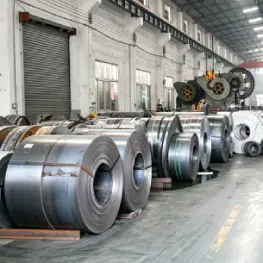
Raw Materials Inspection
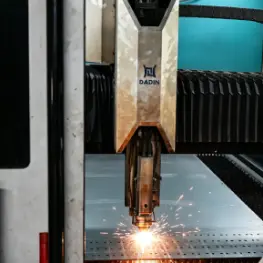
Precision Steel Cutting
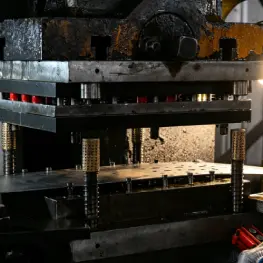
Automated Punching
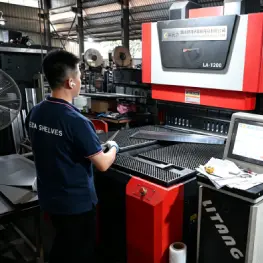
Cold Bending Forming
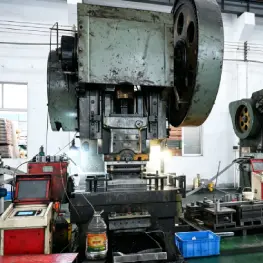
Profile Roll Forming
Surface Polishing
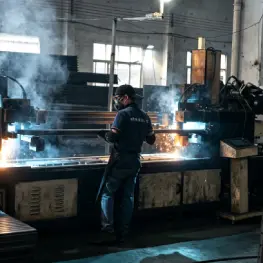
Robotic Welding
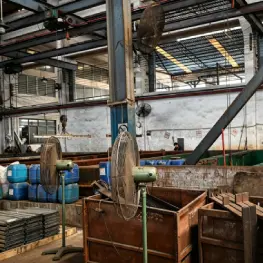
Pickling & Phosphating
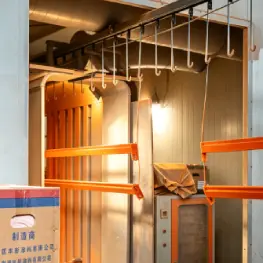
Electrostatic Powder
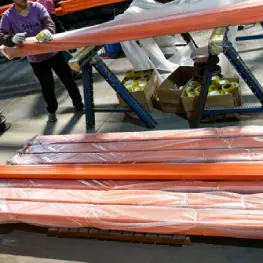
QC & Ocean Packaging
Frequently Asked Questions: Industrial Racking Procurement
Direct engineering and commercial answers to help procurement managers, logistics planners, and EPC contractors navigate technical specifications, regional building codes, and landed freight dynamics.
How do you adapt rack engineering for severe seismic zones (e.g., Chile, Peru, California)?
Our engineering team conducts dynamic modal response analysis using localized seismic hazard maps and spectra acceleration parameters ($S_s, S_1$). We integrate heavy-duty widened base plates with dual-anchor bolting into high-grade foundation concrete, reinforced cold-formed upright profiles, and cross-bay portal bracing according to FEMA 460, RMI MH16.1, and Chilean NCh 2369 / Peruvian E.030 engineering standards.
What is the standard permissible beam deflection limit for heavy industrial pallet racks?
Under both European FEM 10.2.02 and US RMI specifications, the industry standard maximum vertical deflection limit is $L/200$, where $L$ is the clear span distance between upright columns (e.g., a 2,700mm beam has a maximum permissible deflection of 13.5mm under full uniformly distributed load). For sensitive automated picking or automated shuttle interfaces, we engineer stiffer profiles calibrated to $L/250$ or $L/300$.
How are components protected against corrosion during ocean transit and in humid climates?
All steel undergoes automated degreasing, acid pickling, and phosphating prior to electrostatic powder coating (60–90μm thickness). For export, upright frames and beams are separated by air-cushioned polypropylene spacer pads, wrapped in multi-layer stretch film with industrial desiccant bags inside shipping containers to eliminate condensation corrosion during 30-45 day sea transits. Hot-dip galvanization is available for outdoor or coastal yards.
What documentation and technical data are required to receive a free 3D CAD design?
To prepare a structural calculation and optimized CAD layout, please provide: (1) Architectural floor plan showing column grid spacing, building clear heights, and fire exit/obstruction corridors; (2) Pallet footprint (Width x Depth x Height inclusive of cargo overhang) and gross unit weight; (3) Forklift specifications including aisle turning radius, maximum mast reach, and mast collapsed height; (4) Inventory turnover strategy (FIFO vs LIFO).
What is the standard production turnaround time for container-volume projects?
Supported by our 30,000-ton monthly capacity, standard selective pallet racking and long-span shelving orders ranging from 1 to 5 forty-foot high-cube containers (40'HQ) are produced within 14 to 21 working days after final CAD approval. Large automated AS/RS racking structures or multi-tier mezzanine floors are scheduled in synchronized batch deliveries to align seamlessly with regional on-site construction timelines.
How is overseas on-site installation supported by the manufacturer?
We provide piece-marked component packaging cross-referenced with detailed 3D step-by-step assembly drawings and high-definition video walkthroughs. For enterprise-scale logistics hubs or complex mezzanine installations, we dispatch certified structural installation supervisors to direct local rigging crews, ensure anchor torque compliance, and perform laser alignment checks prior to system commissioning.
Plan Your Warehouse Storage Layout with HEDA Engineers
Submit your warehouse dimensions and storage requirements today. Receive an engineered 3D CAD layout, finite-element structural load verification, and itemized containerized pricing within 24 business hours.