Factory-Direct Pallet Flow Racks & Warehouse Racking Systems
Manufactured by Guangzhou Heda Shelves Co., Ltd., each dynamic system is built to international standards with certified Q235B/Q355B structural steel, precision-rated gravity rollers, and integrated braking controllers.
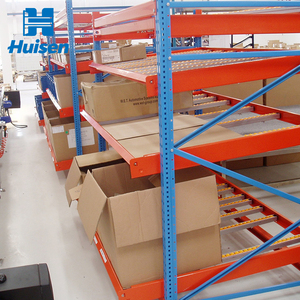
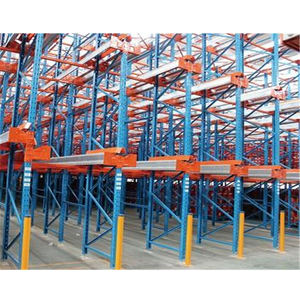
Radio Shuttle Electric Mobile Pallet Rack Warehouse Storage Radio Shuttle Racks
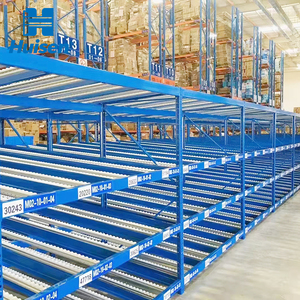
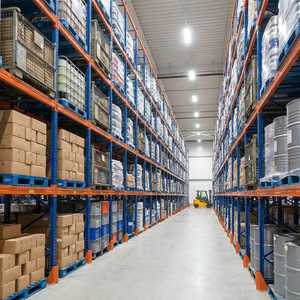
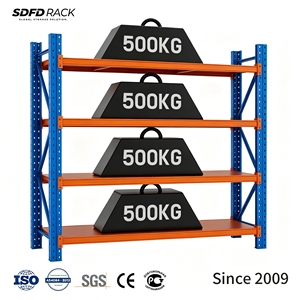
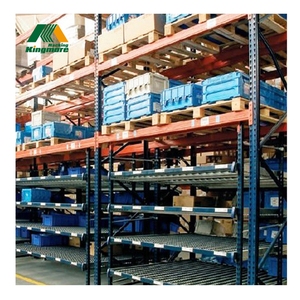
Fabric Roll Pallet Carton Flow Racking for Stacking Racks & Shelves
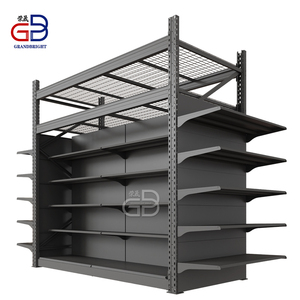
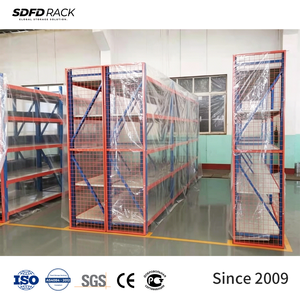
Gravity-Driven Kinematics: The Mechanics of Modern Pallet Flow Systems
A comprehensive engineering breakdown for logistics directors, procurement heads, and structural consultants evaluating high-density First-In, First-Out (FIFO) material handling installations.
In modern high-throughput supply chain networks, warehouse footprint optimization is no longer just about static racking density; it is about combining volume utilization with kinetic throughput velocity. Pallet flow racks (also widely designated as gravity flow racking or dynamic roller racking) utilize a sloping wheeled or roller track bed positioned at an engineered gradient—typically between 3.0% and 3.5% (approx. 1.7° to 2.0°). Utilizing terrestrial gravity, unit loads glide spontaneously from the loading aisle (charge face) down to the picking aisle (discharge face).
The steady-state flow of a pallet on an inclined roller track is governed by the dynamic equilibrium between gravitational drive force and opposing rolling-resistance plus mechanical braking forces: F_net = m · g · sin(θ) - [μ_r · m · g · cos(θ) + F_brake]. When properly calibrated by HEDA Shelves engineers, the net acceleration approaches zero, maintaining a controlled terminal velocity between 0.15 m/s and 0.30 m/s regardless of pallet load variations (300 kg to 1,500 kg).
1. Advanced Dynamic Components: Engineering Anatomy of Gravity Flow
A standard static pallet rack relies completely on forklift entry into aisles, generating high operational cycle times, high fuel/battery expenditure, and frequent structural collision damage. In contrast, an engineered heavy-duty pallet flow rack functions as a closed kinetic conveyor machine inside a rigid steel superstructure. Three core dynamic components dictate system longevity and worker safety:
Centrifugal Brake Rollers
Integrated at precise pitch intervals (typically every pallet position along the flow channel), internal centrifugal brake shoes engage against internal steel drums as angular velocity increases. This mechanical governor prevents runaway pallets without requiring electrical wiring or software sensors.
Pallet Separation Mechanisms
Positioned immediately behind the discharge stop, our automatic mechanical separator isolates the front extraction pallet from the line pressure exerted by trailing pallets. By releasing the backpressure (often exceeding 4,000 kgf in a 5-deep lane), forklifts retrieve pallets safely without pinching or roller dragging.
Self-Centering Guide Rails
Custom-rolled zinc-coated or powder-finished steel entry guides center unevenly loaded or off-spec pallets upon insertion. Split-roller assemblies accommodate bottom deck boards across standard GMA, EUR-1, EUR-2, and industrial slip-sheets, reducing bottom-deck snagging to zero.
2. System Comparison: Pallet Flow vs. Other High-Density Storage Formats
Selecting the optimal warehouse storage configuration requires evaluating the critical trade-offs between SKU selectivity, volumetric cubic storage density, equipment capital expenditure, and material handling labor velocity. Below is an engineering benchmark comparing Pallet Flow Racks with Drive-In, Push-Back, Selective, and Radio Shuttle systems:
| Storage Topology | Rotation Logic | Floor Space Utilization | Forklift Travel Distance | Direct SKU Accessibility | CAPEX per Pallet Position |
|---|---|---|---|---|---|
| Pallet Flow Racking | Strict FIFO | 85% – 90% (Ultra High) | Minimal (Dedicated Aisles) | Medium (1 SKU per lane) | Medium – Engineered |
| Drive-In / Drive-Thru | LIFO (FIFO rare) | 65% – 75% (High) | Extreme (Enters Racking Bay) | Low (High Honeycombing) | Low – Basic Steel |
| Push-Back Racks | Strict LIFO | 70% – 80% (High) | Moderate (Front Access Only) | Medium (Per Lane) | Medium (Nested Carts) |
| Radio Shuttle System | FIFO or LIFO | 85% – 92% (Maximum) | Low (Automated Runner) | Medium (Per Level/Lane) | High (Robotic Capex) |
| Standard Selective | 100% Random Access | 35% – 45% (Low) | High (Aisle every rack row) | 100% Immediate | Lowest Capex |
Emerging Trends Reshaping Pallet Flow Rack Procurement (2025–2030)
As logistics hubs face rising urban land valuation, strict decarbonization quotas, and rapid warehouse automation, strategic racking procurement has fundamentally evolved.
Perishable Cold Storage Optimization
Global frozen food, pharmaceutical biotherapy, and agricultural export sectors (e.g., South American salmon, beef, and fruit export corridors) are experiencing unprecedented expansion. Because refrigerated cubic air volume incurs high utility overhead, logistics providers are replacing selective racks with 15-deep pallet flow systems to eliminate thermal inefficiencies caused by wide forklift aisles.
- Low-temperature synthetic lubricants rated down to -35°C
- Hot-dip galvanized structural profiles to resist condensation corrosion
- Energy-free zero-emission gravity conveyance within chilled perimeters
Autonomous Mobile Robot (AMR) & AGV Pairing
The conventional paradigm of manual counterbalanced forklifts feeding gravity lanes is transitioning toward automated loading. Modern engineering orders require charge-face entry funnels calibrated with millimeter-precise laser reflectors, allowing Automated Guided Vehicles (AGVs) and Reach AMRs to dock pallets autonomously onto flow tracks.
- Dual-tapered entry tracks to absorb robotic insertion tolerance offsets
- Digital optical interlocks monitoring picking face pallet readiness
- Integration with automated end-of-line packaging conveyors
Zero-Electricity Warehousing & Decarbonization
Supply chain leaders face intense ESG audits targeting Scope 1 and Scope 2 emissions. Pallet flow rack systems leverage purely potential gravitational energy, replacing powered chain conveyors and motorized automated high-bay buffers. This delivers significant lifecycle kWh savings while lowering insurance premiums.
- Zero ongoing electrical consumption across the entire storage block
- 100% recyclable high-tensile structural steel profiles
- Environmentally compliant RoHS powder coatings without VOC off-gassing
Why Global Logistics Leaders Partner with HEDA Shelves
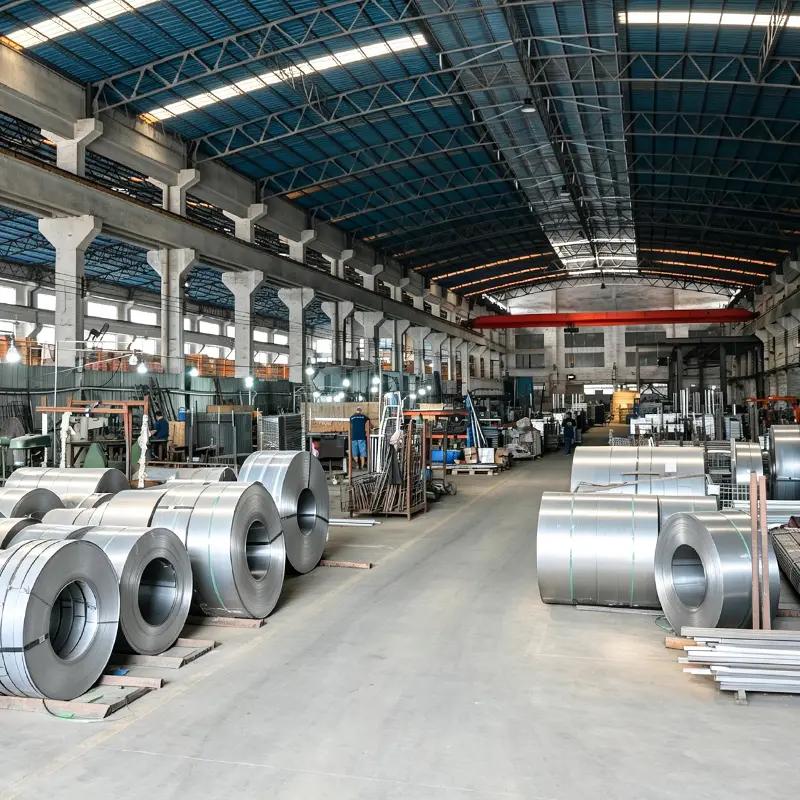
Founded in 2001, Guangzhou Heda Shelves Co., Ltd. has grown into an international powerhouse in warehouse storage systems. Operating from our modernized 30,000 square meter production facility equipped with high-precision automated roll-forming mills, robotic welding workstations, and dual automated electrostatic powder coating lines, HEDA delivers factory-direct engineering integrity without intermediary surcharges.
Frequently Asked Questions: Pallet Flow Rack Procurement
Direct answers from our chief structural and application engineers addressing technical, operational, and commercial questions.
Accelerate Your Warehouse Throughput with Custom Pallet Flow Engineering
Connect directly with HEDA Shelves' technical engineering team today. Receive a tailored 3D CAD layout, complete structural load calculation check, and transparent factory-direct pricing for your facility.