Engineered Heavy-Duty Racking & Warehouse Storage Systems
Direct manufactured high-tensile steel components engineered under ISO 9001:2015 and CE certification standards for global distribution networks.
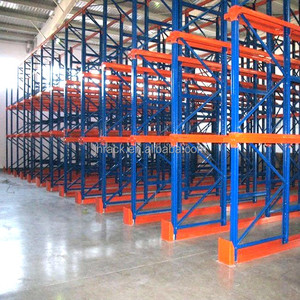
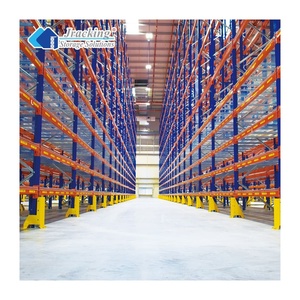
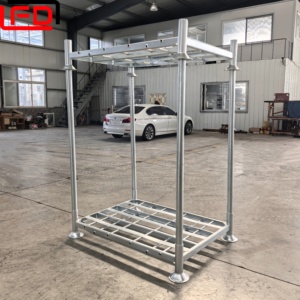
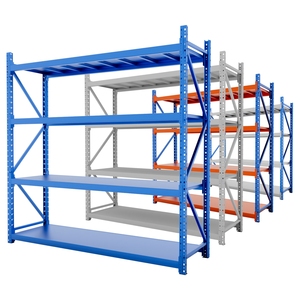
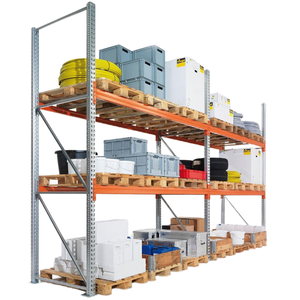
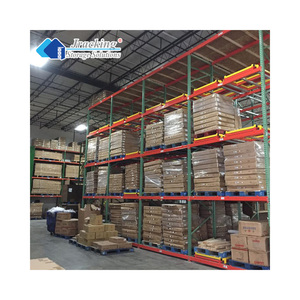
Structural Principles & Volumetric Densification of VNA Racking Systems
Very Narrow Aisle (VNA) pallet racking represents the technical apex of selective pallet storage engineering. In modern warehousing, real estate expenditure per square meter continues to climb rapidly. Traditional wide-aisle counterbalance forklift systems demand operating aisle clearances spanning between 3,500 mm and 4,200 mm. In contrast, precision-engineered VNA racking compresses aisle clear space down to 1,500 mm–1,900 mm while allowing storage verticality to expand upward from 10 meters up to 18+ meters.
Information Gain & Architectural Impact: By recapturing wasted horizontal circulation space and channeling it into vertical pallet density, an optimized VNA configuration increases warehouse volumetric cubic efficiency by 40% to 55% over conventional selective racking, while preserving 100% immediate selectivity for every single unit load (SKU).
100% SKU Direct Accessibility
Unlike dynamic bulk systems such as Drive-In or Push-Back that depend on FIFO/LIFO batching, VNA grants uninterrupted individual access to all pallets without stock reshuffling, optimal for high-velocity FMCG distribution.
Vertical Cube Maximization
Engineered cold-formed steel upright frames deliver structural stability for system top-beam elevations up to 18 meters, unlocking previously unusable overhead clear height under warehouse roof trusses.
Precision In-Aisle Guidance
Turret trucks (man-up or man-down) and automated guided vehicles (AGVs) rely on either mechanical low-profile steel guide rails or inductive floor-embedded wire tracking to navigate safely at maximum travel velocity.
Critical Engineering Pre-requisites: Superflat Concrete Floors & Guidance Kinematics
The operational safety of a high-bay VNA installation is mathematically tethered to the quality of the concrete floor slab. When a specialty turret truck elevates a 1,500 kg pallet to 16 meters, minute floor imperfections of even 1.5 mm under the truck wheels amplify into sway deflections of several inches at the mast summit. As a result, custom OEM manufacturing requires strict compliance with international surface tolerance standards.
| Racking Architecture | Typical Aisle Width (mm) | Maximum Lift Elevation | Floor Tolerance Code | Selectivity Level | Volumetric Efficiency |
|---|---|---|---|---|---|
| Very Narrow Aisle (VNA) | 1,500 – 1,900 mm | 14.0 – 18.5 meters | DIN 18202 / VDMA 40522 / TR34 DM1 | 100% Instant Selectivity | 85% – 92% Cube Utilization |
| Standard Selective Racking | 3,200 – 4,000 mm | 8.0 – 10.5 meters | Standard Industrial Flatness | 100% Instant Selectivity | 45% – 55% Cube Utilization |
| Double-Deep Pallet Rack | 3,100 – 3,600 mm | 9.0 – 11.0 meters | Standard Industrial Flatness | 50% Immediate Access | 60% – 68% Cube Utilization |
| Drive-In / Drive-Through | Eliminated Aisles | 7.0 – 10.0 meters | Standard Concrete Slab | Low (Batch LIFO / FIFO) | 75% – 85% Cube Utilization |
| Radio Shuttle Cart System | Deep Continuous Lanes | 12.0 – 16.0 meters | Standard Structural Floor | Medium (Channel Batching) | 82% – 90% Cube Utilization |
Mechanical Guide Rail Profiles
Continuous hot-rolled angle steel (typically L100×75×8 or L125×75×10 mm) anchored to the slab along both aisle perimeters with heavy chemical anchors, guiding polyurethane side-rollers on the turret truck.
Inductive Wire Guidance Systems
High-frequency signal cables embedded in a 4 mm × 15 mm saw-cut floor slot along the aisle centerline. Sensor antennas beneath the truck follow the magnetic field, removing physical rail obstructions at floor level.
Seismic Dynamic Finite Element Modeling
Because narrow aisle frames endure higher overturning moments during peak operations and seismic ground accelerations, baseplate geometries, gussets, and anchor shear vectors are calculated under EN 15512 and RMI standards.
Guangzhou HEDA Shelves: 25+ Years of Certified Racking Manufacturing
Established in 2001, Guangzhou Heda Shelves Co., Ltd. operates a premier 30,000 square meter integrated manufacturing facility equipped with continuous roll-forming lines, automated CNC punching arrays, and electrostatic epoxy coating corridors. Backed by 300+ structural engineers, precision machinists, and project managers, HEDA manufactures over 30,000 tons of structural steel storage equipment every month, deployed across 10,000+ logistics and industrial warehousing installations in 120+ countries.
Certified Conformity
Full CE Certificate (No. 2435-CPR-8605159), ISO 9001:2015 Quality Management (No. 18624Q00169R0M), and RoHS-compliant pre-treatment chemistry.
Prime Structural Steel
Cold-rolled from certified Q235B and high-yield Q355B coils sourced from tier-one mills, accompanied by mill test certificates (MTC) verifying tensile yields.
Free 3D Layout & FEA Design
Our engineering division prepares comprehensive CAD designs, 3D spatial simulations, and structural load calculations (including seismic load verification) at zero initial cost.
Global Port Logistics
Engineered shipping load configurations optimize container cubic capacity while preventing transit damage through anti-abrasion packaging and bundled numbering schemes.
Technological & Engineering Trends Shaping Next-Generation VNA Racking
The VNA racking segment is undergoing an engineering renaissance driven by robotics, advanced metallurgic cold-forming, and real-time operational telemetry. Modern supply chain demands have shifted VNA from a purely passive structural installation into an active mechanical guidance corridor.
Autonomous Mobile Robot (AMR) Hybrids
VNA corridors are transitioning from operator-manned turret trucks to unmanned driverless autonomous mobile robots equipped with dual-laser LiDAR and optical guidance. Frame structures now integrate dedicated pick-and-drop (P&D) stations at aisle heads to orchestrate seamless handoffs between high-bay turret AGVs and floor-level AMRs.
IoT Structural Telemetry & Deflection Sensors
Modern mega-hubs incorporate optical wireless sensors embedded within beam connectors and upright bases. These systems monitor cumulative cyclic stress, micro-deflections beyond L/200, seismic settlement, and forklift impact forces in real time, transmitting predictive maintenance data directly to the facility's warehouse management system (WMS).
High-Strength Micro-Alloy Profiles
By transitioning from generic structural steels to advanced micro-alloyed cold-formed profiles with yield strengths up to 450 MPa, upright sections can carry higher axial tonnage while reducing structural weight per pallet position, decreasing landed maritime freight expenditure for overseas distributors.
Global Procurement Trends: Direct Factory OEM Sourcing Strategies
Procurement leaders across Third-Party Logistics (3PL), e-commerce fulfillment, cold chain networks, and industrial manufacturing are fundamentally altering how high-bay storage equipment is budgeted, specified, and acquired.
Total Cost of Ownership (TCO) Prioritization
B2B procurement has moved beyond comparing initial steel purchase quotes in isolation. Logistics engineers calculate the combined TCO over 15 years, where building footprint reduction, energy savings from compressed lighting and HVAC zones, and reduced fire-sprinkler pipeline runs offset initial engineering investments within 18 to 28 months.
Seismic Harmonization at Origin
Importers are demanding that structural calculations be conducted at the factory engineering stage to comply with site-specific seismic standards (such as NCh 433 in Chile, NSR-10 in Colombia, E.030 in Peru, or ASCE 7 in the United States), ensuring baseplate punchings, gussets, and anchor depths pass local civil permitting without site modification.
Standardized OEM Modular Replacements
Regional distributors are partnering with single-source OEM manufacturers capable of producing universal pitch upright patterns (e.g., 50mm, 75mm, 76.2mm teardrop or Euro-diamond patterns). This ensures standardized replacement part accessibility and seamless add-on bay integrations across future project phases.
VNA Racking Engineering, Procurement & Logistics FAQ
Direct engineering responses to the most critical structural, financial, and logistical queries raised by warehouse developers and procurement directors.