[email protected] Serving Brazil · Chile · Peru · Colombia · Argentina · Ecuador
Follow us

Top 10 Push Back Racking Supplier & Exporter

Industrial Structural Engineering, High-Density LIFO Dynamics, and Seismic-Rated Warehouse Storage Systems Direct from ISO 9001:2015 & CE Certified Production Bases.

25+
Years Engineering Expertise
30,000t
Monthly Manufacturing Cap
10,000+
Global Warehouse Projects
100%
Factory-Direct Batch QC
High-Density Storage Whitepaper

Engineering Excellence in Dynamic Push Back Racking Systems

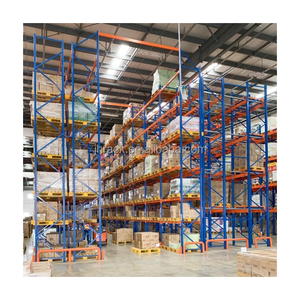
Modern supply chain logistics, distribution centers, and cold-chain infrastructure require space-efficient storage topologies that do not sacrifice throughput velocity. Push back pallet racking represents the pinnacle of nested-cart dynamic engineering, bridging the structural divide between low-selectivity drive-in racks and cost-intensive automated shuttle ecosystems.

Engineering & Operational Dynamics

How Push Back Racking Delivers High-Density LIFO Velocity

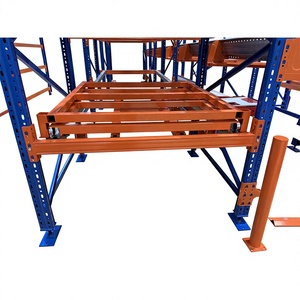
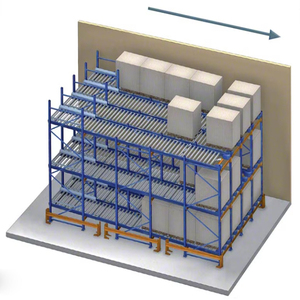
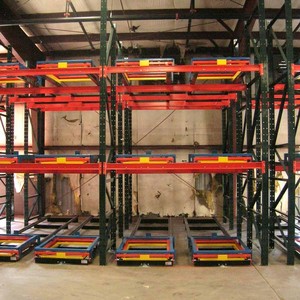
Push back racking works via a series of nested rolling carts pushed along inclined structural rails. Unlike drive-in racks where forklifts must enter the storage frame, push back racks operate entirely from the central access aisle, delivering critical safety and cycle-time advantages.

When loading, the forklift places the first pallet on the topmost cart. The second pallet gently pushes the first pallet backward, exposing the next nested cart below. During retrieval, gravity causes the trailing pallets to glide smoothly to the front pick-face as the lead pallet is removed. This mechanical elegance eliminates fragile electronic components inside the rack while achieving storage densities approaching 75% above standard selective racking layouts.

System Attribute Push Back Racking Selective Pallet Rack Drive-In Racking Radio Shuttle Racking
Storage Density High (Up to 75% floor use) Low (Aisle intensive) Very High (LIFO bulk) Maximum High Density
Aisle Clearance Required Single front operation aisle Aisles between every rack line Deep aisles inside bays Perimeter/End aisles
Forklift Rack Intrusion Zero (Operates outside bay) Zero High (High collision risk) Zero (Shuttle handled)
Pallet Selectivity Lane-level SKU access 100% immediate access Lowest (Block LIFO) System-programmed access
Maintenance & Downtime Virtually zero (Gravity driven) Minimal Moderate (Impact repairs) High (Battery, automation)
Market Intelligence

Push Back Racking Future Procurement Trends

Analysis of purchasing behaviors across global export markets reveals three transformative shifts governing industrial warehouse procurement.

Cold-Chain Energy Density Optimization

With refrigerated and deep-freeze facility operating costs escalating worldwide, cold-chain operators in seafood, agro-export, and meat processing are moving from selective racks to 4-to-6-deep push-back cart systems to shrink total refrigerated cubic meters per pallet position.

Hybridization with High-Speed WMS

Logistics operations are pairing push back racking with modern Warehouse Management Systems (WMS) to manage medium-velocity SKUs. By segregating lanes by expiry or lot code, companies achieve high density without sacrificing rotation velocity.

Seismic Resilience and Direct Certification

Global procurement directors in seismically active corridors (such as Latin America's Pacific Rim) require validated finite element analysis (FEA) matching national codes (e.g., NCh 433, NSR-10, E.030) alongside standard CE and ISO certifications.

Technical Horizon

Push Back Engineering Evolution & Design Innovations

Modern engineering updates in nested cart assemblies focus on structural longevity, low friction resistance, and operator fail-safes.

Cryogenic Sealed Bearings

Next-generation cart wheels incorporate synthetic low-viscosity lubricants rated down to -30°C. This prevents freeze-seize failures typical of legacy roller designs in cold storage applications.

Low-Profile Telescoping Rails

Modern roll-formed high-tensile guide rails reduce nesting height per level by up to 35mm, maximizing vertical clearance and allowing up to one extra pallet tier per building bay height.

Anti-Lift Dynamic Safety Catches

Interlocking mechanical stops prevent carts from lifting or jumping track during rapid forklift deposit, preventing operator error from leading to mechanical binding.
ISO 9001:2015 Manufacturing

10 Industrial Fabrication Milestones for Push Back Systems

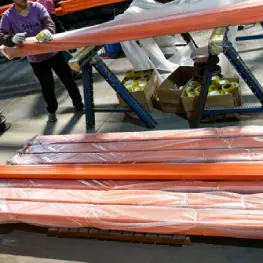
Every component, from cold-rolled steel columns to laser-welded cart frameworks, is built inside HEDA Shelves' 30,000 m² production complex to guarantee tight structural tolerances.

Raw steel inspection
Stage 01
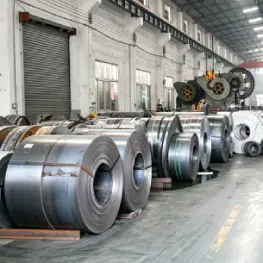
Certified Steel Coil

High-tensile Q235B & Q355B coil testing for tensile integrity.

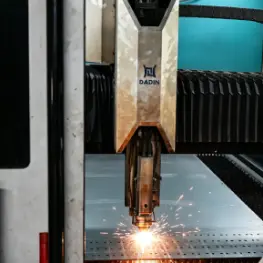
Precision laser and plasma cutting
Stage 02
Precision CNC Cutting

Zero-tolerance shearing and CNC laser profiling for cart parts.

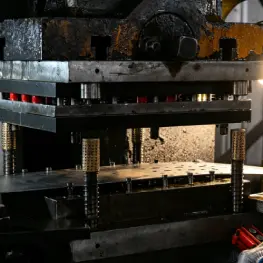
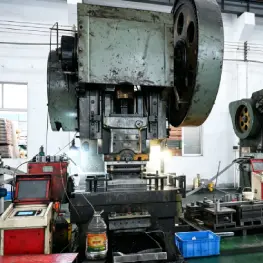
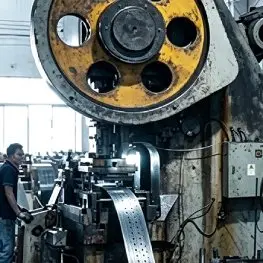
Automated column punching
Stage 03
Automated Punching

Multi-punch continuous presses for precise 50/75mm upright pitch.

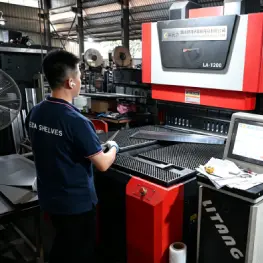
Cold bending and forming
Stage 04
Cold Roll Bending

Hydraulic bending creates structural cart and rail profiles.

Roll forming profiles
Stage 05
Roll Forming

18-pass automated cold rolling lines for upright frame rigidity.

Automated polishing
Stage 06
Surface Polishing

Mechanical shot-blasting removes scale and ensures clean adhesion.

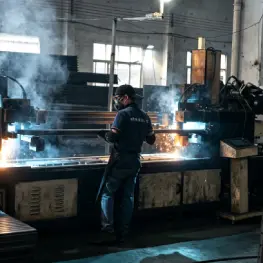
Robotic welding
Stage 07
Robotic Welding

Certified MIG/TIG weld seams along all nested cart joints.

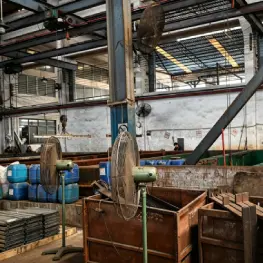
Pickling and phosphating
Stage 08
Phosphating Wash

Anti-corrosion multi-bath dip pre-treatment for harsh climates.

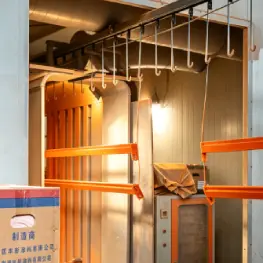
Electrostatic powder coating
Stage 09
Powder Coating

60–80 micron electrostatic curing for chip & scratch resistance.

Quality control and packing
Stage 10
QC & Ocean Packing

Strict dimensional check, bundling, and export load planning.

Factory Direct Exporter

Why Top Global Distributors Choose HEDA Shelves

With 25 years of specialized storage manufacturing, Guangzhou Heda Shelves Co., Ltd. is an established industry partner for complete warehouse infrastructure projects.

Free 3D Layout & Structural Calculations

Send your floor plan. Our in-house engineering team delivers full 3D CAD modeling, clearance analysis, and structural load documentation within 24 to 48 hours at no preliminary charge.

Optimized Container Export Packing

We maximize full container load (FCL) density while protecting coated components with heavy corrugated wrappings, custom steel banding, and numbered components for straightforward offloading.

Internationally Audited Certification

Our manufacturing system operates under verified ISO 9001:2015 quality frameworks and holds CE Certificate No. 2435-CPR-8605159, meeting European and international structural benchmarks.

Procurement Knowledge Base

Push Back Racking Procurement FAQ

Answers to the most common engineering, shipping, and installation inquiries from warehouse procurement managers.

How many pallets deep can a push back racking system be engineered?
Push back racking systems are most commonly configured for 2, 3, 4, 5, or 6 pallets deep per lane. While 2 to 4 pallets deep is standard for standard-capacity forklifts, 5 and 6 deep configurations require higher-capacity lift trucks to push the cumulative load up the incline track during loading.
Can push back racks accommodate damaged or non-standard pallets?
Yes, push back systems are less sensitive to bottom-board damage than roller-flow racks because the pallet sits securely on a heavy-duty steel cart rather than directly on rollers. For warehouses running mixed pallet types (such as CHEP, Euro pallets, or custom skids), carts can be custom engineered with full-support steel mesh or customized cross members.
What forklift type is required to operate push back racking?
Most standard counterbalance and reach forklifts can operate push back racking without special mast attachments. The primary requirement is that the truck's push capacity matches the combined weight of the nested pallets on the slight track incline (typically 2-3 degrees).
How does push back racking perform in sub-zero cold storage facilities?
Push back racking is well-suited for cold storage because its mechanical simplicity does not rely on electrical sensors or batteries. We supply cold-chain setups with low-temperature synthetic bearing greases rated to -30°C, heavy-gauge galvanized cart options, and corrosion-resistant coatings to handle condensation cycles.
What information is required to receive a custom design and quotation?
To receive a detailed CAD layout and quotation, provide: warehouse floor drawings with clear ceiling heights, pallet dimensions (W × D × H) including product overhang, maximum weight per pallet, number of SKUs, forklift model/lift height, and your building's seismic zone.

Plan Your Warehouse High-Density Storage Layout

Connect directly with HEDA Shelves' technical structural team. Receive a preliminary 3D layout, pallet capacity optimization report, and factory-direct export proposal within 24 to 48 hours.

Get a Quote