Engineered Warehouse Racking & Flow Systems Portfolio
Explore our specialized inventory of gravity-assisted, automated shuttle, cantilever, and structural storage configurations manufactured under rigorous mechanical tolerances.
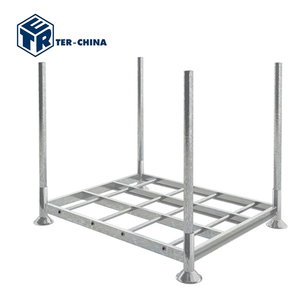
- Material: Hot-dip Galvanized Mild Steel (Q235B)
- Load Capacity: 1,000–2,500 kg per tier
- Design: Demountable modular structural posts
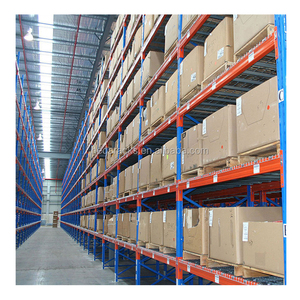
- Finish: Multi-stage electrostatic powder coat
- Beam Profile: Adjustable box/step beams
- Access: 100% direct selective pallet pick
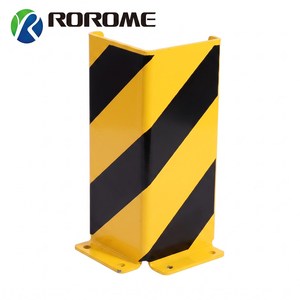
- Material: Heavy structural steel plate
- Feature: Dynamic impact deflection guide rollers
- Application: Upright column & aisle end protection
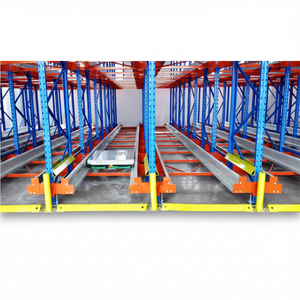
- Operation: Semi-automated radio shuttle car
- Density: Extreme depth high-bay layout
- Rotation: Seamless software FIFO/LIFO control
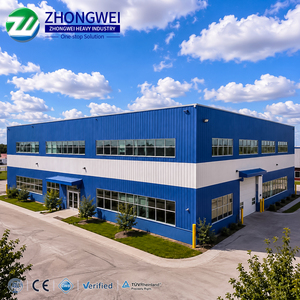
- Framework: Rigid portal steel frame (Q355B)
- Benefit: Maximize floor layout without uprights
- Integration: Compatible with high-bay gravity tracks
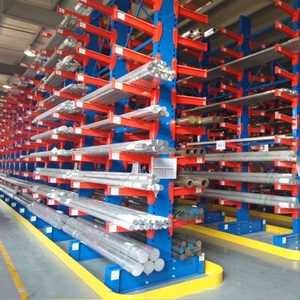
- Capacity: Up to 3,000 kg per arm
- Design: Single/double-sided structural columns
- Handling: Optimized for side loaders & overhead cranes
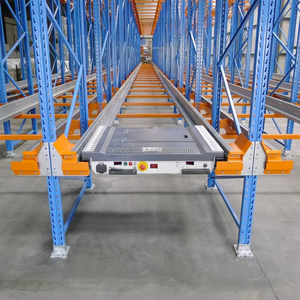
- Speed: Up to 1.0 m/s travel rate
- Battery: Fast-charging industrial lithium pack
- Cold Resistance: Operable down to -25°C
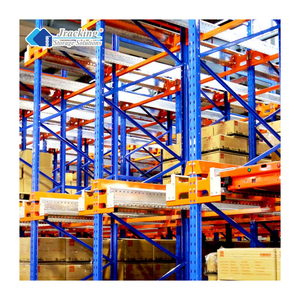
- Mechanism: Motorized floor track drive bases
- Efficiency: Consolidates multiple aisles into one
- Safety: Integrated infrared photoelectric barriers
Engineering Physics, Kinematics & Structural Integrity of Gravity Flow Racking
Gravity Flow Racking, commonly designated within high-throughput intralogistics as Pallet Flow Racking, operates on dynamic inclined wheel or roller bed tracks engineered at precise gradient angles (customarily ranging between 2.5% to 4.0%). In contrast to static selective, drive-in, or push-back racking assemblies, a true industrial gravity flow system harnesses pure kinematic gravitational acceleration paired with specialized hydraulic and centrifugal resistance controls. This setup achieves strict, unassisted First-In, First-Out (FIFO) stock rotation, virtually eliminating human picker lane conflict.
As a leading Chinese supplier and direct-factory exporter, Guangzhou Heda Shelves Co., Ltd. architects every pallet flow channel using cold-rolled structural steel profiles (conforming to GB/T 700 Q235B and high-yield Q355B / EN 10025 S355JR standards). The system utilizes multi-roller tracks embedded with precision cylindrical rollers or reinforced polycarbonate wheel assemblies. Because pallet payloads frequently exceed 1,500 kg per unit, managing rolling terminal velocity becomes a critical safety parameter governed by international logistics design standards such as RMI ANSI MH16.1 and European standard EN 15512.
Critical Velocity Regulation Rule: To prevent runaway pallet momentum and catastrophic front-end structural impact, dynamic centrifugal brake rollers must be integrated along the flow lane at intervals of exactly one pallet depth (typically every 1.2 to 1.4 meters). These governor rollers automatically generate resistive braking force proportional to rolling speed, restricting pallet translation down the incline to a controlled velocity of 0.25 to 0.30 meters per second.
Comprehensive Kinematic Track Components
A high-performance gravity flow system relies on key mechanical sub-assemblies to maintain structural stability, roller longevity, and operational safety:
- Entry Guides & Tapered Centering Arms: Positioned at the loading face to absorb minor forklift misalignment, physically steering pallets into center alignment before wheel engagement.
- Heavy-Duty Cylindrical Steel Rollers: Cold-drawn galvanised steel tubes with spring-loaded, sealed precision cartridge ball bearings, offering high static and dynamic load ratings resistant to floor grit and moisture.
- Centrifugal Speed Controllers: Internal gear-driven mechanical governors that engage brake pads automatically via centrifugal force once roller rotations exceed calibrated safety thresholds.
- Pallet Separation & Safety Disconnect Stops: Mechanical latch mechanisms at the discharge pick face that retain line pressure away from the lead pallet. By isolating upstream pallets, the front unit can be removed by forklift tines without backline pinch force.
- Structural Impact Discharge Bumpers: Engineered cold-bent steel stops bolted to the beam frame, backed by high-durometer polyurethane dampers that cushion resting kinetic energy.
Technical Comparison: Storage Systems Benchmarked Against Pallet Flow
To assist operations executives and warehouse systems engineers in calculating exact floor-space capital expenditure (CapEx), the matrix below analyzes space density, labor cycle times, and structural safety across primary high-density configurations.
| Storage Architecture | Rotation Mode | Storage Density | Forklift Travel In-Lane | Throughput Speed | Average Honeycombing Loss |
|---|---|---|---|---|---|
| Gravity Pallet Flow | Strict FIFO | 80% – 88% | Zero (Dedicated Faces) | High / Rapid Extraction | < 5% |
| Selective Pallet Rack | FIFO / LIFO | 40% – 48% | High (Every Aisle) | Moderate | < 3% |
| Drive-In Racking | Strict LIFO | 65% – 75% | Extreme (Inside Bay) | Low (Slow cycle times) | 20% – 35% |
| Radio Shuttle System | FIFO / LIFO | 82% – 90% | Zero (External Bay) | High / Automated | 5% – 10% |
| Push-Back Racking | Strict LIFO | 60% – 70% | Zero (Aisle Access) | Moderate | 10% – 15% |
Enterprise Strengths, Production Metallurgy & Global Export Scalability
Backed by over two decades of heavy industrial fabrication, Guangzhou Heda Shelves Co., Ltd. serves warehouse operators, EPC general contractors, and trade distributors worldwide.
30,000 m² Scale & 30,000t Capacity
Operating dedicated production bases in Guangzhou and Foshan with automated roll-forming lines, automated punching matrices, and continuous robotic welding cells delivering 30,000 tons monthly.
CE & ISO 9001:2015 Certified
Full regulatory adherence under CE Certificate No. 2435-CPR-8605159 and ISO 9001:2015 No. 18624Q00169R0M, with strict chemical batch traceability and third-party finite element structural load testing.
Global Port Engineering & Seismic Calcs
Projects engineered for site-specific seismic response spectra (Chile NCh 2369, Peru E.030, Colombia NSR-10, US RMI). Smooth ocean transit to Santos, Callao, Valparaíso, Rotterdam, and Los Angeles.
Advanced Surface Chemical Pretreatments
10-stage automated hot pickling and zinc phosphating baths followed by electrostatic polyester powder curing (80–120μm) or hot-dip galvanizing, ensuring 1,000+ salt-spray hours in harsh coastal conditions.
Global Sourcing Trends & Future Engineering Evolutions
Market dynamics, automated warehouse convergence, and sustainable energy pressures are reshaping how global procurement leaders evaluate gravity-driven systems through 2030.
Hybrid AGV/AMR Interface Stations
Modern gravity flow installations increasingly interface with Autonomous Mobile Robots (AMRs) and automated counterbalanced forklifts. Loading bays require laser-guided pallet alignment fixtures and sensorized separation clutches that communicate digitally with Warehouse Execution Systems (WES).
Net-Zero Gravity Energy Utilization
With industrial electricity costs rising across Europe, North America, and Latin America, distribution centers are phasing out motorized live roller conveyors in favor of zero-energy gravity tracks. Pallets move via controlled gravitational potential energy, lowering operating carbon footprints.
Sub-Zero Cryogenic Polymer Rollers
Global growth in fresh produce, biologics, and frozen food logistics drives demand for specialized gravity tracks operable down to -30°C. Modern designs utilize low-friction stainless steel bearings with food-grade silicone lubrication to eliminate bearing seizure in blast freezers.
Seismic Dynamic Finite Element Modeling
Procurement teams require dynamic FEA simulations evaluating lateral seismic sway on long dynamic roller beds. Cross-aisle bracing, reinforced base anchor matrices, and beam connector safety locks are configured to meet local building codes.
Modular Bolt-Together Knockdown Architecture
To reduce ocean container freight surcharges, high-capacity exporters engineer complete knockdown, bolt-assembled roller cassette modules. Pre-assembled tracks drop directly into rack beams on-site, cutting container volume and labor hours.
Full Mill Certificate & Digital QC Inspection
Enterprise procurement now mandates mill test certificates (EN 10204 Type 3.1) verifying steel yield and tensile metrics before container dispatch. In-factory digital tracking delivers real-time photographic and ultrasonic weld testing documentation.
Frequently Asked Questions on Engineering, Export & Commissioning
Actionable answers to help operations directors, project engineers, and import procurement managers streamline gravity flow system acquisition.
Request an Engineered 3D Layout & Factory-Direct Quotation
Send us your warehouse CAD floor plan, clear ceiling height, pallet specifications, and throughput targets. Our engineering team will deliver a structural calculation check and cost analysis within 24 business hours.