- 5,000 kg Beam Level Capacity
- CE Certified Structural Profiles
- 75mm/50mm Pitch Adjustment
Fabricated using prime cold-rolled carbon steel (Q235B & Q355B) under strict CE (EN 15512) and ISO 9001:2015 certification. Below are our flagship modular industrial rack lines calibrated for high-throughput distribution hubs, automated fulfillment centers, and industrial supply yards.
Founded in 2001, Guangzhou Heda Shelves Co., Ltd. has evolved into an authoritative global supplier of industrial bulk racks, drive-in systems, structural mezzanines, and automated warehouse frameworks. Operating from a 30,000 square meter standardized smart manufacturing facility in Guangzhou, China, we operate over 16 automated cold-roll forming lines, advanced robotic welding cells, and an environmentally compliant, two-line automated continuous electrostatic powder coating system.
We do not merely bend steel; our in-house structural engineering department calculates finite-element stress analysis (FEA) compliant with global building frameworks including European standard EN 15512, American RMI MH16.1, and localized seismic codes such as Chile NCh 2369, Peru E.030, and Colombia NSR-10.
Certificate No. 2435-CPR-8605159 & 18624Q00169R0M
Structural static and seismic calculation within 24h
2–4 weeks from drawing lock-in to port dispatch
Optimized container loading saving up to 25% ocean freight
Selecting the correct warehouse rack topology requires an empirical evaluation of space utilization efficiency, SKU selectivity index, picking dynamics, and structural installation Capex.
| Racking Topology | Floor Utilization | SKU Selectivity | Stock Rotation | Load Rating (Max/Level) | Seismic Resistance | Automation Readiness |
|---|---|---|---|---|---|---|
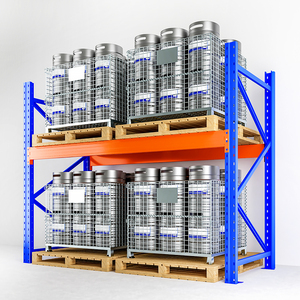
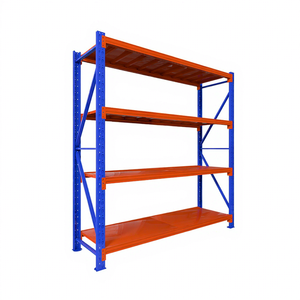
| Selective Pallet Racking | 40% – 45% | 100% Direct | FIFO / LIFO Flexible | Up to 5,000 kg / pair | Standard to High | VNA / Reach Truck / AMR |
| Drive-In / Drive-Thru | 70% – 85% | Low (Batch SKUs) | Strict LIFO (Drive-In) / FIFO | 1,500 kg / pallet slot | Engineered X-Bracing | Manual Guided Forklift |
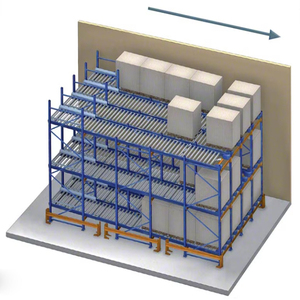
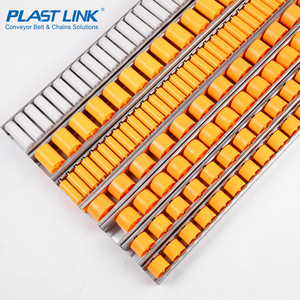
| Gravity Flow Pallet Racks | 75% – 85% | Medium (Lane-Level) | Strict FIFO (Gravity) | 1,800 kg / pallet lane | Reinforced Rail Stops | AS/RS / Conveyor Feeds |
| Push-Back Cart Racking | 65% – 75% | 2–6 Pallets Deep | Strict LIFO | 1,500 kg / nesting cart | Dynamic Incline Design | Standard Counterbalance |
| Teardrop Logistic Racks | 45% – 55% | 100% Direct | FIFO / Fast Turns | 4,000 kg / level | Boltless Punch Locking | AGV / High-Bay Integration |
| Structural Mezzanine Floor | Double/Triple Floor | 100% Accessible | Multi-Tier Picking | 300–1,200 kg / m² | Heavy I-Beam Columns | Goods Lifts / Spiral Chutes |
Global supply chain disruptions, rising commercial land costs, and stringent occupational safety standards have fundamentally redefined procurement priorities for logistics executives.
Procurement directors are rapidly shifting away from conventional hot-rolled sections toward high-strength cold-formed micro-alloyed steel (e.g., Q355B and ASTM A1011 HSLAS). By augmenting the yield strength up to 355–420 MPa, structural engineers achieve a 12% to 18% deadweight reduction in upright columns while simultaneously increasing structural vertical load thresholds. This trend significantly slashes landed oceanic container freight per pallet slot.
Static storage is becoming obsolete in large-scale modern distribution hubs. Forward-thinking procurement now demands "Hybrid-Ready" structural framing—racking units fabricated with pre-punched tie-ins, ultra-tight beam deflection tolerances (L/300 rather than standard L/200), and guide rails configured for autonomous radio shuttles or autonomous mobile robots (AMRs). Warehouses can deploy standard forklifts today and transition to full robotics tomorrow without racking redesign.
Modern procurement incorporates Life Cycle Costing (LCC) models, analyzing not merely FOB factory price, but installation speed, collision tolerance, and protective surface longevity. Factory-applied zinc phosphate pretreatment, minimum 80-micron epoxy-polyester coatings, and structural column protectors reduce maintenance expenditures by up to 60% over a 10-year operating horizon, making tier-1 direct factory procurement financially superior.
From dynamic seismic-damping baseplates to cryogenic metallurgical formulations, industrial shelving has progressed from simple metal fabrication to an advanced civil-mechanical discipline.
With high-throughput logistics hubs multiplying in earthquake-prone regions (such as the Pacific Ring of Fire across Latin America, the Western US, and Southeast Asia), racking design now mandates non-linear dynamic time-history simulations. Modern manufacturers utilize ductile structural base plates, high-tensile 8.8-grade anchored floor embedments, and transverse horizontal portal bracing designed to absorb harmonic ground resonance without catastrophic progressive collapse.
Rapid growth in fresh produce, vaccine distribution, and frozen protein logistics demands high-rack configurations in -25°C to -35°C refrigerated freezers. Conventional structural carbon steel suffers severe ductile-to-brittle transitions under sub-zero temperatures. Advanced manufacturers specify silicon-killed steels with Charpy V-notch impact toughness certified to -30°C, supplemented by hot-dip galvanizing (ISO 1461) to eliminate condensation-induced sub-film rust creep.
Global corporations operating under Scope 3 GHG emissions reporting require fully recyclable logistics assets. The industry has decisively eliminated permanently welded upright frames in favor of engineered knockdown (KD) bolted upright frames. KD construction slashes packaging volume by 45%, optimizes 40ft HQ ocean container cube utilization, and allows swift replacement of damaged lower upright segments without scrapping entire 12-meter high column profiles.
Our Guangzhou production plant implements continuous 10-phase quality gates. Every lot is stamped with heat-treatment traceability, laser-gauged, and sample deflection load-tested to EN 15512 parameters.
Mill Test Certificate (MTC) validation for yield strength, carbon equivalent, and elongation on Baosteel prime coils.
High-speed continuous uncoiling and precision shearing to fractional millimeter cross-sectional tolerances.
Automated punch presses stamping 50mm, 75mm, or teardrop pitch patterns with zero hole misalignment across 14m spans.
Progressive 18-station roller dies shaping omega-profile upright columns without localized work-hardening stress fractures.
Automated gas metal arc welding (GMAW) joining beam-end connectors with consistent throat depth and zero spatter.
Degreasing, hot water rinsing, rust de-oxidation, zinc phosphating, and deionized passivation for extreme paint bonding.
Electrostatic spray guns delivering 80–120 microns of cross-linked TGIC-free polyester powder across all internal recesses.
Precision-controlled 200°C convection baking ensuring scratch resistance, impact resilience, and ASTM salt-spray durability.
Physical proof-load deflection tests (L/200 limit) and ultrasonic weld inspections verified by factory QC staff.
Component bundle tagging, shock-absorbent corner strapping, steel strapping bands, and optimized moisture-barrier wrap.
Clear, authoritative technical answers addressing metallurgical standards, international shipping compliance, structural safety regulations, and project customization.
We source prime, continuous-cast cold-rolled carbon steel coils primarily graded as Q235B (yield strength ≥ 235 MPa, equivalent to ASTM A36 / EN 10025 S235JR) for standard shelving and beams, and Q355B (yield ≥ 355 MPa, equivalent to ASTM A572 Grade 50 / EN S355JR) for heavy-duty tall uprights. Our load-bearing capacities are validated according to EN 15512 and RMI MH16.1 specifications utilizing a 1.5x to 1.65x safety factor against ultimate yield, supported by third-party testing reports and original Mill Test Certificates (EN 10204 Type 3.1).
When clients submit their project coordinates, our engineering department extracts local spectral acceleration parameters ($S_s, S_1$), ground site classes, and importance factors. We engineer widened and thickened structural base plates (up to 12mm–16mm thickness), increase anchor bolt diameter and embedment depths (Hilti or equivalent chemical epoxy anchoring), integrate heavy-gauge back-to-back portal spacers, and implement cross-aisle longitudinal X-bracing to comply with codes like Chile NCh 2369, Peru E.030, Colombia NSR-10, and US IBC/UBC Zone 4.
Structural racking is bulky; improper packing leads to exorbitant "shipping air" freight fees. Heda solves this with advanced 3D container packing software. We engineer knockdown (KD) bolted upright frames where columns and diagonal bracings are nested tightly rather than pre-welded. Heavy long beams are bundled on customized steel skids for swift forklift destuffing. Small accessories (baseplates, safety pins, row spacers) are packed into weighted, reinforced pallet boxes. This achieves up to 95% volumetric fill efficiency in a 40ft HQ, lowering landed shipping costs by 20%–30%.
For standard temperature-controlled warehouses, our 10-stage zinc phosphating plus 80–120μm electrostatic epoxy-polyester powder coating surpasses 500 hours of continuous salt-spray testing (ASTM B117). For high-humidity coastal tropical ports (such as Santos, Guayaquil, Buenaventura) or sub-zero blast freezers with aggressive condensation cycles, we recommend hot-dip galvanizing according to ISO 1461 (minimum 65–85μm zinc thickness) or pre-galvanized zinc coil fabrication (Z275 coating) to eliminate oxidation and flaking permanently.
Under international standards EN 15512 and RMI MH16.1, the maximum permissible vertical deflection of a loaded rack beam must not exceed $L/200$, where $L$ is the clear span distance between upright columns (e.g., a 2,700mm pallet beam deflects no more than 13.5mm under its maximum rated capacity of 3,000kg). For automated systems such as ASRS or shuttle storage lanes, our engineers apply stricter criteria of $L/300$ or $L/400$ to prevent sensor misreads and pallet carrier hang-ups.
To deliver an optimized CAD layout, 3D render, and structural quote within 24–48 hours, we require: (1) Warehouse architectural drawings detailing clear height under joists, column grids, and floor slab thickness/capacity; (2) Palletized cargo dimensions ($W \times D \times H$, including cargo overhang) and maximum gross weight per pallet; (3) Forklift specifications (minimum aisle turning radius, maximum mast lift height); (4) Inventory dynamics (FIFO vs. LIFO, total SKU count, daily throughput turnover); and (5) Site location for seismic and environmental load factoring.
Yes. We routinely fabricate OEM interchangeable components. Our tooling covers standard American Teardrop punch patterns (compatible with major North American brands), 50mm pitch European hook styles, 75mm pitch Australasian styles, and heavy structural bolted C-channels. We verify beam-end connector lug dimensions, pin locations, and upright column throat widths via precision gauge samples or shop drawings prior to full-run batch extrusion.
With our monthly throughput capacity of 30,000 metric tons, standard batch orders of 1 to 5 containers typically complete fabrication in 14 to 21 working days after engineering drawing sign-off. Complex high-bay mezzanines or custom shuttle racking are completed in 3 to 4 weeks. For installation, every container includes step-by-step CAD isometric assembly schematics, component numbered color tags, and comprehensive assembly manuals. We also provide live video engineering support, remote multi-lingual consultations, or on-site supervisor dispatch for large logistics projects.